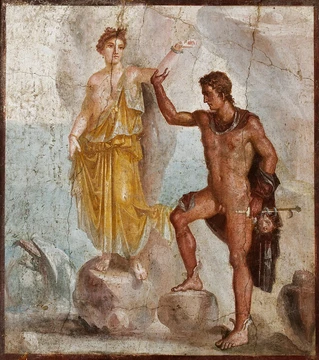
Pelops
King of Pisa, resurrected after being served to the gods.
His name derives from the Greek words for "dark" and "eye" or "face".[1] In Greek mythology, Pelops ruled as king of Pisa in the region called Peloponnesus, and his name derives from words meaning "dark" and "eye" or "face".[1][2] According to various accounts, Tantalus fathered Pelops with one of several possible mothers: Dione, Euryanassa, Eurythemista, or Clytia; some sources also name Atlas and the nymph Linos as his parents.[3][2]
Quick Facts
- Kingdom
- Pisa in the Peloponnesus
- Father
- Tantalus
- Spouse
- Hippodamia
- Notable children
- Atreus
- Thyestes
- Pittheus
- Chrysippus
- Cult site
- Olympia (Pelopion)
- Sacrificial practice
- Night-time libations of a black ram
- Field
- Greek mythology
Facts from the source article.
Key facts and history
Pelops's father Tantalus cut him into pieces and served him as a stew to the Olympian gods.[4] Demeter ate the left shoulder while grieving for Persephone, but the other gods refused the meal.[4] Pindar rejected this tradition as a malicious invention, instead relating that Poseidon took Pelops as a lover.[4] Pelops later sought to marry Hippodamia, whose father King Oenomaus had killed eighteen previous suitors in chariot races.[5]
As Myrtilus died, he cursed Pelops, a curse that plagued his descendants including Atreus, Thyestes, Agamemnon, and Menelaus.[6] Pelops organized chariot races at Olympia as funeral games for Oenomaus, which inspired the ancient Olympic Games.[7] After Tantalus served Pelops to the gods, the other deities reassembled his body and restored him to life, with Hephaestus fashioning an ivory replacement for the shoulder that Demeter had eaten.[4] Pelops called upon Poseidon, his former lover, who responded by providing a chariot pulled by winged horses that had never been tamed.[8][9]
Pelops gave a bribe to Myrtilos, the charioteer of Oinomaos, to sabotage the axle; this caused Oinomaos's death during the race.[2]
What the cited sources add
The Theoi.com account states that Pelops was a Phrygian expelled from Sipylus by Ilus, though other traditions represent him as a native of Greece from Olenos in Achaia.[2] The same source notes that some writers call Pelops's mother Euryanassa or Clytia.[2] The Theoi.com account describes how the gods ordered Hermes to put Pelops's limbs into a cauldron to restore his life, while other versions say Rhea restored him.[2] The Theoi.com account states that Pelops rapidly expanded his territory until he governed most of the western Peloponnesos and established an alliance with King Perseus through marriages between their children.[2]
The Open Library record for ISBN 9780773508378 lists "Theopompus the historian" as a 346-page work published in 1991 by McGill-Queen's University Press.[10]
References
- Wikipedia, "Pelops" (CC BY-SA 4.0), which cites: derived from Pellos (πέλλος) meaning 'dark' or 'dusky' and Ops (ὤψ) meaning 'eye' or 'face' (original not read by us) en.wikipedia.org
- Pelops at theoi.com. facts only, no text reused. theoi.com
- Wikipedia, "Pelops" (CC BY-SA 4.0), which cites: Tyrtaeus, fr. 12.7; Cypria fr. 16.4; Simonides, fr. 11.36; Pindar, Olympian Odes 1.36; Hyginus, Fabulae 124, 245 & 273; Hyginus, Fabulae 82-83; Scholia ad Euripides, Orestes 4 & 11; Scholia ad Euripides, Orestes 11; Scholia ad Euripides, Orestes 11 from Pherecydes, fr. 93 (original not read by us) en.wikipedia.org
- Wikipedia, "Pelops" (CC BY-SA 4.0), which cites: Pindar, "Olympian 1" (original not read by us) en.wikipedia.org
- Wikipedia, "Pelops" (CC BY-SA 4.0), which cites: Pausanias, 6.21.9–11 with a reference to Megalai Ehoiai fr. 259(a) (original not read by us) en.wikipedia.org
- Wikipedia, "Pelops" (CC BY-SA 4.0), which cites: Euripides, Helen 386-405 (original not read by us) en.wikipedia.org
- Wikipedia, "Pelops" (CC BY-SA 4.0), which cites: Burkert, Homo Necans 1983, p 95f. (original not read by us) en.wikipedia.org
- Wikipedia, "Pelops" (CC BY-SA 4.0), which cites: Pindar, First Olympian Ode 71 (original not read by us) en.wikipedia.org
- Wikipedia, "Pelops" (CC BY-SA 4.0), which cites: Cicero, Tusculanae Disputationes 2.27.67 (noted in Kerenyi 1959:64). (original not read by us) en.wikipedia.org
- Open Library record, ISBN 9780773508378 ("Theopompus the historian"). CC0 (metadata); book content not read. openlibrary.org
Each numbered sentence above was checked against the source it cites before publication. Sentences citing Wikipedia adapt text from the English Wikipedia article Pelops (contributors), used under CC BY-SA 4.0; this entry is available under the same licence. Other sources were used for facts only; no text or images are copied from them.
More in Human Sacrifice in Folklore and Mythology
Spotted an error? Know more?
Reader corrections go straight into our review queue. Suggest an edit · How this site is sourced