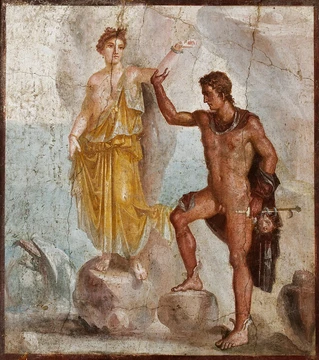
Andromeda (mythology)
Princess of Aethiopia rescued from a sea monster by Perseus.
Her name is Greek, perhaps meaning 'mindful of her husband'.[1] From classical times onward, the story has been repeatedly depicted in visual art, theatrical productions, and musical compositions.[2][3][4]
Quick Facts
- Parents
- Cepheus and Cassiopeia
- Consort
- Perseus
- Birthplace
- Aethiopia
- Offspring
- Perses
- Heleus
- Alcaeus
- Sthenelus
- Electryon
- Mestor
- Gorgophone
- Autochthe
- God of
- Princess of Aethiopia
Facts from the source article.
Key facts and history
An oracle declares that Andromeda must be sacrificed to appease the monster, so she is stripped naked and chained to a rock in Jaffa.[5] After their wedding, Perseus turns Andromeda's former suitor Phineus and his allies to stone with Medusa's head.[5] Their descendants rule Mycenae, and the hero Heracles is among them.[6] Athena places Andromeda in the sky as the constellation Andromeda, in a pose resembling her chained state.[7]
Because Cassiopeia arrogantly claims to surpass the Nereids in beauty, Poseidon punishes her by flooding the shoreline and dispatching the sea monster Cetus to devastate the territory.[8][5] While traveling on winged sandals after beheading Medusa, Perseus spots Andromeda, develops affection for her, and obtains her father's agreement to wed her if he rescues her.[5] Andromeda accompanies Perseus to Seriphos and later to Argos; their offspring include Perses, Alcaeus, Heleus, Mestor, Sthenelus, Electryon, and Gorgophone.[9][10]
What the cited sources add
It notes that Ariosto's story of Ruggiero saving Angelica in 'Orlando Furioso' has a similar plot and is often confused with the Andromeda theme.[11] Melville's narrator also claims that the story of St. George and the Dragon is akin to and possibly derived from the Perseus and Andromeda myth.[12]
References
- Wikipedia, "Andromeda (mythology)" (CC BY-SA 4.0), which cites: "Andromeda", Online Etymology Dictionary (original not read by us) en.wikipedia.org
- Wikipedia, "Andromeda (mythology)" (CC BY-SA 4.0), which cites: Vermeule, "Department of Classical Art Annual Report for the Year 1963", Museum of Fine Arts, Boston, 1963, p. 33–43; Small, "Time in Space: Narrative in Classical Art", The Art Bulletin, December 1999, p. 562–575; Beeson, "Perseus and Andromeda as lovers. A mosaic panel from Brading and its origins", Mosaic, 1986, p. 13–19; Small, "Time in Space: Narrative in Classical Art", The Art Bulletin, December 1999, p. 562–575; Karoglou, "Dangerous Beauty: Medusa in Classical Art", Museum of Art Bulletin, 2018, p. 11 (original not read by en.wikipedia.org
- Wikipedia, "Andromeda (mythology)" (CC BY-SA 4.0), which cites: Knutson, "Companion to Literary Myths, Heroes, and Archetypes", Routledge, 1992, p. 60–69 (we also read that source) en.wikipedia.org
- Wikipedia, "Andromeda (mythology)" (CC BY-SA 4.0), which cites: Knutson, "Companion to Literary Myths, Heroes, and Archetypes", Routledge, 1992, p. 60–69; Rosenthal, "Monteverdi's 'Andromeda': A Lost Libretto Found", Music & Letters, January 1985, p. 1–8; L'Andromeda, Antonio Bariletti, Venice, 1637, p. 3.; Bianconi, "Music in the Seventeenth Century", Cambridge University Press, 1987, p. 183; Rosand, "Opera in Seventeenth-Century Venice", University of California Press, 1990 (we also read that source) en.wikipedia.org
- Wikipedia, "Andromeda (mythology)" (CC BY-SA 4.0), which cites: Grant, "Who's Who in Classical Mythology", Oxford University Press, 1993, p. 31; Kerenyi, "The Heroes of the Greeks", Thames & Hudson, 1997, p. 52–53; Hard 2004, pp. 240, 242; Apollodorus, Library 2.4.3; Ovid, Metamorphoses 4.663–5.235; Marcus Manilius, Astronomica, 5.538–618 (pp. 344–51). (we also read that source) en.wikipedia.org
- Wikipedia, "Andromeda (mythology)" (CC BY-SA 4.0), which cites: Hard 2004, p. 243–244; Apollodorus, Library, 2.4.5. The Hesiodic Catalogue of Women (fr. 241 Most, pp. 346–349) likely listed their children as Alcaeus, Sthenel (original not read by us) en.wikipedia.org
- Wikipedia, "Andromeda (mythology)" (CC BY-SA 4.0), which cites: Smith, s.v. Andromeda; Catasterismi 17 (Hard 2015, p. 18); see also Hyginus, De astronomia 2.11.1. The Catasterismi cites Euripides' lost play Andromeda as the (original not read by us) en.wikipedia.org
- Wikipedia, "Andromeda (mythology)" (CC BY-SA 4.0), which cites: Both Catasterismi 16 (Hard 2015, p. 19) and De astronomia 2.10 cite Sophocles' lost play Andromeda as their source for this. According to Hyginus, Fabulae 64 Ca (original not read by us) en.wikipedia.org
- Wikipedia, "Andromeda (mythology)" (CC BY-SA 4.0), which cites: Hard 2004, p. 242; Apollodorus, Library, 2.4.3. (original not read by us) en.wikipedia.org
- Wikipedia, "Andromeda (mythology)" (CC BY-SA 4.0), which cites: Apollodorus, Library, 2.4.4. (original not read by us) en.wikipedia.org
- "Perseus and Andromeda", National Gallery. facts only, no text reused. nationalgallery.org.uk
- Melville, "Moby-Dick", 1851. facts only, no text reused. gutenberg.org
Each numbered sentence above was checked against the source it cites before publication. Sentences citing Wikipedia adapt text from the English Wikipedia article Andromeda (mythology) (contributors), used under CC BY-SA 4.0; this entry is available under the same licence. Other sources were used for facts only; no text or images are copied from them.
More in Human Sacrifice in Folklore and Mythology
Spotted an error? Know more?
Reader corrections go straight into our review queue. Suggest an edit · How this site is sourced