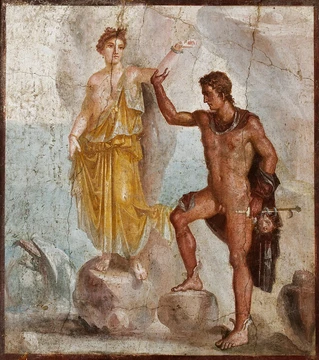
Androcleia and Alcis
Sisters who sacrificed themselves to save Thebes from Orchomenus.
Androcleia and Alcis are sisters in Greek myth who died to save Thebes. An oracle promised victory if a noble citizen died by his own hand. When their father Antipoenus refused, the two young women took their own lives. They were buried in the temple of Artemis Eucleia, where Heracles dedicated a lion image in their honor.
Quick Facts
- Names
- Androcleia (Androclēa) and Alcis (Alcida)
- Culture
- Ancient Greek
- City
- Thebes
- Father
- Antipoenus
- Burial site
- Temple of Artemis Eucleia
- Dedication by heracles
- Image of a lion
- Nationality
- Theban (Greek)
Facts from the source article.
The Oracle's Demand and the Sisters' Choice
According to the Greek geographer Pausanias, the story of Androcleia and Alcis unfolds against the backdrop of a looming military confrontation. Heracles and the citizens of Thebes were mobilizing for a campaign against their neighbours at Orchomenus when an oracle delivered a chilling condition: Thebes would secure victory only if the citizen of the most noble bloodline in the city willingly ended his own life. The nobleman Antipoenus, whose lineage traced back to the legendary Spartoi, was the obvious candidate. Yet he proved unwilling to pay that ultimate price for his fellow citizens. Faced with this impasse, his two daughters stepped forward. Androcleia and Alcis chose to take their own lives in their father's place, accepting death as the cost of their city's survival. Pausanias records that the Thebans celebrated the sisters for their extraordinary courage and selfless generosity, transforming what could have been a tragic failure of leadership into a story of filial devotion and heroic sacrifice.
Honour in the Temple of Artemis Eucleia
The sisters' final resting place became a site of lasting veneration. Rather than being laid to rest in a common burial ground, Androcleia and Alcis were entombed within the temple of Artemis Eucleia, a prominent sacred space in the Theban landscape. This placement elevated their memory to a permanent, visible presence in the religious life of the community. Their commemoration was further enriched by the personal gesture of Heracles himself. The great hero dedicated an image of a lion to the sisters' memory within that same temple, linking their story to his own mythic identity and ensuring that their sacrifice would be remembered alongside one of Greek mythology's most celebrated figures. The choice of a lion as the dedicatory image is particularly resonant, as it echoes the broader heroic symbolism associated with Heracles while giving the sisters a distinctive and powerful emblem of their own. Through this combination of sacred burial and heroic dedication, the Thebans wove Androcleia and Alcis into the religious and cultural fabric of their city in a way that ordinary citizens could never hope to achieve.
A Recurring Pattern in Greek Myth
Classicist Dennis D. Hughes has identified the sacrifice of young women as a recurring motif throughout Greek myth, one that typically involves a prophetic prompt compelling the offering of a life to protect a community. Androcleia and Alcis fit squarely within this pattern: an oracle sets the terms, a noble family is called upon, and ultimately the daughters pay the price that the father refuses. Hughes draws a direct parallel to the daughters of Orion, Menippe and Metioche, who similarly gave their lives to save the city of Orchomenus from a devastating plague. What unites these narratives is the structural role the women play—they are not warriors or rulers but stand-ins for the civic duty that the men in their families decline to fulfil. The oracle mechanism also serves a narrative function, externalizing the demand so that the sacrifice appears fated rather than merely political. In both the Theban and Orchomenian stories, the women's deaths avert catastrophe, and their memory is preserved through cultic honour, suggesting that ancient Greek audiences saw these figures as embodying a particular form of civic virtue distinct from martial heroism.
The Possibility of a Heroine Cult
Scholar Eliza Rosenberg has proposed that Androcleia and Alcis, like other women in Greek myth who sacrificed themselves for their communities, may have been the focus of what she terms a heroine cult. In such a practice, the tomb of a revered female figure becomes a site of personal ritual for living women navigating significant life transitions. Rosenberg suggests that a Theban bride, on the eve of her wedding, might have visited the sisters' tomb in the temple of Artemis Eucleia to offer a lock of her own hair or to voice lamentations in their honour. This ritual would have created a symbolic connection between the bride's own passage into a new social role and the sisters' ultimate act of self-giving. The practice would also have kept the sisters' story alive in the daily religious experience of Theban women, transforming a mythological narrative into a living tradition. By linking the intimate act of preparing for marriage to the grand narrative of civic sacrifice, such a cult would have given Androcleia and Alcis a continuing presence in the spiritual life of the city far beyond the moment of their death.
More in Human Sacrifice in Folklore and Mythology
Spotted an error? Know more?
Reader corrections go straight into our review queue. Suggest an edit · How this site is sourced