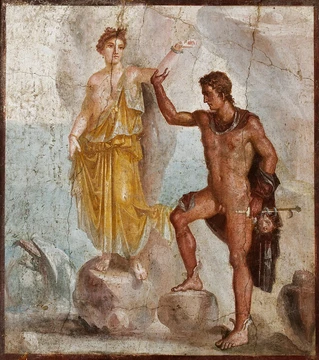
Polyxena
Trojan princess sacrificed on Achilles' tomb after the war.
In Greek mythology, Polyxena was the youngest child of Troy's ruler Priam and his wife Hecuba.[1] Homer's Iliad does not include Polyxena, but later poets wrote about her.[2] Following Troy's defeat, the Greeks killed Polyxena as a sacrifice on Achilles' burial mound.[3]
Quick Facts
- Died
- After the fall of Troy, sacrificed on the tomb of Achilles
- Field
- Greek mythology
- Nationality
- Trojan
- Known for
- Sacrifice by the Greeks after the Trojan War; considered the Trojan version of Iphigenia
Facts from the source article.
What the cited sources add
The Dares Phrygius account states that Hecuba fled with Polyxena and entrusted her daughter to Aeneas.[4] According to Dares, Antenor went to Aeneas and begged him to hand over Polyxena so the Greeks would set sail.[4] Dares wrote that Agamemnon was angry with Aeneas for hiding Polyxena and ordered him to depart from the country.[4] The Euripides play "Hecuba" describes Polyxena declaring she would die a free woman and refusing to be touched as she offered her neck.[5][6]
In Euripides' version, Neoptolemus cut her windpipe with his sword, and even while dying she took care to fall modestly.[5][6] The chronicler Malalas wrote that Polyxena was blooming-lipped, small-footed, and charming.[7]
Key facts and facts and history
The chronicler Malalas described Polyxena as tall, pure, very white, large-eyed, black-haired, and 18 years old when she was killed.[7] According to Dares, she surpassed all others in beauty and remained a completely ingenuous and kind-hearted woman.[4] During the Trojan War, Polyxena and Troilus were ambushed at a fountain, and Troilus was killed by Achilles.[2] In Dares' account, Achilles fell madly in love with Polyxena after seeing her at Hector's tomb.[4]
Achilles sent a proposal to Hecuba offering to leave Troy if she gave him Polyxena to marry.[4] After the war, Neoptolemus demanded that Polyxena be produced because she was the cause of his father's death.[4] According to Dares' account, Polyxena was described as fair, tall, and beautiful, with a slender neck, lovely eyes, and long blonde hair.[4]
References
- Wikipedia, "Polyxena" (CC BY-SA 4.0), which cites: Duckworth, "Polyxena", Macmillan Educational Corporation, 1976, p. 231 (original not read by us) en.wikipedia.org
- Wikipedia, "Polyxena" (CC BY-SA 4.0), which cites: Hall, 249; Aghion et al, 242 (original not read by us) en.wikipedia.org
- Wikipedia, "Polyxena" (CC BY-SA 4.0), which cites: Hall, 254 (original not read by us) en.wikipedia.org
- Dares Phrygius, History of the Fall of Troy 12. facts only, no text reused. theoi.com
- Wikipedia, "Polyxena" (CC BY-SA 4.0), which cites: Euripides, "Hecuba; The Trojan Women; Andromache", Oxford University Press, 2000, p. lines 522–570 (we also read that source) en.wikipedia.org
- Open Library record, ISBN 019283987X ("Hecuba"). CC0 (metadata); book content not read. openlibrary.org
- Malalas, Chronography 5.106. facts only, no text reused. topostext.org
Each numbered sentence above was checked against the source it cites before publication. Sentences citing Wikipedia adapt text from the English Wikipedia article Polyxena (contributors), used under CC BY-SA 4.0; this entry is available under the same licence. Other sources were used for facts only; no text or images are copied from them.
More in Human Sacrifice in Folklore and Mythology
Spotted an error? Know more?
Reader corrections go straight into our review queue. Suggest an edit · How this site is sourced