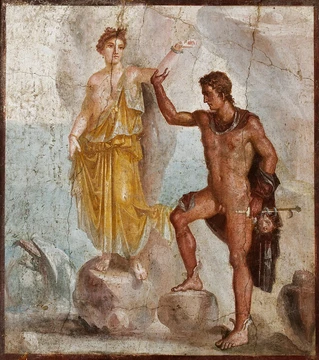
Phrixus
Son of Athamas, rescued by a golden-fleeced ram.
Phrixus was a son of Athamas, king of Boeotia, and the cloud goddess Nephele.[1] His name means "standing on end, bristling".[1] Phrixus, whose sibling was Helle, had sons named Argus, Phrontis, Melas, and Cytisorus with Chalciope, who was the child of Colchis's ruler Aeetes.[1]
Quick Facts
- Born
- Boeotia (mythological)
- Field
- Greek mythology
- Nationality
- Boeotian (mythological)
Facts from the source article.
Key facts and history
According to Hyginus, Athamas refused to sacrifice Phrixus, but Phrixus voluntarily promised to free the state from its distress.[2] Phrixus and Helle were rescued by a flying or swimming ram with golden wool sent by their mother Nephele.[3] During the flight, Helle fell to her death at the point later called the Hellespont.[4] Phrixus was carried to Colchis, where he sacrificed the ram and placed its gilded fleece in the temple of Mars.[2]
One account states that Aeetes later learned from an oracle that he would die at the hands of a descendant of Aeolus and therefore killed Phrixus.[5] Ino, the stepmother, bore animosity toward both Phrixus and his sister Helle.[3] Alarmed by potential famine, the local cultivators sought counsel from an oracle in the vicinity.[3] Those dispatched to the oracle were bribed by Ino to fabricate a message claiming that Phrixus and Helle needed to be sacrificed.[3]
Aeetes, the monarch of Colchis, received Phrixus hospitably and wed him to his daughter Chalciope.[2]
What the cited sources add
Hyginus records that Ino conspired with the women of the entire tribe to parch the seed grain, causing sterility and scarcity.[2] The same source notes that Ino instructed a servant to bring back a false reply from Delphi that the pestilence would end if Phrixus were sacrificed to Jove.[2] Hyginus also states that Phrixus and Helle were wandering in a forest under madness sent by Liber when their mother brought the gilded ram.[2] The Greek Legends and Myths account specifies that Ino had an intense hatred of Phrixus especially.[4]
That account describes how Phrixus managed to hang on to the fleece while Helle lost her grip and plunged to her death.[4] Hyginus names Phrixus' sons as Argus, Melas, and Cylindrus, who later took ship to go to their grandfather Athamas.[2]
References
- Wikipedia, "Phrixus" (CC BY-SA 4.0), which cites: Apollodorus, 1.9.16; Scholia on Apollonius of Rhodes, Argonautica 2.1122 citing Hesiod's Ehoiai (original not read by us) en.wikipedia.org
- "Hyginus, Fabulae 1-49 - Theoi Classical Texts Library". facts only, no text reused. theoi.com
- Wikipedia, "Phrixus" (CC BY-SA 4.0), which cites: Flying is conventional in modern treatments, but see D. S. Robertson, "The Flight of Phrixus", The Classical Review, Vol. 54, No. 1 (Mar., 1940), pp. 1–8. (original not read by us) en.wikipedia.org
- "Phrixus in Greek Mythology", Greek Legends and Myths. facts only, no text reused. greeklegendsandmyths.com
- Wikipedia, "Phrixus" (CC BY-SA 4.0), which cites: "Hyginus, Fabulae 1-49 - Theoi Classical Texts Library"; "Phrixus in Greek Mythology", Greek Legends and Myths (we also read that source) en.wikipedia.org
Each numbered sentence above was checked against the source it cites before publication. Sentences citing Wikipedia adapt text from the English Wikipedia article Phrixus (contributors), used under CC BY-SA 4.0; this entry is available under the same licence. Other sources were used for facts only; no text or images are copied from them.
More in Human Sacrifice in Folklore and Mythology
Spotted an error? Know more?
Reader corrections go straight into our review queue. Suggest an edit · How this site is sourced