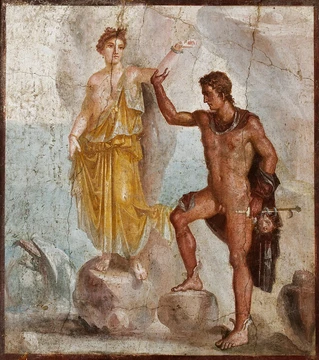
Alcyoneus (son of Diomos)
Youth saved from sacrifice by a lover who slays the monster.
Alcyoneus is a figure in Greek mythology, a young man from Crissa near Delphi who was chosen as a sacrificial victim for the monster Sybaris. His story is a prototypical example of the hero-slays-monster-and-saves-princess tale, though with a male victim and a homosexual couple. The myth survives in the writings of second-century author Antoninus Liberalis.
Quick Facts
- Parents
- Diomus and Meganeira
- Origin
- Crissa (near Delphi)
- Monster
- Sybaris
- Savior
- Eurybarus
- Field
- Greek mythology
- Nationality
- Greek (from Crissa)
- Known for
- Being chosen as a sacrificial victim for the monster Sybaris, then saved by Eurybarus
Facts from the source article.
Etymology
The name Alkyoneus derives from the ancient Greek noun alkuṓn, referring to a sea-bird, usually the common kingfisher. The word's exact meaning is uncertain; Robert S. P. Beekes theorized a pre-Greek origin. Greek folk etymology falsely connected it to háls (brine, salt) and kuéō (to conceive), leading to a misspelling with rough breathing. The English genus name Halcyon and the phrase 'halcyon days' also come from this root.
Mythology
The monster Sybaris terrorized Delphi from Mount Cirphis, preying daily on young animals or humans. Apollo told the inhabitants they would be saved by sacrificing a youth to the monster's cave. Alcyoneus, the only child of Diomus and Meganeira, was chosen by lot. Priests crowned him with garlands and led a procession to Sybaris's cave. On the way, they met Eurybarus from Curetis in Aetolia, who fell in love with Alcyoneus at first sight. Learning of the prophecy, Eurybarus offered to take Alcyoneus's place, donned the garlands, and was led to the cave. He dragged Sybaris out and threw her off the mountain crags; she cracked her head on rocks at the foot of Crissa and was never heard from again.
Culture
The myth follows the typical heroic tale of a fearsome monster demanding human sacrifice, most famously seen in Perseus and Andromeda. Another similar story is Heracles being swallowed by a sea-monster to save Hesione. The tale of Alcyoneus and Eurybarus is identical to a legend about Euthymus, an early fifth-century BC Olympic victor who saved a Temesian woman from a ghostly monster and married her. A notable subversion is that the ogre is female and the beautiful victim male, making the couple homosexual—a rare variant of the dragon-slayer fairytale type (ATU 300). Pausanias describes a painting in Temesa showing a youth about to be sacrificed to a monster called Lycas, with a caption reading Sybaris. Another similar myth involves Menestratus and Cleostratus of Thespiae, where Menestratus took the place of his lover Cleostratus, wearing a fish hook-coated breastplate that killed the dragon when it devoured him. A key difference is that Menestratus and Cleostratus were already a couple, while Alcyoneus and Eurybarus only met during the sacrifice procession, with no confirmation of a later relationship.
More in Human Sacrifice in Folklore and Mythology
Spotted an error? Know more?
Reader corrections go straight into our review queue. Suggest an edit · How this site is sourced