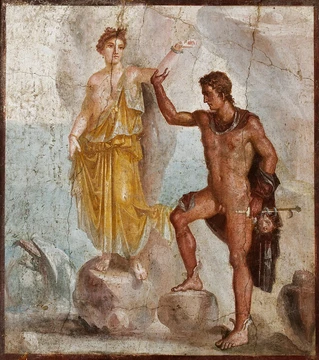
Iphigenia
Daughter of Agamemnon, sacrificed to appease Artemis.
Her name means "strong-born" or "born to strength"[1] Iphigenia, a princess of Mycenae, was the child of King Agamemnon and Queen Clytemnestra according to Greek mythology.[2] The gathering of the Greek fleet at Aulis to prepare for war against Troy is the setting for Iphigenia's story.[3]
Quick Facts
- God of
- Princess of Mycenae
- Father
- Agamemnon
- Mother
- Clytemnestra
- Siblings
- Orestes
- Electra
- and Chrysothemis
- Dynasty
- Atreid Dynasty
Facts from the source article.
Key facts and history
Euripides's play Iphigenia in Aulis describes the sacrifice in detail, with Iphigenia offering herself freely for Greece.[4] In Etruria, the myth became popular on cremation-urns showing Iphigenia held over an altar.[5] On his way to the Trojan War, Agamemnon hunted and killed a stag that was sacred to the goddess Artemis.[6] The fragmentary epic Catalogue of Women refers to the sacrificed daughter as "Iphimede" instead of Iphigenia.[7]
Lucretius, in his poem De rerum natura, used the sacrifice of Iphigenia to attack religion, calling it a source of crimes.[8][9]
What the cited sources add
Pausanias records that the Megarians claim Iphigenia died in Megara and has a hero-shrine there.[10] Pausanias also notes that Hesiod said Iphigenia did not die but became Hecate by Artemis's will.[10] The same source states that poets Euphorion, Alexander of Pleuron, and Stesichorus agreed Iphigenia was Theseus's daughter.[10] Lucretius's poem describes Iphigenia as a "trembling girl" led to the altar on what should have been her bridal day.[8]
References
- Wikipedia, "Iphigenia" (CC BY-SA 4.0), which cites: Henry George Liddell and Robert Scott, A Greek-English Lexicon, s.v. "Iphigenia" and Rush Rehm, The Play of Space (2002, 188). Karl Kerenyi, aware of Iphigenia' (original not read by us) en.wikipedia.org
- Wikipedia, "Iphigenia" (CC BY-SA 4.0), which cites: Wells, "Longman Pronunciation Dictionary", Longman, 2000; Wells, "Longman Pronunciation Dictionary", Longman, 2000; "New Century Classical Handbook", Appleton-Century-Crofts, 1962, p. 601; Wells, "Longman Pronunciation Dictionary", Longman, 2000 (we also read that source) en.wikipedia.org
- Wikipedia, "Iphigenia" (CC BY-SA 4.0), which cites: Siegel, "Agamemnon in Euripides' "Iphigenia at Aulis"", Hermes, 1981, p. 257–65 (original not read by us) en.wikipedia.org
- Wikipedia, "Iphigenia" (CC BY-SA 4.0), which cites: Euripides, "Iphigenia in Aulis", Ivan R Dee, 1997, p. 65–66; This fragmentary passage (fr. 23(a)17–26), found among the Oxyrhynchus Papyri, has been restored to its proper place in the Ehoeae, the Hesiodic Catalogue, in m (we also read that source) en.wikipedia.org
- Wikipedia, "Iphigenia" (CC BY-SA 4.0), which cites: George Dennis, "The Cities and Cemeteries of Etruria", John Murray, 1848; "Greek Myth on Etruscan Urns from Perusia: the sacrifice of Iphigenia", Etruscan Studies, 2015, p. 97–125 (original not read by us) en.wikipedia.org
- Wikipedia, "Iphigenia" (CC BY-SA 4.0), which cites: Nelson, "Iphigenia in the Iliad and the Architecture of Homeric Allusion", TAPA, 2022, p. 55–101; Evans (1970), p. 141 (original not read by us) en.wikipedia.org
- Wikipedia, "Iphigenia" (CC BY-SA 4.0), which cites: Catalogue of Women, fragment 23a (M-W), line 16-26 (original not read by us) en.wikipedia.org
- Titus Lucretius Carus, "Of the Nature of Things", 1916. facts only, no text reused. en.wikisource.org
- Wikipedia, "Iphigenia" (CC BY-SA 4.0), which cites: Titus Lucretius Carus, "Of the Nature of Things", 1916 (we also read that source) en.wikipedia.org
- Pausanias, Description of Greece, 2.22.6-7. facts only, no text reused. topostext.org
Each numbered sentence above was checked against the source it cites before publication. Sentences citing Wikipedia adapt text from the English Wikipedia article Iphigenia (contributors), used under CC BY-SA 4.0; this entry is available under the same licence. Other sources were used for facts only; no text or images are copied from them.
More in Human Sacrifice in Folklore and Mythology
Spotted an error? Know more?
Reader corrections go straight into our review queue. Suggest an edit · How this site is sourced