Resident Evil 4
A survival horror game that redefined the third-person shooter.
Last updated

Capcom France · CC BY 3.0
Resident Evil 4, released in 2005 by Capcom for the GameCube, puts players in the role of special agent Leon S. Kennedy. His mission: rescue Ashley Graham, the U.S. president's daughter, from a religious cult in rural Spain. Leon battles crowds of enemies controlled by a mind-altering parasite and crosses paths with Ada Wong, a spy and mercenary. The game broke from earlier Resident Evil titles by swapping fixed camera angles and slower pacing for a dynamic camera and action-heavy horror gameplay.

The player sees Leon from a third-person perspective, with the camera shifting to an over-the-shoulder view when aiming a weapon, or a first-person view with a sniper rifle. Firearms lack crosshairs, using laser sights instead.
Gameplay
Shots to different body parts produce different results—hitting a leg makes enemies stumble, hitting an arm can disarm them, and players can shoot down thrown axes or scythes. Context-sensitive controls let Leon kick down ladders, jump through windows, dodge attacks, or perform finishing moves on weakened foes. Quick time events require pressing on-screen buttons to avoid falling boulders or survive enemy grapples, often during boss fights.
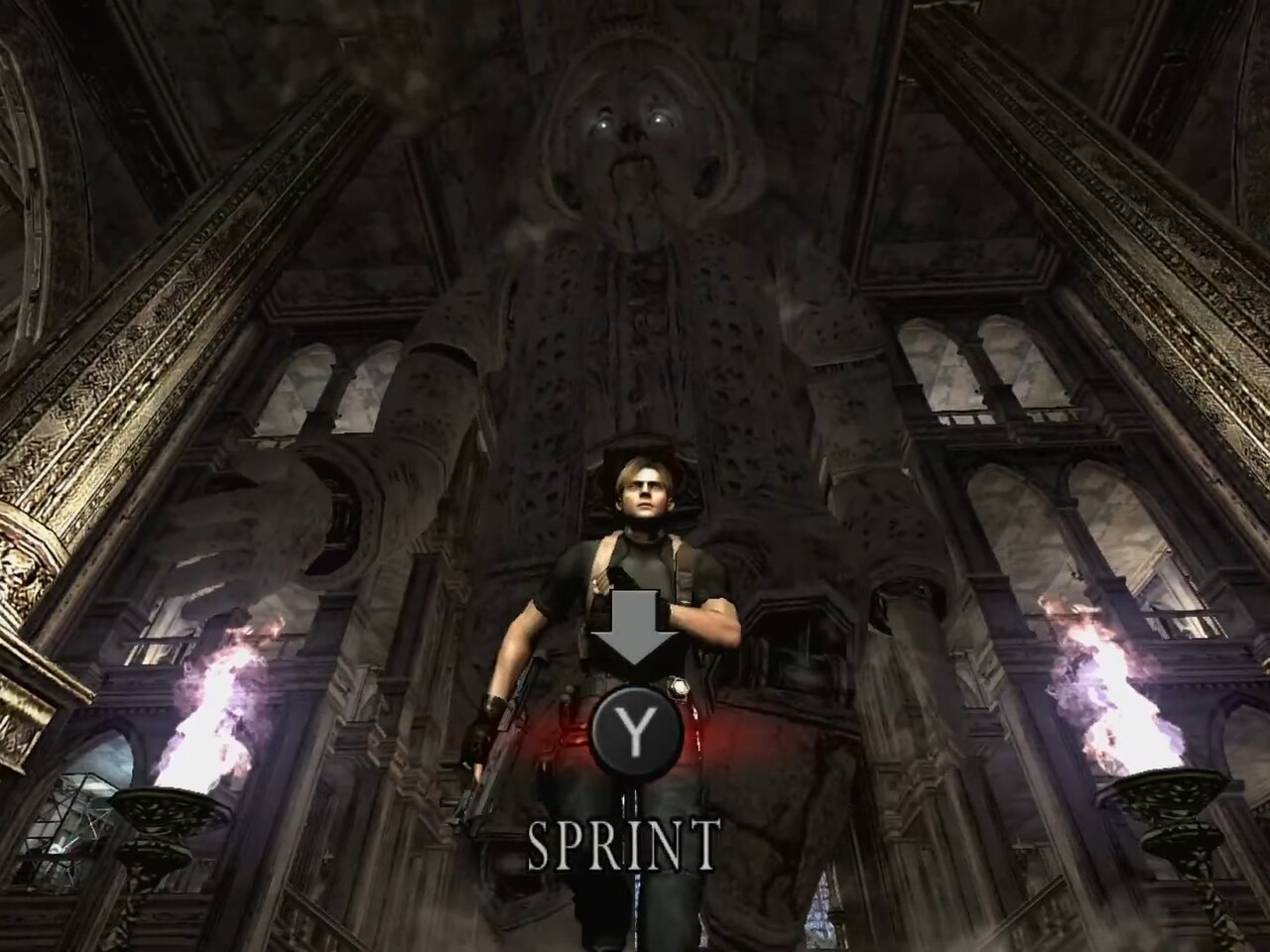
The main enemies are Los Ganados—once farmers, now infected by Las Plagas parasites. They dodge, use melee and ranged weapons, work together, and can sprout mutated parasites from their heads. The inventory uses a grid system inside an attaché case, with each item taking up space. The case can be upgraded for more room.
Weapons, ammo, and healing items go in the case; key items and treasures are stored separately. A Merchant appears in various spots to buy and sell items, upgrade weapons, and trade for treasures. Each weapon has its own strengths and weaknesses.
The PlayStation 2 version added content later included in PC and Wii releases. The biggest addition is "Separate Ways," a side story following Ada Wong's role in the plot and her link to series villain Albert Wesker. "Ada's Report" is a five-part documentary analyzing her relationship with Wesker. Other unlockables across all versions include the "Mercenaries" minigame, the "Assignment Ada" scenario, new costumes for Leon and Ashley, extra weapons, and a cutscene browser.
Plot
In 2004, Leon is sent to a rural Spanish village to rescue Ashley Graham. The villagers, infected by Las Plagas, serve the cult Los Iluminados.
Lore & Background
Resident Evil 4 began development for the PlayStation 2 in 1999. Four proposed versions were discarded.
The first was directed by Hideki Kamiya, but series creator Shinji Mikami felt it was too great a departure, so it became a new game, Devil May Cry (2001). Other versions were discarded until Mikami took over as the director. Resident Evil 4 was announced as part of the Capcom Five, a collaboration between Capcom and Nintendo to create five exclusives for the GameCube.
The main enemies are violent villagers referred to as Los Ganados, once simple farmers until becoming the product of an infestation of Las Plagas. They can dodge, wield melee and projectile weapons, and are capable of working collectively. The inventory system features a grid system represented by an attaché case, which can be upgraded. Items may be bought from and sold to the Merchant that appears in various locations.

Capcom added content for the PlayStation 2 version, which was later incorporated into the PC and Wii releases. The largest addition is 'Separate Ways', a side story focusing on Ada Wong's involvement. Other unlockable content includes the minigame 'The Mercenaries' and short scenario 'Assignment Ada', new costumes, new weapons, and a cutscene browser.
A Turbulent Birth: From PlayStation 2 Prototype to GameCube Exclusive
Development on what would become Resident Evil 4 actually kicked off back in 1999, originally targeting the PlayStation 2. The project went through four complete rejections before it found its final form. The earliest iteration was helmed by Hideki Kamiya, but series creator Shinji Mikami judged it strayed too far from the franchise's identity. That discarded build ultimately transformed into an entirely different title, Devil May Cry, which shipped in 2001.
After several more abandoned attempts, Mikami himself stepped in as director and steered the project toward completion. The finished game was unveiled as one of five titles in the Capcom Five, a special partnership between Capcom and Nintendo to produce exclusive content for the GameCube. It launched in 2005, marking a bold new chapter for a series that had long defined itself through static cameras and deliberate, resource-scarce survival.
Redefining the Third-Person Shooter
Resident Evil 4 shattered the visual and mechanical conventions of its predecessors by placing the camera directly behind Leon's shoulder, a perspective that locked the player's attention onto the action in real time. When he raised a weapon, the view tightened into an over-the-shoulder aim; with a sniper rifle, it switched to a true first-person sight. Rather than a traditional crosshair, every gun carried a laser dot, and the targeting system let players hit specific body parts—kicking a foe's feet to make them stagger, or clipping an arm to send their weapon clattering away.
Thrown axes and scythes could even be shot out of the air. Beyond shooting, the game layered in context-sensitive verbs: kicking a ladder, vaulting through a window, sidestepping a blade, or delivering a brutal finishing blow to a weakened enemy. Quick-time sequences and boss encounters with instant-kill moves kept tension high, while the grid-based attaché-case inventory and the wandering Merchant gave resource management a satisfying, tactile rhythm.
A Cult, a Parasite, and a Presidential Daughter
Set in 2004, the story follows U.S. government agent Leon S. Kennedy as he races into a nameless Spanish village to retrieve Ashley Graham, the President's kidnapped daughter. The abductors are Los Iluminados, a fanatical religious sect whose members have been overtaken by Las Plagas, a parasitic organism that hijacks the mind and turns once-peaceful farmers into violent, coordinated attackers known as Los Ganados. Leon is captured by the village chief, Bitores Mendez, and forcibly injected with the parasite, but he escapes alongside Luis Sera, a former Madrid police officer and ex-researcher for the cult.

Their ultimate antagonist is Osmund Saddler, the cult's leader, whose endgame is to use a Las Plagas sample hidden inside Ashley to infect the President upon her return, triggering a global takeover. The castle lord Ramon Salazar serves as another enforcer, and Luis is ultimately killed by Saddler while delivering infection-suppressing pills to Leon. Woven through the narrative is Ada Wong, a spy from Leon's past who aids him while pursuing her own objective tied to the series' villain Albert Wesker.
A Lasting Blueprint for Modern Action-Horror
Critics hailed Resident Evil 4 across the board—gameplay, visuals, narrative, character work, and voice performance all drew praise—and the title collected multiple Game of the Year honors. Its commercial reach expanded far beyond the GameCube through ports to a wide array of platforms, and by March 2025 it had moved 15.2 million copies worldwide. The game's influence on the broader industry is arguably its most enduring legacy.
By cementing the over-the-shoulder camera as a practical, immersive framing tool, it opened the door for titles like Gears of War, Dead Space, and The Last of Us to adopt the same perspective. It also helped shift the survival-horror genre toward faster, more combat-driven pacing without abandoning tension. The franchise continued with Resident Evil 5 in 2009, and a full remake arrived in 2023, a testament to how deeply the 2005 original is still regarded as a benchmark in interactive storytelling and action design.

Reader's Guide
Resident Evil 4 received acclaim for its gameplay, graphics, story, characters, and voice acting, and won multiple Game of the Year awards. It was ported to numerous formats and became a multi-platform hit, selling 15.2 million copies by March 2025. Resident Evil 4 is widely cited as one of the best and most influential video games ever made. It influenced the evolution of the survival horror and third-person genres, popularizing the 'over-the-shoulder' third-person view used in games such as Gears of War, Dead Space, and The Last of Us.
The gameplay focuses more on combat and shootouts, with the camera placed behind Leon and zooming in for an over-the-shoulder view when aiming. Context-sensitive controls allow players to interact with the environment, and quick time events are incorporated into boss fights. Resident Evil 5 was released in 2009 and a remake was released in 2023.

Frequently Asked Questions
What makes Resident Evil 4 different from earlier Resident Evil games?
The title abandoned the fixed-camera, slow-take approach of its predecessors in favor of a dynamic over-the-shoulder perspective and fast, responsive combat. This shift turned the series from a puzzle-heavy atmospheric experience into what many consider the blueprint for the modern third-person shooter.
Who is the main villain in Resident Evil 4?
The primary antagonist is Osmund Saddler, the leader of the Los Iluminados cult who uses a mind-controlling parasite called the Las Plagas to subjugate the villagers of a remote Spanish village. He orchestrates the kidnapping of Ashley Graham in an attempt to use her as a breeding vessel for the parasite.
More in Horror Games, Further Titles
Sources
Compiled from Wikipedia and the sources listed below. Text from Wikipedia is available under CC BY-SA 4.0; this entry is adapted from it.
- Wikipedia: Resident Evil 4 (CC BY-SA 4.0).
- Word definitions: the Codexery glossary, each quoted from its Wikipedia article.
Spotted an error? Know more?
Reader corrections go straight into our review queue. Suggest an edit · How this site is sourced