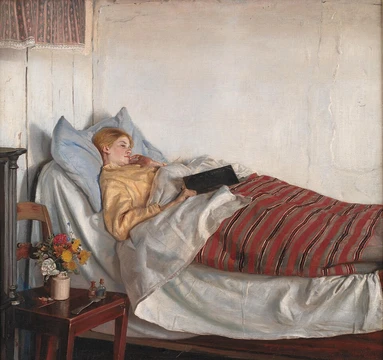
Hallucination
Perception without external stimulus, felt as real.

A hallucination is the experience of perceiving something that feels completely real, even though no external cause for that perception exists. This sets it apart from dreaming, which happens during sleep; from pseudohallucinations, which the person recognizes as unreal; from illusions, which are distortions of actual stimuli; and from mental imagery, which is consciously controlled. A hallucination also differs from a delusional perception, where a real stimulus is correctly sensed but then given an extra, false meaning. Hallucinations can affect any sense, including sight, hearing, smell, taste, touch, balance, pain, temperature, and the perception of time or body position. When multiple senses are involved at once, it is called a multimodal hallucination. A milder version is known as a disturbance, such as glimpsing movement out of the corner of the eye or catching faint noises or voices. Auditory hallucinations are the most common type, especially verbal ones. They can be elementary—like hissing, whistling, or a steady tone—or complex, such as music or voices. Tinnitus is often an elementary auditory hallucination, though pulsatile tinnitus (hearing one’s own blood flow) does not qualify because a real stimulus is present. In schizophrenia, voices usually seem to come from outside the person, while in dissociative disorders they are felt as internal commentary. However, many people without any mental illness also hear voices. Other conditions—like temporal lobe epilepsy, Wilson’s disease, multiple sclerosis, or metabolic disorders—can also cause auditory hallucinations. Musical hallucinations may stem from hearing loss, stroke, tumors, or brain lesions. The Hearing Voices Movement supports people who hear voices but have no other signs of mental illness. High caffeine intake (around five cups of coffee daily) has been linked to a greater likelihood of auditory hallucinations. Visual hallucinations involve seeing something that is not there. Like auditory ones, the source may feel as if it is behind the person, often creating a sense of being watched with hostile intent. Auditory and visual hallucinations frequently occur together. About 55% of auditory hallucinations are malicious, such as hearing others talk about the person rather than to them. Hallucinations can be triggered by drug use (especially deliriants), sleep deprivation, psychosis (including stress-related psychosis), neurological disorders, and delirium tremens. They also commonly occur during sleep paralysis. Hypnagogic hallucinations happen while falling asleep, and hypnopompic hallucinations happen while waking up; both are considered normal.
- field
- Psychology, Psychiatry, Neurology
- known_for
- Perception in the absence of external stimulus with compelling sense of reality
- types
- Auditory, Visual, Command, Olfactory, Multimodal
- associated_conditions
- Schizophrenia, drug use, sleep deprivation, psychosis, neurological disorders, delirium tremens
Lore & Background
Hallucinations are defined as perceptions occurring without an external context stimulus, yet they feel compellingly real. They differ from dreaming, which occurs during REM sleep and not wakefulness; from pseudohallucinations, which are recognized as unreal; from illusions, which distort real stimuli; and from mental imagery, which is voluntary. Hallucinations can affect any sensory modality, including visual, auditory, olfactory, gustatory, tactile, proprioceptive, equilibrioceptive, nociceptive, and thermoceptive. When multiple senses are involved, they are termed multimodal. Auditory hallucinations are the most common type, with verbal ones more frequent than nonverbal. In schizophrenia, voices are typically perceived as coming from outside the person, while in dissociative disorders they are felt as originating from within. Command hallucinations involve orders that may range from benign to harmful, and compliance is more common for non-violent commands. Visual hallucinations are classified as simple (lights, colors, shapes) or complex (lifelike images such as people or animals). Olfactory hallucinations, called phantosmia, involve smelling odors not present, while parosmia is a distortion of real smells. Mild forms, called disturbances, can occur in most senses, such as seeing movement in peripheral vision or hearing faint noises. Hypnagogic hallucinations occur when falling asleep, and hypnopompic when waking up; both are considered normal. Hallucinations are associated with drug use (especially deliriants), sleep deprivation, psychosis, neurological disorders, and delirium tremens, and often occur during sleep paralysis.
Reader's Guide
Hallucinations are significant in both clinical and historical contexts. They serve as key diagnostic features for psychotic disorders such as schizophrenia, where auditory verbal hallucinations are particularly important. However, they also occur in non-psychiatric conditions like lateral temporal lobe epilepsy, Wilson's disease, endocrine disorders, multiple sclerosis, and others, making differential diagnosis crucial. The Hearing Voices Movement supports individuals who hear voices without other signs of mental illness, highlighting that hallucinations are not exclusively pathological. High caffeine consumption has been linked to increased likelihood of auditory hallucinations. Hallucinations remain a central topic in psychology, psychiatry, and neuroscience, bridging normal phenomena like hypnagogic states with severe mental illness, and continue to inform debates about the nature of reality and consciousness.
Did You Know?
- Auditory hallucinations can vary widely in content; some studies suggest that a significant portion may be negative or threatening, but there is no single universally accepted statistic for malicious content.
- Hypnagogic hallucinations occur when falling asleep, and hypnopompic when waking up; both are considered normal phenomena.
- High caffeine consumption has been linked in some studies to an increased likelihood of auditory hallucinations, but the evidence shows correlation rather than direct causation, and no specific threshold has been establi
The Phenomenology of Seeing What Isn't There
A visual hallucination is a vivid, involuntary perceptual event that unfolds in a fully awake mind with no matching external stimulus. Unlike an illusion, which warps or misreads a real object in the environment, a hallucination is generated entirely from within, independent of any visual input reaching the eyes. The experiences range from fully formed images—human figures, detailed scenes, angelic presences—to unformed phenomena such as fleeting flashes of light or abstract geometric patterns. Crucially, these events are not confined to the drowsy threshold between sleep and wakefulness; they can strike at any moment during consciousness.
Patients consistently describe their hallucinations as possessing the physical qualities of genuine perception. The images are often life-sized, richly detailed, and solid, projected outward into the surrounding world. They appear anchored in external space, typically just beyond arm's reach or further away, carrying three-dimensional form with depth, shadows, and crisp edges. They may be rendered in full color or stark black and white, and they can remain perfectly still or shift with movement. This convincing realism is what distinguishes hallucination from imagination and makes it such a clinically significant phenomenon.
A Signature Across a Spectrum of Illness
Visual hallucinations are far from a single diagnosis; they thread through a remarkably wide array of neurological and psychiatric conditions. The DSM-5 elevates hallucinations to a critical diagnostic criterion for psychotic disorders such as schizophrenia and schizoaffective disorder, and roughly one-third of individuals with psychotic disorders report them. In schizophrenia specifically, prevalence sits between twenty-five and fifty percent, often alongside auditory hallucinations but sometimes appearing independently.
Beyond psychosis, complex visual hallucinations are documented in Charles Bonnet syndrome, where visually impaired individuals perceive clear, detailed images of people, faces, animals, and objects. They surface in migraine coma, treated idiopathic Parkinson's disease, epilepsy, narcolepsy-cataplexy syndrome, untreated Lewy body dementia, peduncular hallucinosis following a midbrain infarct, and hallucinogen-induced states. In delirium, visual hallucinations represent the most common type. Stimulant intoxication with cocaine or methamphetamine frequently produces visions of crawling insects tied to concurrent tactile disturbances, while in Lewy body dementia, stationary objects appear to move and complex scenes involving nonexistent people and objects emerge.
Neural Pathways and the Mystery of Mechanism
Despite their prevalence, the underlying mechanisms of visual hallucinations remain poorly understood, a gap that directly hinders the development of targeted therapeutic approaches. Two neurotransmitters—serotonin and acetylcholine—play particularly important roles, as they are concentrated in the visual thalamic nuclei and the visual cortex. The striking similarity of hallucinations across vastly different conditions suggests a shared neural pathway, and researchers have proposed three pathophysiologic mechanisms to explain this convergence.
The first involves irritation of the visual association cortices, specifically Brodmann's areas 18 and 19, which produces complex visual hallucinations. The second mechanism is deafferentation: when lesions interrupt or destroy the afferent connections of visual nerve cells, the normal inhibitory processes on cortical input to visual association areas are removed, generating complex hallucinations as a kind of release phenomenon. Simple, unstructured hallucinations called phosphenes, and those with geometric structure called photopsias, trace back to irritation of the primary visual cortex, Brodmann's area 17.
Neuroimaging adds another layer: in psychotic patients who experience visual hallucinations, the functional connection between the primary visual cortex (V1) and other brain regions is reduced, a finding that runs counter to the expectation that V1 would be active during conscious visual perception.
What People See and How It Feels
The content of visual hallucinations varies enormously from person to person, and most individuals report experiencing multiple types simultaneously. Scenes involving people and animals are the most common, followed by simple geometric images, while complex formed hallucinations overall outnumber simple non-formed ones. In psychotic disorders, the imagery tends to be more frightening than in organic conditions, featuring bugs, dogs, snakes, and distorted faces. Yet in the same population, visions of God, angels, the devil, saints, and fairies are also common. Parkinson's disease can bring visions of dead individuals, a phenomenon relatively rare in psychosis.
A particularly striking variant is the Lilliputian hallucination, in which miniature people appear, often engaged in unusual actions, and the emotional response is more often wonder than terror. Episodes typically last from seconds to minutes, and many patients experience them daily. The frequency ranges from rare to very frequent.
What unifies the experience is a profound sense of helplessness. Individuals are frequently surprised when hallucinations strike, feel powerless to alter or stop them, and generally believe the visions are private, experienced only by themselves.
Frequently Asked Questions
What is Hallucination?
Hallucination is a sensory experience in which a person perceives something that has no actual external source, yet it registers as completely genuine to them. It can involve any of the five senses and sits at the intersection of psychology, psychiatry, and neurology.
What types of Hallucination are recognized?
The principal forms include auditory (hearing sounds or voices), visual (seeing figures or scenes), command (feeling compelled to perform an action), olfactory (detecting odors), and multimodal (involving two or more sensory channels at once).
What conditions is Hallucination most commonly linked to?
It frequently surfaces alongside schizophrenia, substance use, prolonged sleep deprivation, acute psychotic episodes, a range of neurological disorders, and delirium tremens.
How is Hallucination different from an illusion or a dream?
An illusion warps a stimulus that is actually present, whereas a hallucination arises with no external trigger at all. It is also set apart from dreaming, ordinary mental imagery, and pseudohallucination, in which the person retains partial awareness that the experience is not truly external.
More in Medical Conditions 1-15
Spotted an error? Know more?
This is a living reference — every entry is fact-audited, and reader corrections feed straight into our audit queue. Suggest an edit · See this site's audit record