
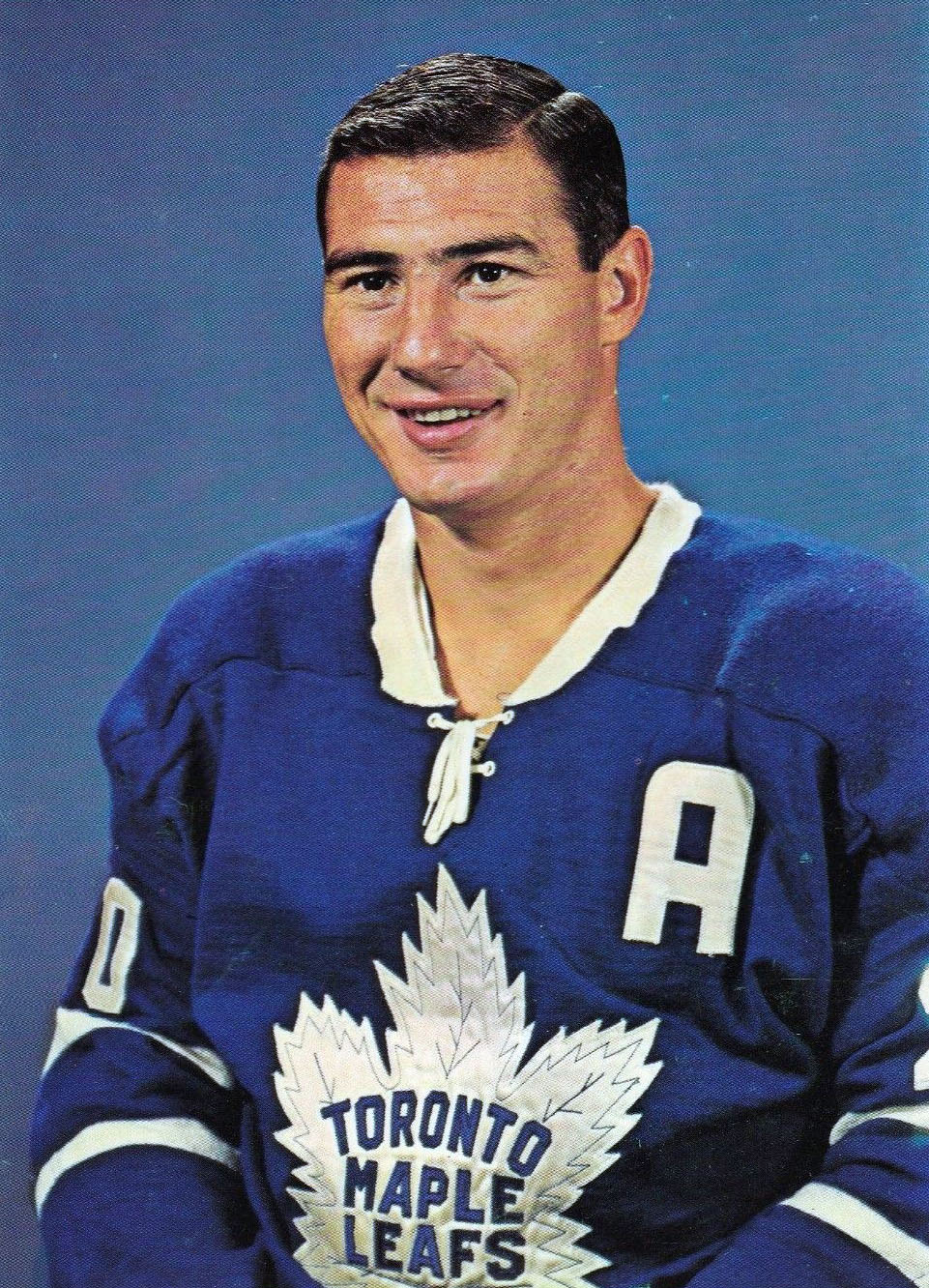
Bob Pulford
Player, coach, and executive; Hall of Fame inductee in 1991.

Ralston-Purina Company, maker of Chex cereals · Public domain
Bob Pulford spent his NHL career as a forward with the Toronto Maple Leafs and Los Angeles Kings before moving behind the bench, first as head coach of the Kings and then for three decades with the Chicago Blackhawks as both coach and general manager. He was inducted into the Hockey Hall of Fame in 1991.
Born in Newton Robinson, Ontario, in 1936, Pulford came up through the Maple Leafs’ farm system after playing minor hockey in Weston. He played junior hockey for the Toronto Marlboros for three seasons, winning two Memorial Cups under coach Turk Broda. He joined the Maple Leafs for the 1956–57 season and wore number 20 for 14 seasons, helping the team win four Stanley Cups between 1962 and 1967. When the NHL Players’ Association formed in the spring of 1967, Pulford became its first president. In the 1967 Stanley Cup Final, with the series tied 1-1 and the third game tied 2-2, he scored the overtime winner against Montreal goalie Rogie Vachon—whom he would later coach in Los Angeles. The Leafs traded him to the Kings in September 1970, and he played two seasons there before retiring as a player in 1972.
Pulford immediately became head coach of the Kings for the 1972–73 season, a role he held for five years. He transformed Los Angeles from one of the league’s worst defensive and penalty-killing teams into one of the best, guiding them to their first playoff appearance in five years in 1974. He won the Jack Adams Award as coach of the year in 1975, when the Kings set a club record with 105 points that stood through 2013. He also led the Kings to their first playoff series wins since 1969, defeating the Atlanta Flames in the first round in both 1976 and 1977. He left the Kings after the 1976–77 season due to ongoing clashes with owner Jack Kent Cooke, who often interfered in player personnel decisions and traded young talent for aging veterans.
Pulford then moved to the Chicago Blackhawks, where he served as coach in three separate stints from 1977 to 1987. He was promoted to senior vice president in 1990 but returned as general manager from 1992 to 1997, 1999 to 2000, and 2003 to 2005. During his third stint as GM, he nominally doubled as head coach, demoting Lorne Molleken to an assistant, though Molleken remained the main operator behind the bench while Pulford acted as a senior consultant.
Quick Facts
- Played For
- Toronto Maple Leafs / Los Angeles Kings
- Position
- Left wing
- Shoots
- Left
- Height Ft
- 5
- Height In
- 11
- Weight Lb
- 188
- Birth Date
- 1936-03-31
- Birth Place
- Newton Robinson, Ontario, Canada
- Death Date
- 2026-01-05
- Death Place
- West Palm Beach, Florida, U.S.
- Career Start
- 1956
- Career End
- 1972
Facts from the source article.
Lore & Background
Pulford played junior hockey for the Toronto Marlboros from 1953 to 1956, winning two Memorial Cups under coach Turk Broda. He joined the Maple Leafs for the 1956–57 season and wore jersey number 20 for 14 seasons, winning four Stanley Cups. When the NHL Players' Association was formed, Pulford became its first president in spring 1967. He scored the overtime game-winner in game three of the 1967 Stanley Cup Final against the Montreal Canadiens, beating goalie Rogie Vachon; he later coached Vachon in Los Angeles.
After retiring as a player in 1972, Pulford immediately became head coach of the Kings. He helped transform Los Angeles from one of the worst defensive and penalty-killing teams to one of the best, guiding them to their first playoff appearance in five years in 1974 and winning the Jack Adams Award in 1975. That season the Kings amassed 105 points, a club record through 2013. He left the Kings after constant feuding with owner Jack Kent Cooke, who meddled in player personnel matters.
Pulford served as coach for the Blackhawks on three separate occasions from 1977 to 1987, and later took on general manager duties multiple times. During his third stint as GM, he nominally doubled as head coach but Lorne Molleken remained the main operator on the bench. At the time he left the bench, only Billy Reay had won more regular season games for the Hawks; Pulford is now third behind Reay and Joel Quenneville.
Reader's Guide
Bob Pulford's significance lies in his multifaceted career as a player, coach, and executive spanning decades. As a player, he was a key member of four Stanley Cup-winning Toronto Maple Leafs teams and served as the first president of the NHL Players' Association. As a coach, he won the Jack Adams Award in 1975 after transforming the Los Angeles Kings into a competitive team, setting a club points record that stood through 2013. He also led the Kings to their first playoff series wins since 1969. With the Chicago Blackhawks, he coached 426 games over three stints and later served as general manager multiple times, remaining involved with the organization for 30 years. His induction into the Hockey Hall of Fame in 1991 recognizes his contributions to the sport. Pulford's career illustrates the transition from player to coach to executive, and his influence extended to his son-in-law Dean Lombardi, who was president and general manager of the Kings when they won their first Stanley Cups in 2012 and 2014.
Did You Know?
- Pulford was the first president of the NHL Players' Association, elected in spring 1967.
- He won the Jack Adams Award as NHL coach of the year in 1975.
- Pulford's son-in-law Dean Lombardi was president and general manager of the Los Angeles Kings when they won their first Stanley Cups in 2012 and 2014.
Origins in Kingston
The Hockey Hall of Fame traces its roots to 1943, when James T. Sutherland, a former president of the Canadian Amateur Hockey Association, championed the idea of a permanent institution dedicated to the sport's history. Sutherland believed Kingston, Ontario, was the true birthplace of hockey and lobbied for the hall to be established there. That year, the NHL and the CAHA reached a formal agreement to create what was originally called the "International Hockey Hall of Fame," with a dual mandate to celebrate outstanding players and to raise funds for a permanent building. The first board of governors was a mix of hockey executives—Red Dutton, Art Ross, Frank Sargent, and Lester Patrick—and journalists including Abbie Coo, Wes McKnight, and Basil O'Meara. On April 30, 1945, the inaugural class of nine honoured members was inducted, including Hobey Baker, Charlie Gardiner, Eddie Gerard, Frank McGee, Howie Morenz, Tommy Phillips, Harvey Pulford, Hod Stuart, and Georges Vezina. Notably, this historic ceremony took place before the institution had secured a permanent physical location of its own.
The Toronto Chapter
Sutherland's death in 1955 dealt a significant blow to the Kingston-based project, removing its most vocal advocate. By 1958, the hall still lacked the funding needed to construct a permanent building in Kingston, and NHL President Clarence Campbell, frustrated by the prolonged delay, withdrew the league's support for the Kingston location. In January of that year, the NHL struck a deal with the Canadian National Exhibition to build a new facility in Toronto. Frank J. Selke was appointed managing director of the project. A temporary exhibit opened within Canada's Sports Hall of Fame at Exhibition Place in August 1958, drawing 350,000 visitors during the CNE fair that year. The overwhelming public response convinced both the NHL and the CNE that a permanent structure was warranted. The NHL committed to fully funding the construction, which began in 1960. On August 26, 1961, Prime Minister John Diefenbaker officially opened the first permanent Hockey Hall of Fame building, which shared its structure with the Canadian Sports Hall of Fame. More than 750,000 people visited during its inaugural year, and admission remained free until 1980.
A New Home in Downtown
By the mid-1980s, the Exhibition Place facility had become too cramped for the growing collection, and the board of directors concluded that a new, larger home was essential. The hall vacated its longtime building in 1992, leaving its half of the structure to the Canadian Sports Hall of Fame; the building was eventually demolished, though a portion of its façade was preserved as an entrance to BMO Field stadium. Development of the new location began in the BCE Place complex—now known as Brookfield Place—featuring the historic Bank of Montreal building at the corner of Yonge and Front Streets in downtown Toronto. The architectural design was the work of Frank Darling and S. George Curry. The new facility officially opened on June 18, 1993, offering 4,700 square metres of exhibition space, roughly seven times the size of its predecessor. Between 1994 and 2019, the hall averaged an annual attendance of approximately 292,000 visitors. Scotty Morrison, who had served as president since 1986, oversaw the complex relocation and the reinstallation of exhibits.
Honouring the Game
The selection of new honourees is handled by an 18-person committee composed of players, coaches, and other hockey figures, which convenes each June. Inductees are recognized in three primary categories: players, builders, and on-ice officials. The builders' category encompasses coaches, general managers, commentators, team owners, and others who have contributed to the growth of the sport. In 2010, a dedicated subcategory for female players was added. The annual induction ceremony takes place in November at the Hall of Fame building, followed by a special "Hockey Hall of Fame Game" pitting the Toronto Maple Leafs against a visiting team. As of May 2024, the institution has inducted 310 players (including ten women), 119 builders, and 16 on-ice officials. The hall has also hosted IIHF exhibits and the IIHF Hall of Fame since 1998, broadening its international scope. The organization operates as a non-profit called the Hockey Hall of Fame and Museum, independent of the NHL, with revenue generated primarily through admissions. It has faced criticism for its heavy focus on NHL players while largely overlooking contributions from other North American and international leagues.
Gallery
Frequently Asked Questions
Who is Bob Pulford?
Bob Pulford was a Canadian forward, coach, and general manager who played for the Toronto Maple Leafs and Los Angeles Kings before spending roughly three decades building the Chicago Blackhawks franchise. He was enshrined in the Hockey Hall of Fame in 1991.
How many Stanley Cups did Bob Pulford win as a player?
Pulford lifted four championship banners with Toronto in 1962, 1963, 1964, and 1967. He had developed in the Leafs' farm system after playing junior hockey for the Toronto Marlboros, where he won two Memorial Cups under Turk Broda.
What was Bob Pulford's coaching record with the Blackhawks?
Across 426 NHL games as head coach in Chicago, Pulford posted 182 wins, 176 losses, and 68 ties. He also served as the team's general manager during that same multi-decade stretch.
Did Bob Pulford win the Jack Adams Award?
Yes, he was named the NHL's coach of the year with the Jack Adams Award in 1975 while leading the Chicago Blackhawks. That honor recognized a standout season within his long tenure building and coaching the franchise.
When and where did Bob Pulford die?
Bob Pulford passed away on January 5, 2026, at the age of 89. He was born on March 31, 1936, in the small Ontario town of Newton Robinson.
More in Hockey Hall of Fame Builders and Executives, Part 3 1-24
Spotted an error? Know more?
Reader corrections go straight into our review queue. Suggest an edit · How this site is sourced