
Lingchi
A Chinese execution method involving slow slicing of the body.

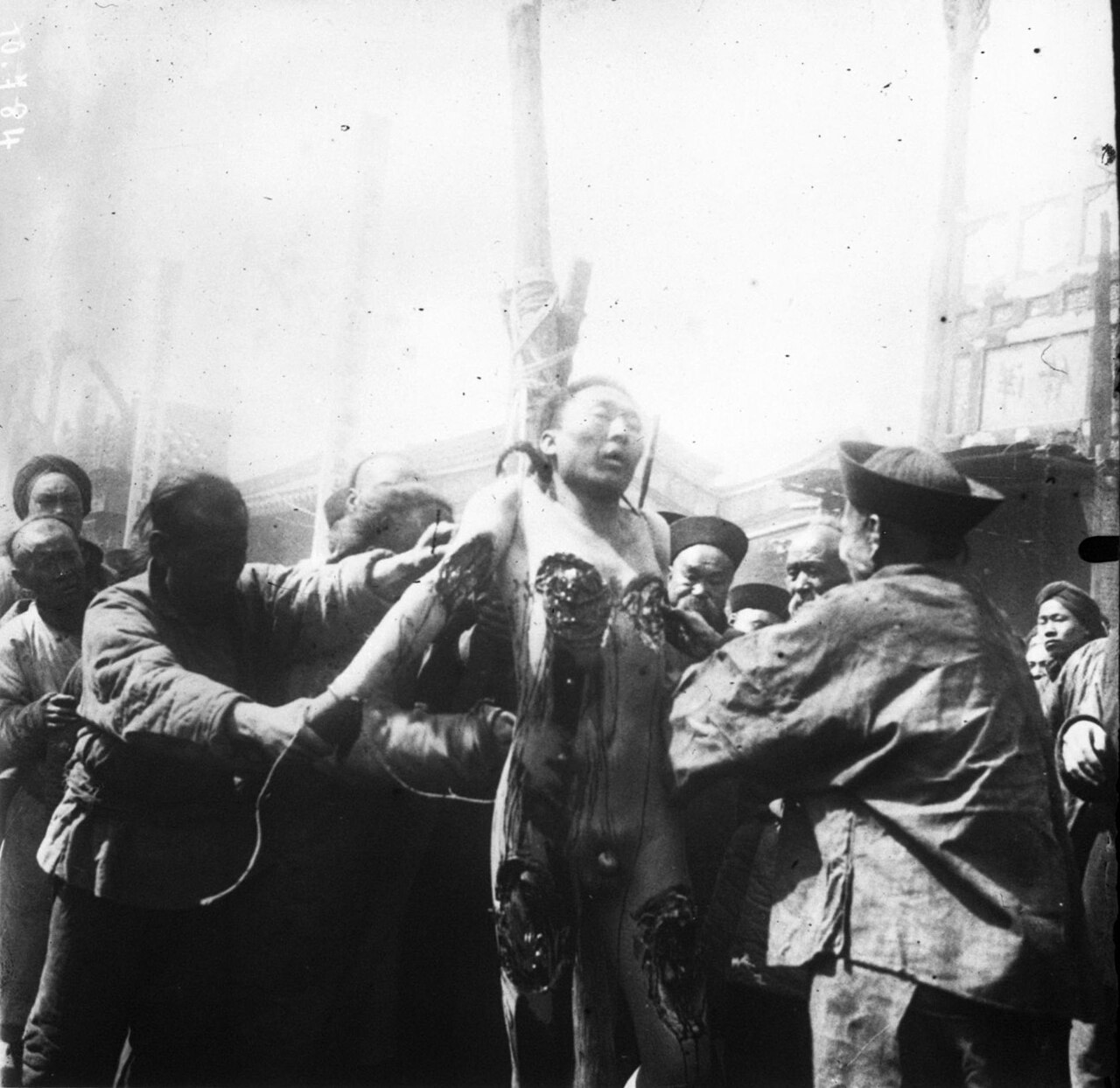
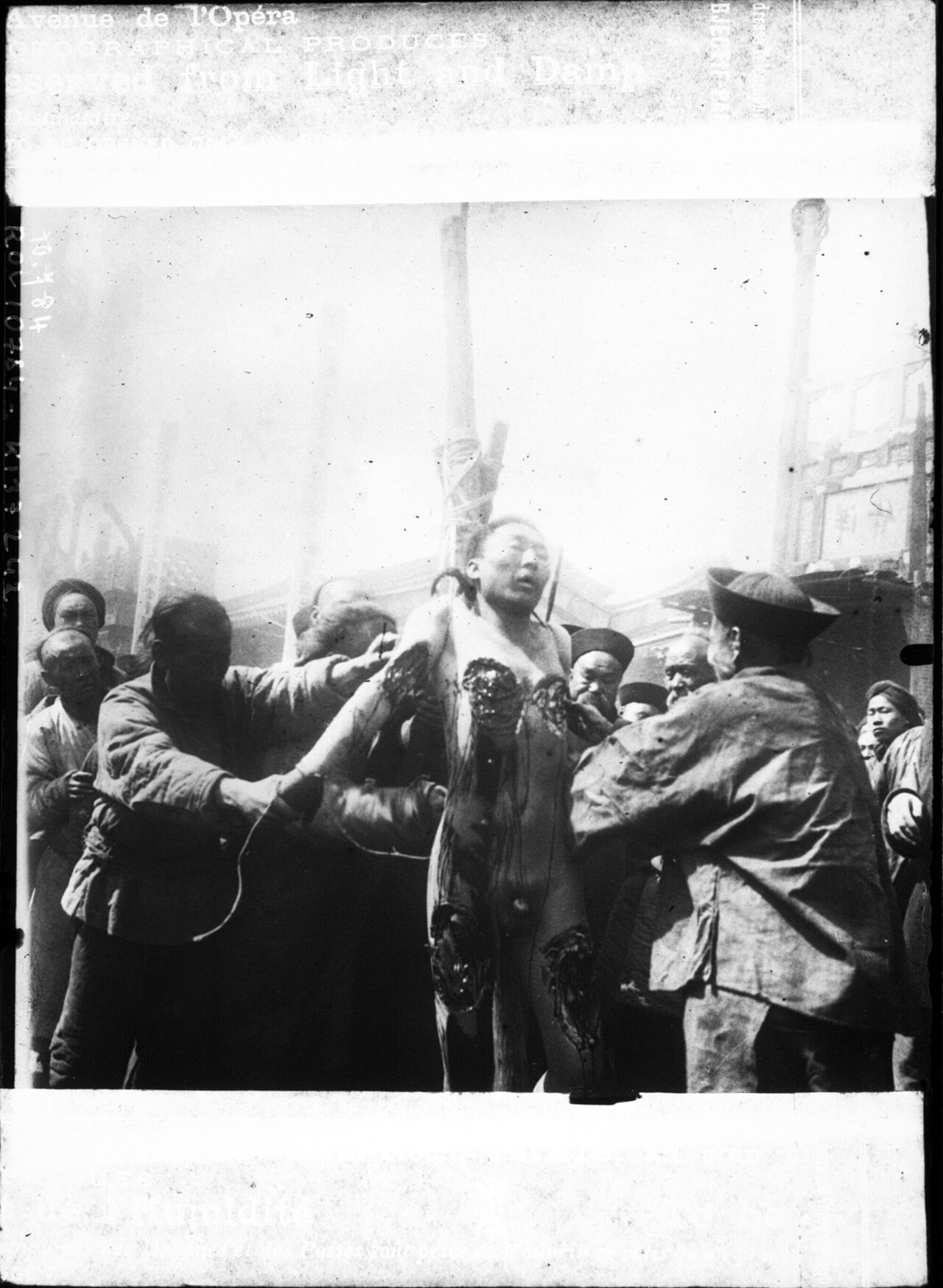
Agence Rol. Agence photographique (commanditaire) · Public domain
Lingchi (IPA: [lǐŋ.ʈʂʰɨ̌], Chinese: 凌遲), usually translated 'slow slicing' or (incorrectly) 'death by a thousand cuts,' is a form of torture and execution used in China from c. 900 until its ban in 1905, and also in Vietnam and Korea. It involved methodically removing portions of the body with a knife over an extended period, eventually causing death, and was reserved for crimes viewed as especially heinous, such as treason. Even after being outlawed, the concept has persisted in various media.
Quick Facts
- Title
- Lingchi
- P
- língchí
- W
- ling / 2 / -ch'ih / 2
- Mi
- l · ing · 2 · . · ch · ^ · 2
- J
- ling / 4 / -ci / 4
- Y
- lìhng-chìh
- Ci
- l · ing · 4 · . · c · i · 4
- Tl
- lêng-tî
- Qn
- tùng xẻo / lăng trì
Facts from the source article.
Lore & Background
The term 'lingchi' describes the prolonging of a person's agony during killing. One theory suggests it grew into a specific torture technique; another proposes the term originated from the Khitan language, as its penal meaning emerged during the Khitan Liao dynasty. The process involved tying the condemned to a wooden frame in a public place, then progressively slicing off flesh in a manner not specified in Chinese law, thus likely varying. The punishment worked on three levels: public humiliation, slow death, and post-death punishment. According to Confucian filial piety, altering or cutting the body was unfilial, and being cut to pieces meant the body would not be whole in spiritual life after death.
Reader's Guide
Lingchi existed under the earliest Chinese emperors, though similar but less cruel tortures were often prescribed. It was prescribed in Liao dynasty law codes and became more widely used in the Song dynasty under Emperors Renzong and Shenzong. An early abolition proposal came from Lu You (1125–1210), who argued it affected the harmony of nature and injured benevolent government. This anti-lingchi trend coincided with opposition to 'cruel and unusual' punishments not included in the Tang dynasty's Five Punishments, showing the abolitionist trend was deeply ingrained in Chinese legal tradition, not purely derived from Western influences. Lingchi was abolished in 1905 due to a revision of the Chinese penal code by Shen Jiaben. Western perceptions often differed from actual practice; for example, George Ernest Morrison claimed the punishment was 'commonly, and quite wrongly, translated as death by slicing into 10,000 pieces' and that mutilation was often done after death, not before.
Did You Know?
- The term 'lingchi' may have originated from the Khitan language during the Liao dynasty.
- During the Yuan dynasty, 100 cuts were inflicted, but by the Ming dynasty there were records of 3,000 incisions.
- The family of the condemned could sometimes bribe the executioner to inflict a stab to the heart first.
- Lingchi was also used in Vietnam, notably for the French missionary Joseph Marchand in 1835.
The Mechanics of the Punishment
The condemned was bound to a wooden frame, typically in a public setting, and subjected to progressive slicing with a knife. Chinese law never codified the exact sequence, so practice likely shifted across regions and eras. The punishment operated on three simultaneous registers: it humiliated the person before a crowd, it stretched suffering over time, and it denied the victim bodily wholeness in the afterlife—a direct violation of Confucian filial piety, which held that one must not alter the body received from one's parents. In practice, the cuts generally targeted the arms, legs, and chest, culminating in limb amputation and then decapitation or a thrust to the heart. A merciful executioner, or a less grave charge, might bring the first blade to the throat, killing instantly, with remaining cuts serving only to dismember the already-dead body. Families who could afford it sometimes bribed the executioner to deliver that fatal heart-stab first. The number of incisions varied wildly: a hundred in the Yuan dynasty, three thousand recorded in the Ming, yet a mid-nineteenth-century observer described the whole affair as lasting no more than four or five minutes.
Legal Scope and Imperial Caprice
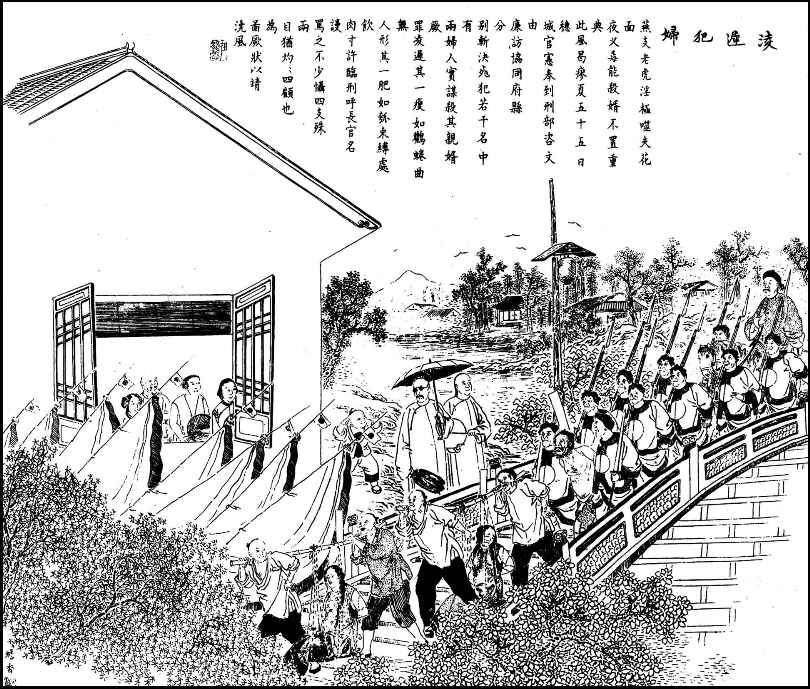
Lingchi was legally reserved for the gravest offences—high treason, mass murder, killing one's parents, or slaying one's master. Yet the boundary between judicial punishment and personal vengeance was thin. Emperors routinely weaponized the sentence as a tool of intimidation, ordering it for trivial infractions or extending it to the relatives of political enemies. The short-reigned Liu Ziye dispatched innocent officials to the blade, while Gao Yang and An Lushan each used it only a handful of times. The Five Dynasties ruler Shi Jingtang briefly abolished the practice, only for later sovereigns to revive it. By the Song dynasty, under Renzong and Shenzong, it had become a more routine instrument of state power. The Liao dynasty's legal codes formally prescribed it, and Emperor Tianzuo applied it with particular frequency. A striking 1879 Peking Gazette case illustrates the social dimensions: a married woman and her lover were convicted of murdering her father-in-law to prevent him from exposing their affair. She received lingchi; her paramour, decapitation; and her husband was publicly shamed in the cangue for failing to control his wife.
A Century-Long Abolitionist Current
The impulse to end lingchi was not a sudden import from the West but a thread running through Chinese legal thought for centuries. In the Southern Song era, the poet-scholar Lu You (1125–1210) submitted a memorandum to the imperial court arguing that watching a person's muscles stripped while breath, liver, and heart still functioned violated the harmony of nature and was unworthy of a benevolent government. His reasoning was copied and preserved by successive generations of jurists across dynasties. That same argumentative lineage culminated in 1905, when reformist Shen Jiaben (1840–1913) wove it into the memorandum that secured the practice's formal abolition. The broader context mattered: the Tang dynasty's canonical table of the Five Punishments had deliberately excluded lingchi and other "cruel and unusual" methods, establishing a legal tradition that distinguished acceptable state punishment from gratuitous cruelty. The abolitionist current was thus deeply rooted in indigenous jurisprudence rather than being a reflexive adoption of Western humanitarian norms.
Myth, Memory, and the Western Gaze
The popular English phrase "death by a thousand cuts" is, by most scholarly accounts, a gross misrepresentation. The Chinese term more accurately conveys "slow slicing," and art historian James Elkins has argued that the actual process, while undeniably involving dismemberment of a living person, could not have stretched across hundreds of wounds. A condemned individual would almost certainly lose consciousness after one or two severe injuries, capping the total at perhaps a few dozen cuts. German criminologist Robert Heindl preferred the more clinical label "death by division." Yet the sensationalized version took root in Western popular imagination, and lingchi became a durable fixture in how some outsiders pictured China. Even after the 1905 ban, the concept continued to surface across film, literature, and other media as a shorthand for extreme cruelty. The practice had also extended beyond China's borders, appearing in the penal traditions of Vietnam and Korea, and the flesh of victims was sometimes sold as medicine, adding another layer to a punishment that was as much about post-mortem degradation as about the act of killing itself.
Gallery

Frequently Asked Questions
What is Lingchi?
Lingchi (凌遲) is a historical execution method in which a condemned person was slowly cut apart with a blade over a prolonged period until death resulted. It is most accurately rendered in English as 'slow slicing,' though popular culture often mislabels it as 'death by a thousand cuts.'
During what period and in which regions was Lingchi practiced?
The practice was carried out in China roughly from the 9th century onward and also appeared in Vietnam and Korea. It was formally banned in 1905, ending more than a millennium of its use.
What offenses qualified a person for Lingchi?
It was reserved for what imperial law considered the most egregious crimes, including treason, patricide, matricide, mass murder, and killing one's master or employer. Ordinary theft or minor assault would never have warranted this sentence.
Is 'death by a thousand cuts' an accurate description of Lingchi?
No — that phrase is a popular but incorrect rendering that implies a fixed count of thousands of cuts. A more precise translation is 'slow slicing,' which reflects the methodical removal of body portions with a knife rather than any specific number.
Why does Lingchi still appear in modern media and discussions?
Even after its legal abolition in 1905, the concept endures as a symbol of extreme state punishment in historical drama, literature, and academic study of imperial justice. It remains a frequently cited example when scholars trace the evolution of criminal law across East Asia.
More in History of Imperial China 1-22
Spotted an error? Know more?
Reader corrections go straight into our review queue. Suggest an edit · How this site is sourced