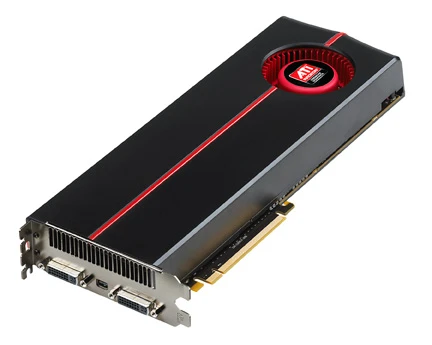
Radeon HD 8000 series
OEM rebadge of the 7000 series with one GCN 2.0 chip.

The Radeon HD 8000 series is a line of computer GPUs from AMD. While early rumors suggested a launch in the second quarter of 2013 using a 28 nm manufacturing process and an improved Graphics Core Next architecture, the series ultimately ended up being an OEM rebadge of the HD 7000 series. The Bonaire chip is an exception, as it is based on GCN 2.0 and represents a newer design. The HD 7000 series, which debuted in 2011, marked AMD’s move from VLIW (TeraScale) to a RISC/SIMD architecture called Graphics Core Next. High-end and mainstream cards used GCN-based chips, while some mid-range and low-end models were rebranded TeraScale cards. All GCN-based chips were built on a 28 nm process, becoming the first chips ever to be based on that technology. Desktop GCN chips were codenamed Southern Islands, while mobile GCN chips (excluding rebranded ones) were codenamed Solar System. AMD’s Eyefinity multi-monitor technology, introduced with the Radeon HD 5000 series in September 2009, has been included in all chips since then. All GCN-based chips, starting with the GCN 1.0 HD 7000 series, include both the Unified Video Decoder (UVD) and Video Coding Engine (VCE). These are fully supported by AMD Catalyst and by free and open-source graphics drivers. OpenCL accelerates many scientific software packages by a factor of 10 to 100 or more compared to CPUs. OpenCL 1.0 through 1.2 are supported on all TeraScale and GCN chips. OpenCL 2.0 is supported on GCN 2nd Gen (or 1.2 and higher). For OpenCL 2.1 and 2.2, only driver updates are needed on OpenCL 2.0-compatible cards. Vulkan 1.0 is supported on all GCN-architecture GPUs. Vulkan 1.1 support (for GCN 2nd Gen or higher) was added with drivers in 2018, initially only for the HD 8770. On newer drivers, Vulkan 1.1 is supported on all GCN-based GPUs under Windows and Linux. Vulkan 1.2 is available with Adrenalin 20.1 and Linux Mesa 20.0 for GCN 2nd Gen or higher. Desktop models with GCN architecture support the Mantle and Vulkan APIs. OpenGL 4.5 is supported on TeraScale 2 with AMD Crimson Beta (driver 15.30 or later). OpenGL 4.5 and Vulkan 1.0 are supported on GCN 1.0 and higher with AMD Crimson 16.3 or later. Vulkan 1.1 support for GCN 1.0 and higher requires AMD Adrenalin 18.3.3 or later.
Quick Facts
- Codename
- Southern Islands / Sea Islands / Solar System / Richland / Kabini
- Architecture
- TeraScale 2 / TeraScale 3 / GCN 1st gen / GCN 2nd gen
- Created
- Q2 2013
- Entry
- 8350 / 8450 / 8470 / 8490 / 8570 / 8670 / 8730
- Midrange
- 8760 / 8770
- Highend
- 8870 / 8950 / 8970
- Enthusiast
- 8990
Facts from the source article.
Lore & Background
The Radeon HD 8000 series was initially rumored to launch in the second quarter of 2013, manufactured on a 28 nm process and using the improved Graphics Core Next architecture. However, the series turned out to be an OEM rebadge of the 7000 series, meaning most cards were essentially re-releases of existing hardware. The exception is the Bonaire chip, which is based on GCN 2.0, representing a newer development. The Radeon HD 7000 series, which the 8000 series rebadges, launched in 2011 and marked AMD's shift from VLIW (TeraScale) to RISC/SIMD architecture (Graphics Core Next). High-end and mainstream cards used GCN-based chips, while some mid-low end cards were rebranded TeraScale-based cards. All GCN-based chips were made using the 28 nm process, becoming the first chips ever to be based on that technology. Multi-monitor support via AMD Eyefinity was introduced in September 2009 with the Radeon HD 5000 series and has been present on all chips since.
Reader's Guide
The Radeon HD 8000 series is notable primarily as an OEM rebadge of the 7000 series, with the exception of the Bonaire chip which introduced GCN 2.0. This means the series did not represent a major generational leap for desktop consumers, instead serving as a refresh for OEM systems. The series inherits the features of the 7000 series, including Eyefinity multi-monitor support, Unified Video Decoder (UVD), and Video Coding Engine (VCE) on GCN-based chips. In terms of API support, the article notes that OpenCL 2.0 is supported with GCN 2nd Gen (which includes Bonaire), and Vulkan 1.0 is supported for all GCN architecture. Vulkan 1.1 support is noted for GCN 2nd Gen or higher, with the HD 8770 specifically mentioned. The series' legacy is tied to the transition from GCN 1.0 to GCN 2.0, though most cards were simply rebadged. The article does not provide a chipset table for the 8000 series, but references the Radeon HD 7000 series and other related series in its 'See also' section.
Did You Know?
- The series turned out to be an OEM rebadge of the 7000 series, though the Bonaire chip is GCN 2.0 based.
- All GCN-based chips in the 7000 series (rebadged as 8000) were the first chips ever made using the 28 nm process.
- OpenCL 2.0 is supported with GCN 2nd Gen, which includes the Bonaire chip in the 8000 series.
More in Graphics Hardware 1-24
Spotted an error? Know more?
Reader corrections go straight into our review queue. Suggest an edit · How this site is sourced