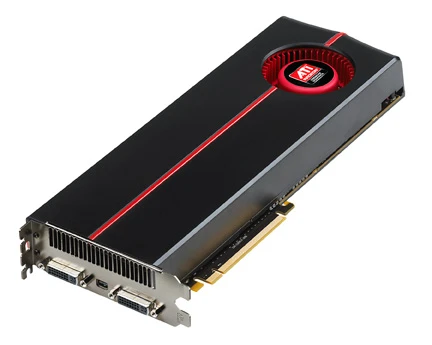
Graphics card
An expansion card that generates graphics output to a display.

A graphics card—also called a video card, display card, graphics accelerator, graphics adapter, VGA card, video adapter, or display adapter GPU—is an expansion board for a computer that creates the signal sent to a monitor or other display. To set it apart from the graphics processor built into the motherboard or CPU, it’s often referred to as a discrete or dedicated graphics card. The core component that does the actual number crunching is the graphics processing unit (GPU), though people sometimes mistakenly use “GPU” to mean the whole card.
Most graphics cards do more than just push pixels to a screen. Their GPU can handle extra processing tasks, taking some of the load off the CPU. Platforms like OpenCL and CUDA let these cards be used for general-purpose computing, with applications ranging from AI training and cryptocurrency mining to molecular simulation.
A typical graphics card is a printed circuit board that plugs into an expansion slot inside a computer. Some come in separate enclosures and connect via a docking station or cable; these are called external GPUs (eGPUs). Compared to integrated graphics, dedicated cards usually offer better performance—a more powerful one can render more frames per second.
**History**
Graphics cards have evolved alongside computer display standards. On IBM PC compatibles, early standards included Monochrome Display Adapter (MDA), Color Graphics Adapter (CGA), Hercules Graphics Card, Enhanced Graphics Adapter (EGA), and Video Graphics Array (VGA). Each step allowed more colors, higher resolutions, and richer interfaces, setting the stage for modern graphics.
In the late 1980s, companies like Radius made specialized cards for the Apple Macintosh II that included discrete 2D QuickDraw acceleration. QuickDraw, a core part of the Mac’s graphical interface, handled bitmapped graphics, fonts, and shapes; hardware support for it marked the beginning of specialized graphics processing in consumer machines.
A major leap came in the mid-1990s with 3dfx Interactive’s Voodoo series, one of the first consumer GPUs to support 3D acceleration. The Voodoo offloaded demanding 3D rendering from the CPU to the GPU, greatly improving gaming performance and realism.
The first fully integrated GPU handling both 2D and 3D was the NVIDIA RIVA 128, released in 1997.
- Tdp example
- 280 watts (GeForce Titan RTX)
- Power consumption example
- 300 watts average (GeForce RTX 2080 Ti Founder's Edition)
- Pcie power limit
- 75 watts
- Six pin socket power
- 75 W
- Eight pin socket power
- 150 W
- Peak power draw rtx 3090 hall of fame
- 630 watts
- Peak power draw standard rtx 3090
- 450 watts
- Peak power draw rtx 3080
- 350 watts
- Length example
- over 300mm (RTX 4090)
Lore & Background
Historically, graphics cards evolved alongside computer display standards. In the realm of IBM PC compatibles, early standards included Monochrome Display Adapter (MDA), Color Graphics Adapter (CGA), Hercules Graphics Card, Enhanced Graphics Adapter (EGA), and Video Graphics Array (VGA). In the late 1980s, companies like Radius developed specialized graphics cards for the Apple Macintosh II that incorporated discrete 2D QuickDraw capabilities. The mid-1990s saw a major leap with 3dfx Interactive's Voodoo series, one of the earliest consumer-facing GPUs supporting 3D acceleration. The NVIDIA RIVA 128, released in 1997, integrated both 3D and 2D processing on a single chip, simplifying hardware requirements. Contemporary graphics cards are built using chips from AMD, Intel, and Nvidia, and support tasks beyond 3D rendering, including 2D graphics, video decoding, TV output, multi-monitor setups, and integrated sound capabilities. Within the industry, these products are often called graphics add-in boards (AIBs).
Reader's Guide
Graphics cards are notable for their ability to offload graphics processing from the CPU, reducing load and improving overall system performance, particularly in video gaming, 3D animation, and video editing. They have separate random access memory (RAM), dedicated cooling, and power regulators, which gives them a performance advantage over integrated graphics. Integrated graphics, while lower cost and more energy efficient, share system resources with the CPU and thus offer less performance. The power demands of graphics cards have increased significantly; high-end models like the GeForce Titan RTX have a thermal design power of 280 watts, and the GeForce RTX 2080 Ti Founder's Edition averaged 300 watts under gaming loads. Modern cards with power consumption over 75 watts typically include six-pin (75 W) or eight-pin (150 W) power sockets. Heat extraction is a major design consideration for computers with multiple high-end cards. Graphics cards come in various size profiles, including low-profile cards for smaller cases, while high-end cards like the RTX 4090 can exceed 300mm in length and occupy two or three expansion slots.
Did You Know?
- The acronym 'GPU' is sometimes erroneously used to refer to the entire graphics card.
- The NVIDIA RIVA 128, released in 1997, was one of the first consumer-facing GPUs to integrate both 3D and 2D processing on a single chip.
- The GeForce Titan RTX has a thermal design power of 280 watts.
- A custom flashed RTX 3090 named 'Hall of Fame' has been recorded reaching a peak power draw of 630 watts.
More in Graphics Hardware 1-24
Spotted an error? Know more?
Reader corrections go straight into our review queue. Suggest an edit · How this site is sourced