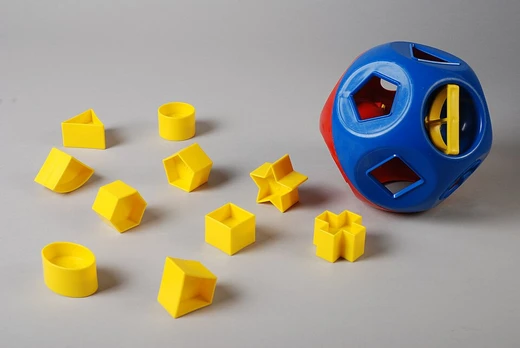
Two-dimensional space
A mathematical space with two degrees of freedom.

A two-dimensional space is a mathematical setting where points have two degrees of freedom: you can describe any location using two coordinates, or move in two independent directions. Such spaces are commonly called planes—most famously the Euclidean plane—or, more broadly, surfaces. They can mirror physical spaces, like flat planes, or curved surfaces such as spheres, cylinders, and cones, which may be infinite or finite. Other two-dimensional spaces, like the affine plane or complex plane, do not represent physical positions at all.
The flat Euclidean plane is the simplest example, an idealized version of a flat surface like a sheet of paper. On it, any two points connect via a unique straight line, and distance along that line can be measured. The space is flat because if a third line is perpendicular to two others, those two are parallel—they never meet and stay a constant distance apart.
Two-dimensional spaces can also be curved, such as a sphere or a hyperbolic plane. Small patches of these look flat, but locally parallel straight lines do not remain equidistant: on a sphere they converge, on a hyperbolic plane they diverge. Spaces with a locally Euclidean notion of distance but non-uniform curvature are called Riemannian surfaces (not to be confused with Riemann surfaces). Some surfaces are embedded in three-dimensional Euclidean space or another ambient space, inheriting their structure from it—for example, ruled surfaces like cylinders and cones have a straight line through every point, and minimal surfaces locally shrink their area, as soap films do physically.
Lorentzian surfaces resemble a two-dimensional slice of relativistic spacetime, with one spatial and one time dimension. Constant-curvature examples include the flat Lorentzian plane (a two-dimensional subspace of Minkowski space) and the curved de Sitter and anti-de Sitter planes.
Other mathematical planes and surfaces modify or discard the structures of the Euclidean plane. The affine plane keeps the idea of parallel lines but has no concept of distance; however, signed areas can be compared, as they can in a more general symplectic surface. The projective plane abandons both distance and parallelism. A two-dimensional metric space has some distance concept, but it need not match the Euclidean one. A topological surface can be stretched, twisted, or bent without changing its essential
- field
- Mathematics
- known_for
- Fundamental concept in geometry, topology, and physics
Lore & Background
The most basic example is the flat Euclidean plane, an idealization of a flat surface in physical space such as a sheet of paper or a chalkboard. On the Euclidean plane, any two points can be joined by a unique straight line along which the distance can be measured. The space is flat because any two lines transversed by a third line perpendicular to both of them are parallel, meaning they never intersect and stay at uniform distance from each-other.
Two-dimensional spaces can also be curved, for example the sphere and hyperbolic plane, sufficiently small portions of which appear like the flat plane, but on which straight lines which are locally parallel do not stay equidistant from each-other but eventually converge or diverge, respectively. Two-dimensional spaces with a locally Euclidean concept of distance but which can have non-uniform curvature are called Riemannian surfaces. Some surfaces are embedded in three-dimensional Euclidean space or some other ambient space, and inherit their structure from it; for example, ruled surfaces such as the cylinder and cone contain a straight line through each point, and minimal surfaces locally minimize their area, as is done physically by soap films.
Other types of mathematical planes and surfaces modify or do away with the structures defining the Euclidean plane. For example, the affine plane has a notion of parallel lines but no notion of distance; however, signed areas can be meaningfully compared, as they can in a more general symplectic surface. The projective plane does away with both distance and parallelism. A two-dimensional metric space has some concept of distance but it need not match the Euclidean version. A topological surface can be stretched, twisted, or bent without changing its essential properties.
Reader's Guide
Two-dimensional spaces are foundational in mathematics, providing the simplest setting for studying geometry, topology, and analysis. The Euclidean plane serves as the classical model for flat geometry, while curved surfaces like spheres and hyperbolic planes illustrate non-Euclidean geometries crucial to understanding the shape of the universe and general relativity. Lorentzian surfaces, which look locally like a two-dimensional slice of relativistic spacetime, are essential in theoretical physics for modeling spacetime with one spatial and one time dimension. Non-Euclidean planes such as the affine, projective, and symplectic surfaces extend geometric concepts by removing or altering notions of distance and parallelism, influencing fields from algebraic geometry to symplectic topology. The real coordinate space R² is one of the most fundamental two-dimensional spaces, consisting of pairs of real-number coordinates, and is used to represent arbitrary quantities in parameter spaces or configuration spaces of physical systems. More exotic spaces, such as the complex plane (two-dimensional in real coordinates but one-dimensional in complex coordinates) and two-dimensional lattices, demonstrate the versatility of two-dimensional structures across pure and applied mathematics.
Did You Know?
- Two-dimensional spaces can be curved, such as the sphere and hyperbolic plane, where locally parallel lines converge or diverge.
- Lorentzian surfaces look locally like a two-dimensional slice of relativistic spacetime with one spatial and one time dimension.
- The affine plane has a notion of parallel lines but no notion of distance.
- The real coordinate space R² consists of pairs of real-number coordinates and is one of the most fundamental two-dimensional spaces.
More in Geometry And Shapes 1-24
Spotted an error? Know more?
This is a living reference — every entry is fact-audited, and reader corrections feed straight into our audit queue. Suggest an edit · See this site's audit record