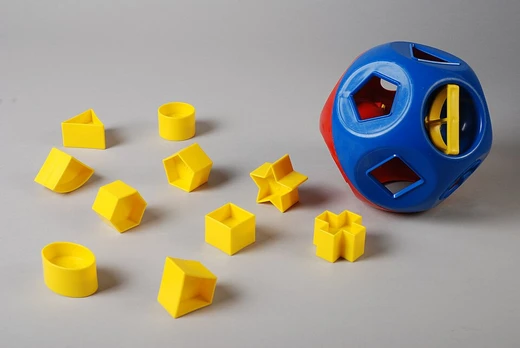
Tetrahedron
A polyhedron with four triangular faces and four vertices.

A tetrahedron is a polyhedron composed of four triangular faces, six straight edges, and four vertices. It is the simplest of all ordinary convex polyhedra and is also known as a triangular pyramid. The tetrahedron is the three-dimensional case of the more general concept of a Euclidean simplex, and may thus also be called a 3-simplex.
- field
- Geometry
- known_for
- Simplest convex polyhedron; triangular pyramid; 3-simplex
Lore & Background
The tetrahedron is one kind of pyramid, with a flat polygon base and triangular faces connecting the base to a common point. In the case of a tetrahedron, the base is a triangle, so any of the four faces can be considered the base. Like all convex polyhedra, a tetrahedron can be folded from a single sheet of paper, and it has two such nets. For any tetrahedron there exists a sphere called the circumsphere on which all four vertices lie, and another sphere called the insphere tangent to the tetrahedron's faces.
A regular tetrahedron has all four faces as equilateral triangles, with all edges the same length. It is the simplest deltahedron. Irregular tetrahedra include orthocentric tetrahedra (all three pairs of opposite edges perpendicular), trirectangular tetrahedra (three right angles at one vertex), isodynamic tetrahedra, and isogonic tetrahedra. A disphenoid is a tetrahedron with four congruent triangles as faces, and a 3-orthoscheme is a tetrahedron where all four faces are right triangles.
The characteristic tetrahedron of the regular tetrahedron is a 3-orthoscheme. The regular tetrahedron is subdivided into 24 instances of its characteristic tetrahedron by its planes of symmetry, occurring in two mirror-image forms, 12 of each. The cube can be dissected into six 3-orthoschemes, and the characteristic 3-orthoscheme of the cube is a space-filling tetrahedron.
Reader's Guide
The tetrahedron holds fundamental significance in geometry as the simplest convex polyhedron and the three-dimensional analogue of the triangle. Its study provides a foundation for understanding more complex polyhedra and simplexes in higher dimensions. The classification of tetrahedra into regular, orthocentric, trirectangular, isodynamic, isogonic, disphenoid, and orthoscheme types reveals the rich variety of shapes possible within this basic form. The regular tetrahedron's subdivision into characteristic orthoschemes illustrates deep connections to symmetry groups and regular polytopes. The space-filling property of certain tetrahedra, such as the characteristic orthoscheme of the cube, demonstrates their role in tiling three-dimensional space. The tetrahedron's nets and its circumsphere and insphere properties are essential in both theoretical geometry and practical applications like paper folding and crystallography. Its role as a deltahedron and its relationship to the cube through dissection highlight its importance in understanding spatial relationships and symmetry.
Did You Know?
- A tetrahedron can be folded from a single sheet of paper and has two such nets.
- For any tetrahedron there exists a circumsphere on which all four vertices lie and an insphere tangent to its faces.
- The regular tetrahedron is the simplest deltahedron, a polyhedron all of whose faces are equilateral triangles.
- The cube can be dissected into six 3-orthoschemes, three left-handed and three right-handed.
Foundations of the Simplest Solid
The tetrahedron stands as the most elementary convex polyhedron in three-dimensional geometry. Built from just four triangular faces, six straight edges, and four vertices, it represents the minimal configuration that can enclose a volume in Euclidean space. Because any one of its four faces can serve as a base with the remaining three triangular faces rising to a shared apex, the shape is equally well described as a triangular pyramid. It also occupies a natural place in the broader family of Euclidean simplices, earning the alternate name 3-simplex as the three-dimensional member of that sequence. Like every convex polyhedron, a tetrahedron can be assembled from a single flat sheet of paper; in fact, exactly two distinct net patterns allow this folding. Two remarkable spheres are associated with every tetrahedron: a circumsphere passing through all four vertices, and an insphere tangent to all four faces, underscoring the shape's deep internal symmetry even in its most general form.
The Regular Form and Its Place Among Deltahedra
When every face of a tetrahedron is an equilateral triangle of identical size, the result is the regular tetrahedron, the most symmetric instance of the family. All six edges share the same length, and all four faces are congruent, making it the simplest member of the deltahedra, polyhedra whose faces are exclusively equilateral triangles. Seven other convex deltahedra exist beyond this four-faced pioneer, but none match its economy of structure. The regular tetrahedron also qualifies as a special case of the broader disphenoid class, in which all four faces are congruent triangles with exclusively acute angles. Its geometric purity has made it a cornerstone of mathematical study, from its role as the characteristic tetrahedron of itself, subdivided by symmetry planes into twenty-four mirror-image pairs, to its appearance as the foundational building block in the classification of regular polytopes.
A Family of Irregular Variants
Beyond the perfectly regular form, tetrahedra branch into a rich taxonomy of irregular types, each defined by specific angular or metric relationships among their edges and faces. An orthocentric tetrahedron has all three pairs of opposite edges meeting at right angles, while a semi-orthocentric tetrahedron satisfies this perpendicularity for only one such pair. The trirectangular tetrahedron features three mutually perpendicular face angles at a single vertex, mirroring the corner of a cube. More exotic still are the isodynamic tetrahedron, where cevians from vertices to the incenters of opposite faces all meet at one point, and the isogonic tetrahedron, in which cevians to the insphere contact points on opposite faces are concurrent. The disphenoid occupies a middle ground: four congruent acute-angled triangular faces, with the regular tetrahedron as its most symmetric special case. These variants reveal how a mere four faces can encode a surprising diversity of geometric character.
Orthoschemes and the Geometry of Symmetry
A 3-orthoscheme, also called a birectangular or quadrirectangular tetrahedron, is a tetrahedron whose four faces are all right triangles, with two right angles at each of two vertices. Structurally, it is the convex hull of three mutually perpendicular edges arranged in a linear path that makes two right-angled turns. The mathematician H. S. M. Coxeter recognized these shapes as characteristic tetrahedra because of their intimate connection to regular polytopes and their symmetry groups. The cube, for instance, can be dissected into six unit-edge orthoschemes in four distinct ways, all surrounding the same long diagonal, or into forty-eight smaller copies via its full set of symmetry planes. Similarly, the regular tetrahedron itself is subdivided into twenty-four characteristic tetrahedra, twelve of each mirror-image form, by its symmetry planes. Every regular polytope possesses its own characteristic orthoscheme, making these right-triangle tetrahedra a universal key to understanding higher-dimensional symmetry.
Frequently Asked Questions
What is a tetrahedron?
A tetrahedron is a three-dimensional solid built from four flat triangular faces that meet along six edges at four corner points. You can picture it as a pyramid whose base is a triangle and whose three side faces are triangles as well.
How many faces, edges, and vertices does a tetrahedron have?
It has exactly four triangular faces, six straight edges, and four vertices. At every vertex, three edges converge, and each face shares its edges with the other three faces.
Why is the tetrahedron considered special in geometry?
It is the simplest ordinary convex polyhedron, meaning no other convex solid can be built from fewer faces or vertices. That minimal structure makes it a foundational reference point when studying three-dimensional shapes.
What other names does a tetrahedron go by?
It is commonly called a triangular pyramid because of its pyramid-like silhouette with a triangular base. In more advanced mathematical language, it is also known as a 3-simplex, reflecting its place as the three-dimensional member of the simplex family.
How does the tetrahedron relate to the broader concept of simplices?
A simplex is a general shape that extends the idea of a triangle into any number of dimensions, and the tetrahedron is specifically the three-dimensional instance. So a line segment is a 1-simplex, a triangle is a 2-simplex, and the tetrahedron sits at the 3-simplex level.
More in Geometry And Shapes 1-24
Spotted an error? Know more?
This is a living reference — every entry is fact-audited, and reader corrections feed straight into our audit queue. Suggest an edit · See this site's audit record