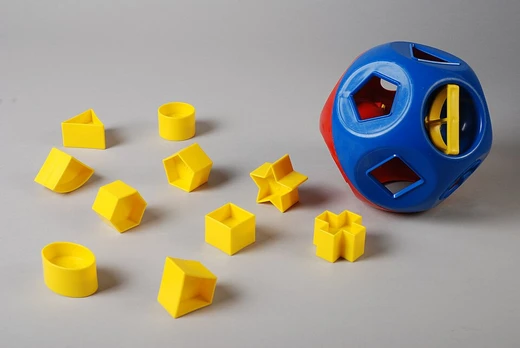
Shape
Geometric information remaining after removing location, scale, orientation, and reflection.

A shape describes an object’s form—its outline, boundary, or outer surface—and is separate from traits like color, texture, or what it’s made of. In geometry, a shape ignores where the object is, how big it is, which way it faces, and whether it has a mirror-image version. A figure includes both shape and size (for example, the figure of the Earth). A plane shape, or plane figure, is confined to a flat surface, unlike solid three-dimensional shapes. A two-dimensional shape, also called a 2D figure, can exist on a curved surface (a two-dimensional space).
Simple shapes fall into broad categories. Polygons are grouped by how many edges they have—triangles, quadrilaterals, pentagons, and so on. Each group splits further: triangles can be equilateral, isosceles, obtuse, acute, or scalene; quadrilaterals include rectangles, rhombi, trapezoids, and squares. Other common shapes are points, lines, planes, and conic sections like ellipses, circles, and parabolas. Among the most common three-dimensional shapes are polyhedra (shapes with flat faces), ellipsoids (egg-shaped or sphere-like), cylinders, and cones. If an object matches one of these categories exactly or roughly, we use that category to describe its shape—for instance, a manhole cover is called a disk because it closely resembles a geometric disk.
In geometry, a shape is the geometric information left after you remove location, scale, orientation, and reflection from an object’s description. Moving a shape, enlarging it, rotating it, or reflecting it in a mirror yields the same shape, not a different one. Many two-dimensional geometric shapes can be defined by a set of points (vertices) and lines connecting them in a closed loop, plus the interior points inside. These are polygons, such as triangles, squares, and pentagons. Other 2D shapes are bounded by curves, like circles and ellipses. Many three-dimensional geometric shapes can be defined by vertices, lines connecting them, two-dimensional faces enclosed by those lines, and the interior points inside. These are polyhedrons, including cubes and pyramids like tetrahedrons. Other 3D shapes are bounded by curved surfaces, such as ellipsoids and spheres. A shape is convex if every point on a line segment between any two of its points also lies inside the shape.
There are several ways to compare shapes. Congruence means one object can become the other thro
- field
- Geometry
- known_for
- Definition of shape as geometric information invariant to location, scale, orientation, and reflection
Lore & Background
In geometry, a shape consists of the geometric information that remains when location, scale, orientation, and reflection are removed from the description of a geometric object. Moving, enlarging, rotating, or reflecting a shape yields the same shape, not a distinct one. Simple shapes can be classified into categories such as polygons (triangles, quadrilaterals, pentagons), conic sections (ellipses, circles, parabolas), and three-dimensional forms like polyhedra, ellipsoids, cylinders, and cones.
Reader's Guide
The concept of shape is fundamental in geometry and many sciences. It allows objects to be compared through congruence (rigid transformations plus reflections), similarity (adding uniform scaling), and isotopy (deformations without tearing or hole creation). Procrustes analysis is used to determine whether two objects have the same shape or to measure shape differences. In advanced mathematics, quasi-isometry serves as a criterion for approximate shape equivalence. The definition of shape as an equivalence class under translations, rotations, and uniform scalings provides a precise mathematical framework, as articulated by mathematician David George Kendall. This understanding applies to physical objects, where shape depends only on the outer boundary and is independent of size and placement.
Did You Know?
- A shape excludes information about an object's position, size, orientation, and chirality.
- Two objects are congruent if one can be transformed into the other by rotations, translations, and/or reflections.
- A square and a circle are homeomorphic to each other, but a sphere and a donut are not.
- The letters 'b' and 'd' are congruent and similar, but in some contexts they are not regarded as having the same shape.
Defining Shape and Setting Its Boundaries
Shape is the graphical capture of an object's form—its outline, external boundary, or surface—deliberately stripped of everything else. Unlike color, texture, or material composition, shape exists as a purely geometric property. In formal geometry, the concept goes further: it discards position, size, orientation, and even chirality (mirror-image handedness). This means that moving, resizing, rotating, or reflecting a shape does not produce a new one; the underlying form remains identical. A related but distinct concept is "figure," which bundles shape together with size—think of the "figure of the Earth," where both the roundness and the actual dimensions matter. Plane shapes are confined to a flat surface, while two-dimensional figures can stretch across more general curved two-dimensional spaces. This layered taxonomy—shape versus figure, plane versus solid, flat versus curved—gives mathematicians precise vocabulary for isolating exactly which geometric information they are studying.
Taxonomy and the Architecture of Simple Forms
The world of simple shapes organizes itself into elegant hierarchical categories. Polygons, the workhorses of two-dimensional geometry, are first sorted by edge count—triangles, quadrilaterals, pentagons, and so on—then subdivided by internal properties. Triangles branch into equilateral, isosceles, obtuse, acute, and scalene varieties; quadrilaterals split into rectangles, rhombi, trapezoids, and squares. Beyond polygons, the family tree includes points, lines, planes, and the conic sections: ellipses, circles, and parabolas. In three dimensions, polyhedra with their flat faces sit alongside ellipsoids (egg- or sphere-like bodies), cylinders, and cones. The practical power of this taxonomy is that real-world objects can be matched to these ideal forms, even approximately. A manhole cover is called a disk not because it is a perfect geometric circle, but because its form is close enough to invoke the category. Regular polygons from the pentagon onward follow a Greek-derived naming convention with the "-gon" suffix, producing pentagon, hexagon, heptagon, octagon, nonagon, and decagon in sequence.
Equivalence, Comparison, and the Philosophy of "Same Shape"
Deciding whether two objects share the same shape is far from trivial. Geometry offers several comparison frameworks. Congruence means one object can become the other through rotations, translations, and reflections alone. Similarity relaxes this by allowing a uniform scaling on top of those rigid moves. Isotopy is even more permissive: two objects are isotopic if one can be continuously deformed into the other without tearing or punching holes. Yet context matters. The letters "b" and "d" are congruent and similar, but many people still call them different shapes because a mirror reflection is involved. A hollow sphere and a solid sphere may be treated as sharing the same shape if only the outer boundary counts. Statistician David George Kendall captured the informal intuition: shape is "all the geometrical information that remains when location, scale and rotational effects are filtered out." In rigorous terms, shape becomes an equivalence class of subsets in Euclidean space, and tools like Procrustes analysis or quasi-isometry let scientists quantify how close two shapes truly are.
Convexity, Complexity, and Shapes That Defy Description
Not all shapes behave with the neatness of a triangle or a cube. A shape is convex when every line segment connecting two of its points stays entirely within the shape—a property that makes many calculations tractable. But the physical world is full of forms that resist such tidy classification. Coastlines, the branching architecture of trees, and the intricate geometry of plant structures can grow so complicated that traditional mathematical description breaks down. For these, analysts turn to differential geometry or the theory of fractals, which capture self-similar complexity at every scale. Even within well-behaved geometry, the distinction between two-dimensional and three-dimensional forms introduces subtlety: a plane figure must lie on a flat surface, whereas a two-dimensional figure is free to inhabit any curved two-dimensional space. Polyhedra—cubes, tetrahedrons, pyramids—are built from vertices, edges, and flat faces, while their curved-surface counterparts like spheres and ellipsoids require a different descriptive toolkit. The result is a rich landscape where simple ideal forms coexist with shapes whose very complexity demands new mathematical languages.
Frequently Asked Questions
What is a shape in geometry?
A shape is the pure form of an object—its outline, boundary, or outer surface—independent of color, texture, or material. It captures only the geometric information that remains after you strip away where the object sits, how large it is, which direction it faces, and whether it is a mirror image.
What properties does a shape deliberately exclude?
In geometric terms, a shape is invariant to location, scale, orientation, and reflection. This means two objects with the same shape are considered identical even if one is bigger, rotated, translated, or flipped relative to the other.
What is the difference between a shape and a figure?
A shape refers solely to form, while a figure combines shape with a specific size. For instance, the Earth's silhouette is its shape, but the Earth's actual radius and volume together describe its figure.
Can a two-dimensional shape live on a curved surface?
Yes. A 2D figure is not restricted to a perfectly flat plane; it can be defined on any two-dimensional space, including curved surfaces. What matters is that it has only two dimensions of extent, not that the underlying surface is flat.
Why is the concept of shape considered foundational in geometry?
Shape isolates the essential geometric information of an object by removing all accidental properties like position, size, facing direction, and handedness. This invariance lets geometers compare, classify, and reason about forms without being distracted by how or where they happen to appear.
More in Geometry And Shapes 1-24
Spotted an error? Know more?
This is a living reference — every entry is fact-audited, and reader corrections feed straight into our audit queue. Suggest an edit · See this site's audit record