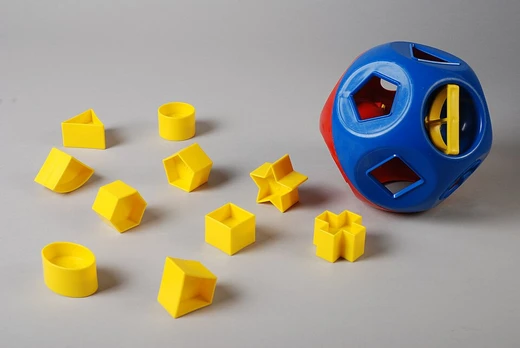
Sphere
A sphere is a set of points equidistant from a center in 3D space.

A sphere is a curved surface in three-dimensional space, much like how a circle is a curved line in a plane. It consists of every point that lies exactly the same distance, called the radius, from a fixed central point. The word comes from the Ancient Greek *sphaîra*, meaning "ball," and the earliest known discussions of spheres were by ancient Greek mathematicians.
Spheres are a fundamental shape in mathematics and appear throughout nature and industry. Soap bubbles naturally form spheres when at rest. In geography, Earth is often treated as a sphere, and in astronomy, the celestial sphere is a key concept. Many manufactured objects, such as pressure vessels, curved mirrors, and lenses, are based on spheres. Because a sphere rolls smoothly in any direction, most sports balls, toys, and ball bearings are spherical.
A line from the center to the surface is also called a radius, and the term refers to both the segment and its length. Extending a radius through the center to the opposite side gives a diameter, which is twice the radius (d = 2r). Diameters are the longest possible line segments between two points on the sphere, and those two points are called antipodal points. A sphere with a radius of 1 is a unit sphere. For convenience, spheres are often placed with their center at the origin of a coordinate system.
A great circle on a sphere shares the same center and radius as the sphere and splits it into two equal halves called hemispheres. Although Earth is not perfectly spherical, geographic terms are useful for describing spheres. An axis is a line through the center, and where it meets the sphere are two antipodal poles (north and south). The great circle halfway between the poles is the equator. Great circles through the poles are lines of longitude or meridians, while small circles parallel to the equator are circles of latitude or parallels. Such geographic terms should only be used for illustration unless no confusion is possible.
Mathematicians treat a sphere as a two-dimensional closed surface within three-dimensional Euclidean space. They distinguish a sphere from a ball: a ball is a solid figure that includes the volume inside the sphere. An open ball excludes the sphere itself; a closed ball includes it. The sphere is the boundary of both open and closed balls. Older references sometimes used "sphere" to mean the solid, similar to how "cir
- field
- Mathematics, Geometry
- known_for
- Fundamental surface in mathematics; basis for balls, bubbles, celestial sphere, and manufactured items
- radius
- r
- diameter
- d = 2r
- unit_sphere
- r = 1
Lore & Background
The sphere is a fundamental surface in many fields of mathematics. Spheres and nearly-spherical shapes appear in nature and industry; bubbles such as soap bubbles take a spherical shape in equilibrium. The Earth is often approximated as a sphere in geography, and the celestial sphere is an important concept in astronomy. Manufactured items including pressure vessels and most curved mirrors and lenses are based on spheres. Spheres roll smoothly in any direction, so most balls used in sports and toys are spherical, as are ball bearings.
Reader's Guide
The sphere is a two-dimensional closed surface embedded in three-dimensional Euclidean space. Mathematicians distinguish between a sphere and a ball: a ball is a solid figure that includes the volume contained by the sphere, while a sphere is the boundary of a ball. The distinction has not always been maintained, and older references sometimes talk about a sphere as a solid. In analytic geometry, a sphere with center (x0, y0, z0) and radius r is the locus of points satisfying (x−x0)² + (y−y0)² + (z−z0)² = r². Since it can be expressed as a quadratic polynomial, a sphere is a quadric surface. A great circle on the sphere has the same center and radius as the sphere and divides it into two equal hemispheres. Terms borrowed from geography—such as poles, equator, meridians, and parallels—are convenient to apply to the sphere, though mathematicians note that such terminology should be used only for illustration unless there is no chance of misunderstanding.
Did You Know?
- The earliest known mentions of spheres appear in the work of ancient Greek mathematicians.
- A sphere is a two-dimensional closed surface embedded in three-dimensional Euclidean space.
- A unit sphere has radius r = 1.
- Small spheres or balls are sometimes called spherules, as in Martian spherules.
Origins & Fundamental Definition
The concept of the sphere traces its roots back to the ancient Greek word sphaîra, which simply meant "ball." As a geometric surface, it serves as the three-dimensional counterpart to the circle, which is a one-dimensional curve. At its core, a sphere is defined as the collection of every point in three-dimensional space that sits at an identical distance from a single fixed point. That fixed point earns the title of center, while the shared distance is called the radius. The earliest recorded discussions of this shape appear in the writings of ancient Greek mathematicians, marking the beginning of a long mathematical tradition. Today, the sphere stands as a foundational surface across numerous branches of mathematics, underpinning everything from pure geometry to applied sciences. Its perfect symmetry and uniform curvature make it one of the most elegant and widely studied objects in the mathematical landscape, bridging abstract theory and tangible reality in ways that have persisted for millennia.
Anatomy & Terminology
The vocabulary surrounding a sphere is rich and layered. A radius can refer both to the line segment connecting the center to any surface point and to the numerical length of that segment. Extending a radius straight through the center to the far side yields a diameter, the longest possible chord between two surface points, always measuring twice the radius. The two endpoints of any diameter are called antipodal points of one another. For convenience, mathematicians often work with a unit sphere of radius one, centered at the coordinate origin. A great circle shares the sphere's center and radius and splits it into two congruent hemispheres. Borrowing from geography, a line through the center defines an axis, its intersections with the surface become poles, the circle equidistant from both poles is the equator, circles through the poles are meridians, and smaller parallel circles are lines of latitude. Crucially, modern mathematics distinguishes a sphere, a two-dimensional closed surface embedded in three-dimensional space, from a ball, which is the three-dimensional solid it encloses. An open ball excludes the surface; a closed ball includes it. Tiny spheres are sometimes called spherules.
Algebraic & Analytic Formulation
In the language of analytic geometry, a sphere centered at coordinates (x₀, y₀, z₀) with radius r is captured by the equation (x − x₀)² + (y − y₀)² + (z − z₀)² = r². This expression describes the locus of every point whose squared distances from the center sum to r². Because the equation is a quadratic polynomial in three variables, the sphere belongs to the family of quadric surfaces, a broader class of algebraic surfaces. A more general form, a(x² + y² + z²) + 2(bx + cy + dz) + e = 0, where a is nonzero, also represents a sphere. By completing the square, one can extract the center coordinates as (−b/a, −c/a, −d/a) and compute the radius ρ from the coefficients using the expression (b² + c² + d² − ae) divided by a². Depending on the sign and magnitude of ρ, the equation may have no real solutions at all, meaning no actual points in space satisfy it. This algebraic framework allows mathematicians to manipulate, classify, and reason about spheres with the same precision as any other polynomial-defined object.
Presence in Nature, Industry & Daily Life
Far beyond the chalkboard, the sphere permeates the physical world in striking ways. In nature, soap bubbles settle into a perfectly spherical shape when they reach equilibrium, a consequence of surface tension pulling the film into the most efficient enclosure. On a planetary scale, the Earth is routinely approximated as a sphere in geographic and cartographic work, and astronomers rely on the concept of the celestial sphere to map the positions of stars and other distant objects. In engineering and manufacturing, the sphere underpins the design of pressure vessels, which must withstand internal forces uniformly in every direction. Most curved mirrors and lenses used in optical instruments are based on spherical geometry. In everyday life, the sphere's ability to roll smoothly in any direction makes it the natural choice for sports balls, children's toys, and the tiny ball bearings that reduce friction in machinery. This universality, from microscopic spherules found on Mars to the grand sweep of the sky, testifies to the sphere's unique place at the intersection of physics, technology, and human experience.
Frequently Asked Questions
What is a sphere?
A sphere is a three-dimensional curved surface made up of every point that sits at one fixed distance from a central point. It is essentially the 3D counterpart to a circle, which is a 2D curved line in a plane.
What is the radius of a sphere?
The radius (r) is the constant distance from the sphere's center out to any point on its surface. The diameter is simply twice that value, expressed as d = 2r.
Where does the word 'sphere' come from?
The term traces back to the Ancient Greek word sphaîra, which literally means 'ball.' Ancient Greek mathematicians were the earliest known scholars to discuss the shape formally.
Why is the sphere considered fundamental in geometry?
It underpins the math behind balls, soap bubbles, the celestial sphere, and a wide range of manufactured objects. Its perfect symmetry makes it a cornerstone of three-dimensional mathematics.
Where do we encounter spheres in the real world?
Soap bubbles naturally settle into a spherical shape when at rest, and Earth is commonly modeled as a sphere in geography. The concept also extends into astronomy through the idea of the celestial sphere.
More in Geometry And Shapes 1-24
Spotted an error? Know more?
This is a living reference — every entry is fact-audited, and reader corrections feed straight into our audit queue. Suggest an edit · See this site's audit record