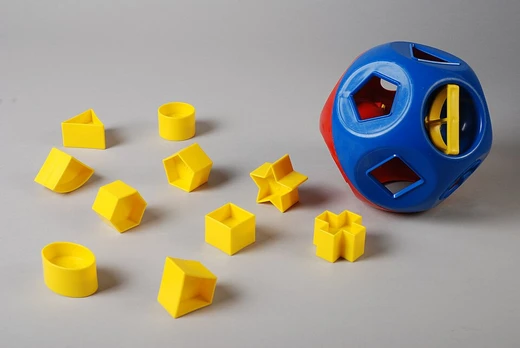
Solid geometry
Geometry of three-dimensional Euclidean space and solid figures.

Solid geometry, or stereometry, is the study of three-dimensional Euclidean space. It focuses on solid figures, which are portions of 3D space enclosed by a two-dimensional closed surface—for instance, a solid ball is made up of a sphere and everything inside it. The field involves measuring the volumes of various shapes, such as pyramids, prisms, cubes (and other polyhedrons), cylinders, cones (including truncated ones), and other solids formed by rotation.
The Pythagoreans worked with the regular solids, but the pyramid and cylinder were already studied by Egyptians, Babylonians, and pre-Platonic Greeks. Eudoxus later made important contributions to measuring these, showing that a pyramid and a cone each have one-third the volume of a prism and a cylinder, respectively, that share the same base and height. However, the rigorous proof for the cone's volume is more commonly attributed to Archimedes. Similarly, the first rigorous proof of the exact formula for a sphere’s volume (V = 4/3 πr³) is attributed to Archimedes, not Eudoxus.
Basic topics in solid geometry include measurements of volumes and surfaces, while advanced topics cover projective geometry in three dimensions (which can prove Desargues’ theorem by adding an extra dimension), further polyhedra, and descriptive geometry.
For a sphere, the term clearly refers to the surface of a ball, but for other solid figures—like a cylinder—it can be ambiguous whether the name means the surface or the enclosed volume.
Key techniques include analytic geometry and vector methods, which allow the systematic use of linear equations and matrix algebra—important for higher dimensions. A major application of solid geometry is in 3D computer graphics.
- field
- Geometry
- known_for
- Measurement of volumes of solids, including pyramids, prisms, cones, cylinders, and spheres
Lore & Background
The Pythagoreans dealt with the regular solids, but the pyramid and cylinder were already studied by Egyptians, Babylonians, and pre-Platonic Greeks. Eudoxus made important contributions to their measurement, showing that a pyramid and a cone have one-third the volume of a prism and cylinder on the same base and of the same height. However, the rigorous proof for the cone's volume is more commonly attributed to Archimedes. The first rigorous proof of the exact formula for a sphere’s volume (V = 4/3 πr³) is also attributed to Archimedes, not Eudoxus.
Reader's Guide
Solid geometry, or stereometry, provides the foundational framework for understanding and measuring three-dimensional objects. Its historical development, from the Pythagoreans through the Platonists and Eudoxus, established key volume relationships that remain central to mathematics. The field encompasses basic topics such as volumes of polyhedrons, cylinders, cones, and spheres, as well as advanced topics like projective geometry of three dimensions, further polyhedra, and descriptive geometry. Techniques from analytic geometry and vector methods, including linear equations and matrix algebra, have become essential for systematic work in solid geometry, particularly for higher dimensions. A major modern application of solid geometry is in 3D computer graphics, where the principles of volume, surface, and spatial relationships are directly applied.
Did You Know?
- Eudoxus proved that a pyramid has one-third the volume of a prism on the same base and of the same height.
- Eudoxus proved that a cone has one-third the volume of a cylinder on the same base and of the same height, though the rigorous proof is more commonly attributed to Archimedes.
- The first rigorous proof of the exact formula for a sphere’s volume (V = 4/3 πr³) is attributed to Archimedes, not Eudoxus.
- The pyramid and cylinder were studied by Egyptians, Babylonians, and pre-Platonic Greeks, not first by the Platonists.
The Grammar of Primitives and Boolean Logic
Constructive solid geometry builds three-dimensional form through a deceptively simple vocabulary. The foundational building blocks are geometric primitives—cuboids, cylinders, prisms, pyramids, spheres, and cones—each defined by a small set of numeric parameters. A sphere, for instance, needs only the coordinates of its center and a single radius value. The specific collection of primitives a modeler can draw from is bounded by whatever software package they are using; some suites permit operations on curved surfaces while others restrict the user to straight-edged forms. Once primitives are in hand, the modeler assembles them using Boolean set operations: union (OR), intersection (AND), and difference (NOT), supplemented by geometric transformations such as rotation or translation. The power of the approach lies in composition. By chaining these elementary operations, a designer can generate objects of remarkable visual complexity while starting from just a handful of basic shapes. This stands in deliberate contrast to other solid-modeling paradigms such as polygon mesh modeling, boundary representation, and box modeling, each of which encodes geometry in a fundamentally different way.
Engineering Precision and Game-World Construction
In practical engineering, CSG has become nearly universal. Virtually every major CAD package—AutoCAD, SolidWorks, CATIA, Fusion 360, PTC Creo, and many others—relies on the technique to represent tool cuts, mating features, and any situation where parts must fit together with mathematical exactness. A particularly valued property is the guarantee of solidity: if every primitive in the construction tree is water-tight, the final composite object is water-tight as well. This eliminates the consistency checks and extra topological bookkeeping that boundary-representation methods require to verify a valid solid. In the gaming world, CSG powers level design in engines as varied as Quake, Unreal, Valve's Hammer editor, and Torque. When the construction is procedural or parametric, a level designer can reshape an entire complex structure simply by nudging a primitive's position or swapping one Boolean operator for another. This editability, combined with the ability to produce intricate geometry from a small set of simple objects, makes CSG a favorite for both industrial design and interactive entertainment.
Ray Tracing Elegance and Point Classification
One of CSG's most mathematically elegant strengths emerges during rendering, particularly in ray tracing. Because a CSG object is defined entirely by its underlying primitives and the Boolean expression that binds them, a ray tracer can intersect a single ray with each primitive independently, collect the resulting intersection intervals along the one-dimensional ray line, apply the Boolean operator to those intervals, and simply select the nearest surviving point to the camera. No mesh traversal, no triangle lookup—just set arithmetic on intervals. The same structural clarity makes point-in-solid testing trivial. To determine whether an arbitrary point lies inside or outside a CSG shape, the evaluator tests the point against every primitive in the tree and then evaluates the Boolean expression. The answer is immediate and exact. This property is especially prized in ray tracing pipelines and in Monte Carlo transport codes such as Geant4, MCNP, and OpenMC, where particles must be classified as inside or outside complex geometries millions of times per simulation.
Inverse CSG: Reversing the Construction
While building a CSG tree from primitives is straightforward, the reverse problem—taking an existing polygonal mesh and discovering the minimal set of primitives and Boolean operations that reproduce its exact volume—is known as inverse CSG and is substantially harder. The search space is enormous because it blends continuous parameters (the dimensions and positions of candidate primitives) with discrete choices (which Boolean operators to apply and in what order). A valid solution must occupy the same three-dimensional volume as the input mesh while using as few nodes as possible, and simpler trees are preferred so that the resulting model remains easy for a human to edit. Several strategies have been developed. Deductive methods construct a collection of half-spaces that describe the interior of the geometry, then group those half-spaces into recognizable primitives. Another line of work separates primitive detection from tree synthesis, leveraging modern program-synthesis tools to find a minimally complex Boolean expression. A third family of approaches employs genetic algorithms, iteratively mutating an initial shape until it converges on the target mesh.
Frequently Asked Questions
What is Solid geometry?
Solid geometry, also called stereometry, is the branch of mathematics dedicated to understanding three-dimensional Euclidean space. It deals with solid figures—regions of space bounded by a closed two-dimensional surface—and their measurable properties.
What shapes does Solid geometry study?
The field covers a wide range of three-dimensional forms, including pyramids, prisms, cubes, cylinders, cones (both full and truncated), spheres, and other polyhedra or solids of revolution. Its central task is calculating the volume enclosed by each of these shapes.
Who first worked with Solid geometry?
Ancient Egyptians and Babylonians already explored the volumes of pyramids and cylinders long before the Greeks formalized the discipline. The Pythagorean school later contributed by investigating the five regular polyhedra.
How does Solid geometry differ from plane geometry?
While plane geometry is confined to two-dimensional figures like triangles and circles, Solid geometry extends the study into the third dimension. It asks questions about volume and spatial enclosure rather than just area and perimeter.
Why is Solid geometry important?
It provides the mathematical tools needed to measure and model real-world three-dimensional objects, from architectural structures to natural forms. Its volume formulas underpin engineering, physics, and countless practical applications.
More in Geometry And Shapes 1-24
Spotted an error? Know more?
This is a living reference — every entry is fact-audited, and reader corrections feed straight into our audit queue. Suggest an edit · See this site's audit record