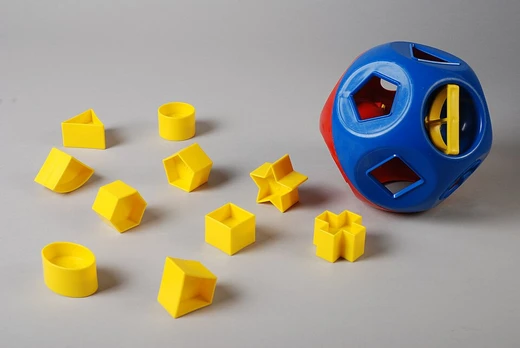
Three-dimensional space
Three coordinates define a point in space.

Three-dimensional space is a mathematical setting where locating any point requires three values, known as coordinates. It is also called 3-space or, less often, tri-dimensional space. In its most familiar form, this is the three-dimensional Euclidean space—the Euclidean space of dimension three—which serves as a model for the physical world. More general three-dimensional spaces are referred to as 3-manifolds. Colloquially, the term can also mean a specific three-dimensional region, a solid figure, or a subset of space.
Technically, a list of n numbers can be understood as the Cartesian coordinates of a location in an n-dimensional Euclidean space. The collection of all such n-tuples is usually written as ℝⁿ, and it can be identified with the combination of an n-dimensional Euclidean space and a Cartesian coordinate system. When n equals 3, this space is simply called three-dimensional Euclidean space (or just "Euclidean space" if the context is clear). In classical physics, it models the physical universe, where all known matter exists. Under relativity theory, it can be viewed as a local subspace of spacetime. Although this space remains the most common way to model everyday experience, it is only one example of a 3-manifold. In this classical example, the three values refer to measurements in different directions, and any three directions can be chosen as long as they do not all lie in the same plane. If those directions are pairwise perpendicular, the values are often labeled width (or breadth), height (or depth), and length.
The philosopher Aristotle recognized that there are three dimensions: a magnitude divisible in one way is a line, in two ways a surface, and in three ways a body. Beyond these, he argued, no other magnitude exists, because the three dimensions are all there are, and anything divisible in three directions is divisible in all. Books XI through XIII of Euclid's *Elements* cover three-dimensional geometry. Book XI develops ideas about perpendicularity, parallelism, and orthogonality of lines and planes, along with the construction and properties of angles and parallelepiped solids. Book XII deals with infinitesimals and the method of exhaustion for finding the area of a circle or the volume of a pyramid, cone, cylinder, or sphere. Book XIII describes how to construct the five regular Platonic solids—cube, octahedron, icosahedron, and
- field
- Geometry
- known_for
- Modeling physical space; basis of analytic geometry; foundation for differential geometry and vector analysis
Lore & Background
The philosopher Aristotle recognized the existence of three dimensions, stating that a magnitude divisible one way is a line, two ways a surface, and three ways a body. Books XI to XIII of Euclid's Elements dealt with three-dimensional geometry, covering perpendicularity, parallelism, solids, and the construction of the five regular Platonic solids. In the 17th century, three-dimensional space was described with Cartesian coordinates through analytic geometry developed by René Descartes, while Pierre de Fermat independently developed similar ideas. The polar coordinate system was earlier developed by Bonaventura Cavalieri and later formalized by Jakob Bernoulli and others.
Reader's Guide
Three-dimensional space is fundamental to classical physics, serving as the model of the physical universe. Its development spans from Aristotle's philosophical recognition through Euclid's geometric treatises to the analytic geometry of Descartes and Fermat. In the 18th century, Alexis Clairaut, Leonhard Euler, and Gaspard Monge advanced the study of curves, surfaces, and differential geometry. The 19th century saw William Rowan Hamilton's quaternions introduce the terms scalar and vector, with Josiah Willard Gibbs later formalizing the dot and cross products. Hermann Grassmann and Giuseppe Peano developed abstract vector spaces, and Arthur Cayley advanced matrix mathematics for n-dimensional geometry. The space is described by Cartesian, cylindrical, or spherical coordinates, and its geometric properties include lines, planes, spheres, and balls. It remains the most widely used way to model the experienced world, though it is only one example of a 3-manifold.
Did You Know?
- Aristotle stated that a magnitude divisible three ways is a body, and beyond three dimensions there is no other magnitude.
- Euclid's Elements Books XI–XIII cover three-dimensional geometry, including the construction of the five regular Platonic solids.
- William Rowan Hamilton coined the terms scalar and vector in his work on quaternions.
- Josiah Willard Gibbs introduced the modern notation for dot and cross products in his classroom teaching notes.
More in Geometry And Shapes 1-24
Spotted an error? Know more?
This is a living reference — every entry is fact-audited, and reader corrections feed straight into our audit queue. Suggest an edit · See this site's audit record