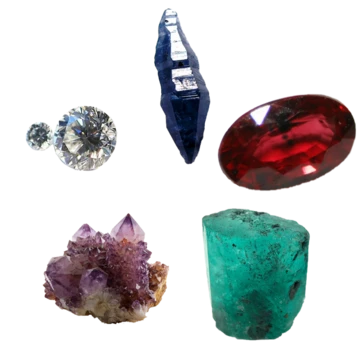
Tanzanite
A rare blue-violet gemstone found only in Tanzania.

Tanzanite is the blue and violet variety of the mineral zoisite, a calcium aluminium hydroxyl sorosilicate belonging to the epidote mineral group. Its distinctive coloration arises from trace amounts of vanadium. The gemstone is found exclusively in a very small mining area near the Mererani Hills, within the Simanjiro District of the Manyara Region in Tanzania. It is renowned for its exceptionally strong trichroism, meaning it displays different colors depending on the crystal orientation: blue, violet, and burgundy. The perceived color also shifts under different lighting; blue tones are more prominent under fluorescent light, while violet hues are more visible under incandescent illumination. In its natural, rough state, tanzanite appears reddish brown to clear, and it typically requires heat treatment to remove this brownish veil and reveal the sought-after blue and violet shades.
Geologically, tanzanite formed approximately 585 million years ago during the mid-Ediacaran period, resulting from massive plate tectonic activity and intense heat in the area that would later become Mount Kilimanjaro. The deposits are usually located in the hinge of isoclinal folds. The gemstone was introduced to the market in 1968 by Tiffany & Co., which renamed it "tanzanite" after its country of origin, deeming the scientific name "blue-violet zoisite" insufficiently consumer-friendly. In 2002, the American Gem Trade Association added tanzanite as a December birthstone, the first change to their official list since 1912. The Tanzanian government recognizes Jumanne Mhero Ngoma as the discoverer in January 1967, who later received a certificate of recognition and a financial reward from President Julius Nyerere. The mines were nationalized in 1971, and later divided into four blocks (A, B, C, and D). A 2003 ban on exporting unprocessed tanzanite aimed to spur local processing, and a 2010 law required mining companies to cede 50% ownership to the Tanzanian State Mining Company. Total reserves were estimated in a 2018 report, with Block C expected to have a life of mine lasting into the 2040s.
- field
- Gemology
- discovered
- 1967
- discoverer
- Jumanne Mhero Ngoma (recognized by Tanzanian government)
- location
- Simanjiro District, Manyara Region, Tanzania
- mineral_group
- Epidote group
- color_cause
- Vanadium
- known_for
- Trichroism, single-source gemstone
Lore & Background
Tanzanite is the blue and violet variety of the mineral zoisite, a calcium aluminium hydroxyl sorosilicate belonging to the epidote group. Its distinctive coloration arises from trace amounts of vanadium. The gemstone is renowned for its exceptionally strong trichroism, meaning it can appear blue, violet, or burgundy depending on the crystal’s orientation. It also shifts color under different lighting: blue tones are more pronounced under fluorescent light, while violet hues become visible under incandescent illumination. In its natural, rough state, tanzanite ranges from reddish brown to clear; heat treatment is standard to remove the brownish veil and reveal the sought-after blue-violet shades. The gem is found exclusively in a very small mining area near the Mererani Hills in the Simanjiro District of Tanzania’s Manyara Region. Geologically, it formed around 585 million years ago during the mid-Ediacaran period, created by intense plate tectonic activity and heat in what later became the Mount Kilimanjaro region. Deposits typically occur in the hinge of isoclinal folds. Discovered in 1967, the stone was named “tanzanite” by Tiffany & Co. to market it more appealingly than its scientific name, “blue-violet zoisite.” In 2002, the American Gem Trade Association added tanzanite as a December birthstone, the first change to their list since 1912.
Reader's Guide
Tanzanite’s significance derives from its single-source origin and its distinctive optical behavior. The gemstone exhibits strong trichroism, meaning it displays three different colors—blue, violet, and burgundy—depending on the angle at which the crystal is viewed. Its appearance also shifts with lighting: blue tones are more pronounced under fluorescent light, while violet hues become dominant under incandescent illumination. In its natural rough state, tanzanite is reddish brown to clear; nearly all gem-quality material is heat-treated to remove the brownish veil and reveal the desired blue-violet color. This treatment is standard and does not affect the stone’s value. The gem was discovered in 1967 in the Mererani Hills of Tanzania, within a very small mining area roughly 7 km long and 2 km wide. It was named by Tiffany & Co., who introduced it to the market in 1968, choosing “tanzanite” over the scientific name “blue-violet zoisite” for consumer appeal. In 2002, the American Gem Trade Association added tanzanite as a December birthstone, the first change to the official birthstone list since 1912. Geologically, tanzanite formed about 585 million years ago during the mid-Ediacaran period, resulting from plate tectonic activity and intense heat. The Tanzanian government regulates mining through a block system and has banned the export of unprocessed rough stones to encourage local cutting and processing. With estimated total reserves of 109 million carats, tanzanite remains a benchmark for rarity and color in the gem trade.
Did You Know?
- Tanzanite is only found in a mining area approximately 7 km long and 2 km wide near the Mererani Hills in Tanzania.
- The gemstone was named by Tiffany & Co. in 1968, as 'blue zoisite' was deemed not consumer-friendly.
Common Misconceptions (Editorial)
- Some believe tanzanite was discovered by Manuel de Souza, but the Tanzanian government recognized Jumanne Mhero Ngoma as the initial discoverer in January 1967. - It is often thought that tanzanite is a separate mineral; in fact, it is a blue and violet variety of the mineral zoisite, part of the epidote group.
Why It Matters (Editorial)
Tanzanite endures as a gemological marvel because it is found in only one tiny area on Earth—a 7 km by 2 km zone near the Mererani Hills—making it thousands of times rarer than diamonds. Its vivid trichroism, shifting from blue to violet depending on the angle, captivates collectors and jewelers alike, while its single-source origin ties its value and mystique directly to the landscape and history of Tanzania.
More in Gemstones 1-22
Spotted an error? Know more?
This is a living reference — every entry is fact-audited, and reader corrections feed straight into our audit queue. Suggest an edit · See this site's audit record