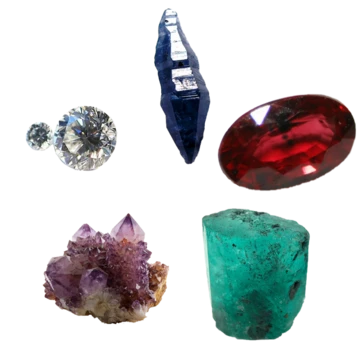
Sapphire
A precious gemstone variety of corundum, valued for hardness and color.

andreboeni · CC BY 2.0
Sapphire is a precious gemstone and a variety of the mineral corundum, composed primarily of aluminium oxide with trace amounts of elements such as iron, titanium, chromium, and others. Its name traces back through Latin and Greek to a Semitic origin, where it originally referred to lapis lazuli. While blue is the most iconic color, sapphire occurs in many hues; any color other than blue is termed "fancy sapphire," and stones displaying two or more colors are called "parti sapphires." Red corundum is classified as ruby, not sapphire, though pink corundum may be categorized as either depending on regional conventions. Sapphire ranks 9 on the Mohs scale of hardness, making it the third-hardest natural mineral after diamond and moissanite. This durability suits it for non-ornamental uses, including infrared optical components, durable windows, wristwatch crystals, movement bearings, and thin electronic wafers used as insulating substrates for integrated circuits and blue LEDs. Natural sapphires are cut and polished for jewelry, but they are also synthesized in laboratories for industrial and decorative purposes. Significant deposits exist in numerous countries, including Australia, Afghanistan, Cambodia, China, Ethiopia, India, Madagascar, Myanmar, Sri Lanka, Thailand, and the United States. Although often found near ruby deposits, sapphires typically form in different geological settings, such as granitic pegmatites rather than marble. Quality and price depend on color, clarity, cut, and treatment; untreated stones command higher values, and origin—particularly from Jammu and Kashmir—can greatly influence cost. For gems over one carat, buyers often require certification from respected laboratories like GIA or SSEF.
- known_for
- Precious gemstone variety of corundum, hardness 9 on Mohs scale (second-hardest natural mineral after diamond; natural moissanite is harder at 9.5 but extremely rare), used in jewelry and industrial a
Lore & Background
Sapphire is derived from the Latin word sapphirus, itself from the Greek sappheiros, which originally referred to lapis lazuli. Natural sapphires are cut and polished into gemstones and worn in jewelry, and they may also be created synthetically in laboratories for industrial or decorative purposes. Significant deposits are found in Australia, Afghanistan, Cambodia, Cameroon, China (Shandong), Colombia, Ethiopia, India (Jammu and Kashmir), Kenya, Laos, Madagascar, Malawi, Mozambique, Myanmar (Burma), Nigeria, Rwanda, Sri Lanka, Tanzania, Thailand, United States (Montana), and Vietnam. Every sapphire mine produces a wide range of quality, and origin is not a guarantee of quality; Jammu and Kashmir receives the highest premium, though Burma, Sri Lanka, and Madagascar also produce fine quality gems.
Reader's Guide
Sapphire's significance lies in its combination of hardness, color variety, and historical use as a gemstone. Blue sapphires are evaluated based on purity of blue hue, with violet and green as common secondary hues; the highest prices are paid for pure blue with vivid saturation. Fancy sapphires include yellow, orange, green, brown, purple, and violet, with padparadscha—a pink-orange variety—fetching the highest prices among non-blue sapphires. Star sapphires exhibit asterism due to needle-like inclusions of rutile, and are cut en cabochon. Color-change sapphires show different colors in different light. The cost of natural sapphires varies by color, clarity, size, cut, and overall quality; untreated stones are worth far more than treated ones, and geographical origin also impacts price. For gems of one carat or more, independent reports from laboratories such as GIA are often required. Non-ornamental uses include infrared optical components, high-durability windows, wristwatch crystals, and electronic wafers for integrated circuits and GaN-based blue LEDs.
Did You Know?
- Sapphire is the second-hardest natural mineral after diamond, with a hardness of 9 on the Mohs scale; natural moissanite ranks above corundum at 9.5, but it is extremely rare in nature and typically synthetic.
- The name sapphire originally referred to lapis lazuli, derived from the Greek word sappheiros.
Identity & Classification
Sapphire occupies a distinctive position in the mineral world as a color variety of the species corundum. The red variety of this same species is designated as ruby, while every other hue of corundum is classified as sapphire. Chemically, both are composed of aluminium oxide (Al2O3), making them siblings separated only by color. In the traditional Western classification inherited from ancient Greek thought, sapphire sits alongside diamond, emerald, and ruby as one of the four precious stones—a grouping that reflects their historical rarity, their translucency, their fine color in purest form, and their exceptional hardness scoring between 8 and 10 on the Mohs scale. The term "hardstone" appears in art history and archaeology as an older label for what we now call semi-precious gems, though sapphire itself has never been demoted from its precious standing. The distinction between precious and semi-precious, while rooted in antiquity, does not always align with modern market values, as some semi-precious stones can far exceed a mid-quality emerald in price.
Grading & the Quest for Value
Unlike diamonds, which benefit from the Gemological Institute of America's standardized system introduced in the early 1950s—complete with the revolutionary use of 10x magnification for clarity assessment—sapphires and other colored gemstones still rely primarily on naked-eye evaluation by trained gemologists. The familiar "four Cs" (color, cut, clarity, carats) apply with modification, but their relative weights shift dramatically. For a colorless diamond, cut reigns supreme, followed by clarity and then color. For sapphire, the hierarchy inverts: the purity and beauty of its color become the primary determinant of quality, with clarity taking a secondary role. A recognized grading scale called "water" further refines assessment, with "first water" denoting the highest transparency and brilliance, while "second" or "third water" indicates lesser clarity. Inclusions, color zoning, and optical phenomena such as asteria (star effects) all factor into the final valuation, making each sapphire a unique negotiation between measurable properties and subjective beauty.
Physical & Optical Character
A sapphire's identity as a gem is written in its physical and optical properties. Gemologists characterize it through a constellation of measurable traits: hue, tone, and saturation define its color; luster, refractive index, and birefringence describe how it interacts with light; dispersion, specific gravity, hardness, cleavage, and fracture complete the physical profile. Sapphires may exhibit pleochroism, meaning they appear in different colors when viewed from different angles, and they can display double refraction. Some specimens show luminescence under certain conditions, and each stone possesses a distinctive absorption spectrum that serves as a kind of optical fingerprint. The crystal habit—the natural form in which the mineral is found—also varies from specimen to specimen. Because sapphires score high on the Mohs scale, they resist scratching and retain polish far better than softer minerals, which is precisely why brittle, low-hardness stones like brazilianite are rarely set in jewelry despite their attractive color and luster.
Cultural Legacy & Market Forces
The classification of sapphire as "precious" is not a fixed scientific truth but a cultural inheritance stretching back to ancient Greek gemological thinking, where rarity and desirability determined a stone's rank. This framework has shifted over the centuries: amethyst was once a cardinal precious gem until bulk deposits were discovered in Brazil in the 19th century, and stones like aquamarine, peridot, and cat's eye have been elevated to precious status in various eras based on their popularity. Today, the commercial gemstone trade largely abandons the precious-versus-semi-precious binary, recognizing that market value depends on far more than a stone's historical label. The broader colored-gemstone industry—of which sapphire is a cornerstone—was valued at approximately US$1.55 billion in 2023 and is projected to climb to $4.46 billion by 2033. The people who shape this world carry specialized titles: the gemologist who identifies and grades stones, the lapidarist or gemcutter who fashions them, and the diamantaire who works exclusively in diamonds.
Common Misconceptions (Editorial)
Some people believe that sapphire is the hardest natural mineral, second only to diamond, but natural moissanite is harder than corundum at 9.5 on the Mohs scale, though it is extremely rare in nature and typically synthetic. Additionally, many assume the name sapphire has always referred to the blue corundum gemstone, but the word originally came from the Greek *sappheiros*, which referred to lapis lazuli.
Why It Matters (Editorial)
Sapphire endures not only as a prized gemstone in jewelry, celebrated for its hardness and range of colors, but also as a critical industrial material in infrared optics, durable windows, and electronic wafers. Its scientific and practical value, combined with its deep historical and cultural resonance, ensures sapphire remains relevant far beyond ornamentation.
Gallery






More in Gemstones 1-22
Spotted an error? Know more?
This is a living reference — every entry is fact-audited, and reader corrections feed straight into our audit queue. Suggest an edit · See this site's audit record