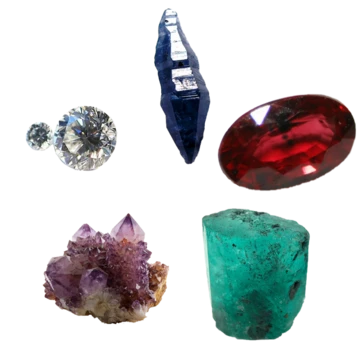
Lapis lazuli
Deep-blue stone prized since antiquity for color and pigment.

Lapis lazuli is a deep-blue metamorphic rock composed primarily of lazurite, along with pyrite, diopside, and calcite. Its intense blue color results from the presence of trisulfur radical anions within the crystal structure, with disulfur and tetrasulfur radicals capable of shifting the hue toward yellow or red. The stone takes its name from the Persian word *lāžward*, which also serves as the root for words meaning "blue" in several languages, including Spanish and Portuguese *azul* and English *azure*. Mined as early as the 7th millennium BC in the Sar-i Sang mines and other deposits in Badakhshan province in modern northeast Afghanistan, lapis lazuli was traded extensively. Artifacts dated to 7570 BC have been found at Bhirrana, the oldest site of the Indus Valley Civilisation, and beads have been discovered in Neolithic burials at Mehrgarh, the Caucasus, and as far as Mauritania. The stone was highly valued by the Indus Valley Civilisation and was used in the funeral mask of Tutankhamun. By the end of the Middle Ages, Europe imported lapis to grind into ultramarine pigment, which was used by Renaissance and Baroque artists such as Masaccio, Perugino, Titian, and Vermeer, often reserved for the clothing of central figures like the Virgin Mary. Ultramarine has also been found in the dental tartar of medieval nuns and scribes, likely from licking brushes while producing manuscripts. Major sources continue to include Afghanistan, mines west of Lake Baikal in Russia, and the Andes in Chile, with smaller amounts from Pakistan, Italy, Mongolia, the United States, and Canada.
- composition
- Lazurite, pyrite, diopside, calcite
- earliest mining
- 7th millennium BC
- major source
- Badakhshan province, northeast Afghanistan
- also found in
- Russia, Chile, Pakistan, Italy, Mongolia, United States, Canada
- primary use
- Jewelry, carvings, pigment (ultramarine)
Lore & Background
Lapis lazuli has been mined in the Sar-i Sang mines and other sites in Badakhshan, Afghanistan, since the 7th millennium BC. It was highly valued by that civilization and traded widely, with beads found in Neolithic burials in Mehrgarh, the Caucasus, and as far as Mauritania. By the end of the Middle Ages, Europe imported lapis to grind into ultramarine pigment, used by artists such as Masaccio, Perugino, Titian, and Vermeer, often for the clothing of central figures, especially the Virgin Mary. Ultramarine has also been found in dental tartar of medieval nuns and scribes, possibly from licking brushes while producing manuscripts. The Persian name lāžward is the root for words meaning 'blue' in several languages, including Spanish azul and English azure. The stone was also used in ancient Egypt, Persia, and by the Mycenaeans, and was often called 'sapphire' in classical and medieval times.
Reader's Guide
Lapis lazuli holds significance as one of the earliest traded gemstones, with mining and use spanning over 8,000 years. Its intense blue color, due to trisulfur radical anions, made it a symbol of royalty and divinity in ancient Egypt, Mesopotamia, and the Indus Valley. The stone's transformation into ultramarine pigment linked it to some of the most celebrated artworks of the Renaissance and Baroque, where it was reserved for the most sacred figures. Its name influenced the vocabulary of color across multiple languages. Modern sources include Afghanistan, Russia, and Chile, and synthetic versions have largely replaced it in paint. The stone continues to be used in jewelry and carvings, and its historical role in trade, art, and language underscores its enduring legacy.
Did You Know?
- The name 'lapis lazuli' originates from the Persian word lāžward, which is the root for 'blue' in Spanish (azul) and English (azure).
- Ultramarine pigment from lapis was found in the dental tartar of medieval nuns and scribes, possibly from licking paintbrushes.
- The intense blue color of lapis lazuli is due to the trisulfur radical anion (S•−3) in the crystal.
Common Misconceptions (Editorial)
- Some people mistakenly believe lapis lazuli is a mineral, but it is actually a metamorphic rock composed of several minerals, including lazurite, pyrite, diopside, and calcite. - It is often assumed that the name "azure" comes from a different source, but both "azure" and Spanish "azul" derive from the Persian word *lāžward*, the same root as "lapis lazuli." - A common misconception is that ultramarine pigment was only used by famous male artists; in fact, it has been found in the dental tartar of medieval nuns and scribes, indicating they also used the pigment, likely while illuminating manuscripts.
Why It Matters (Editorial)
Lapis lazuli endures not just as a beautiful gem but as a bridge connecting human creativity across millennia, from Neolithic traders in Central Asia to Renaissance painters depicting the Virgin Mary. Its transformation from a rock into ultramarine—a pigment so precious it was reserved for the most sacred subjects—reminds us that the materials we value often carry the weight of history, trade, and cultural aspiration.
More in Gemstones 1-22
Spotted an error? Know more?
This is a living reference — every entry is fact-audited, and reader corrections feed straight into our audit queue. Suggest an edit · See this site's audit record