Cranberry
Last updated
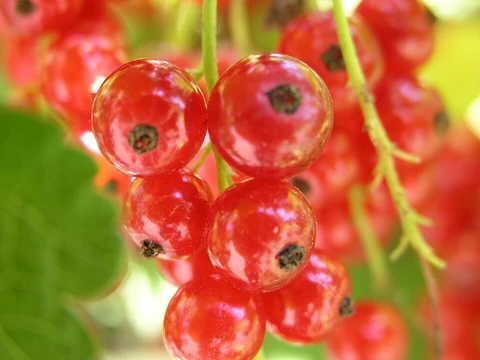
The fruit is a berry that is initially light green, turning red when ripe, and has an acidic taste that usually overwhelms its sweetness.[1] Creeping cranberry shrubs have slender, wiry stems and small evergreen leaves, reaching lengths of up to 2 m and heights of 5 to 20 cm.[2]
Scientific classification
- CladeTracheophytes
- CladeAngiosperms
- CladeEudicots
- CladeAsterids
- OrderEricales
- FamilyEricaceae
- GenusVaccinium
- SubgenusVaccinium subg. Oxycoccus
Named by (Hill) A.Gray
Sources: Wikipedia taxobox: Cranberry (CC BY-SA 4.0)
Quick Facts
- Number of species
- 4–5
Facts from the source article.
Biology and range
Cranberries are small semi-evergreen vines that prefer to grow in sandy bogs.[3] The name cranberry derives from the Middle Low German kraanbere, first named as cranberry in English by missionary John Eliot in 1647.[4] The dark pink flowers of cranberries have petals that are distinctly reflexed, which fully exposes the forward-pointing style and stamens.[1] Pollination of cranberry flowers is carried out by bees.[1]
Unlike cranberries, these related species produce bell-shaped flowers with non-reflexed petals and grow as taller shrubs with woodier stems.[5] Within the subgenus, cranberries are divided into 4–5 species.[5] Some taxonomic systems treat Oxycoccus as a distinct genus rather than a subgenus.[6] The plant Vaccinium oxycoccos was traditionally called fenberry in England, a name derived from its growth in English fen lands.[4]
Cultivation of V. macrocarpon occurs across the northern United States, Canada, and Chile.[7]
What the specialist sources record
The Memorial Sloan Kettering Cancer Center notes that cranberry juice or extracts may be helpful for urinary tract infections in limited populations, but there is not enough evidence to recommend it for UTI prevention.[8] The same source states that in patients prone to kidney stones, regular use of cranberry should be avoided as it contains oxalates.[8] The Cranberry Story from the Pinelands National Reserve records that in New Jersey, cranberry farming began in 1835 in a bog near Burrs' Mills in Burlington County.[9] The South Dakota State University Extension notes that early settlers originally called them craneberries because the reflexed petals made the flower look like the head of a sandhill crane.[3]
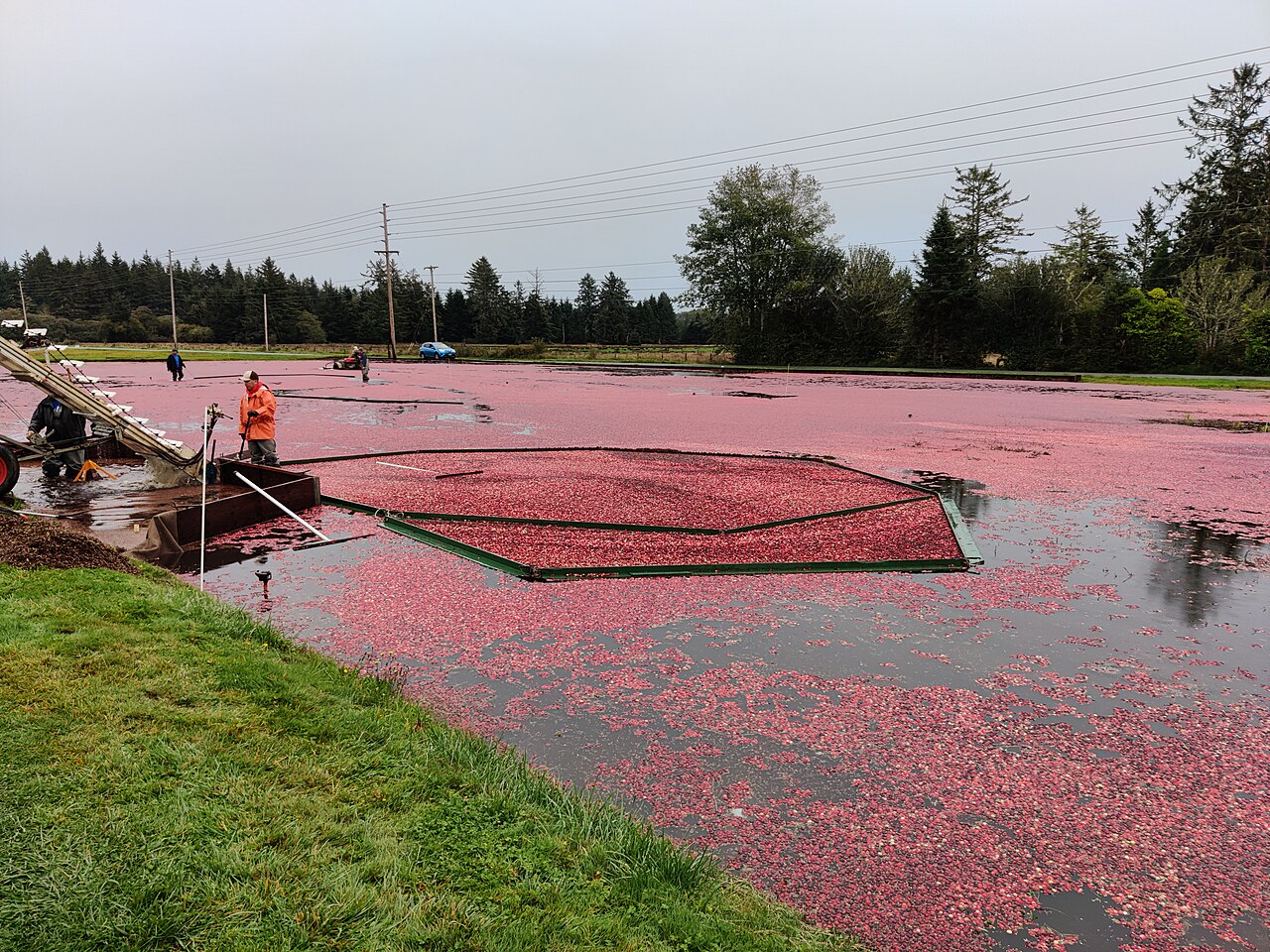
The Memorial Sloan Kettering Cancer Center adds that cranberry juice increases the risk of uric acid stone formation because of its acidifying effect.[8] According to the Economic Research Service of the U.S. Department of Agriculture, the cranberry harvest in the U.S. typically occurs from about mid-September through the end of October.[10] The same Economic Research Service report indicates that in 2020, Wisconsin produced approximately 59% of the U.S. cranberry crop, making it the leading producer.[10]
References
- Wikipedia, "Cranberry" (CC BY-SA 4.0), which cites: Keith, "Cranberries: A colorful and nutritious fruit", South Dakota State University Extension (we also read that source) en.wikipedia.org
- Wikipedia, "Cranberry" (CC BY-SA 4.0), which cites: "About Cranberries", Cranberry Institute (original not read by us) en.wikipedia.org
- Keith, "Cranberries: A colorful and nutritious fruit", South Dakota State University Extension. extension.sdstate.edu
- Wikipedia, "Cranberry" (CC BY-SA 4.0), which cites: "American Cranberry (Vaccinium macrocarpon): FAQ", Research Guides, University of Wisconsin Libraries, Madison, WI, 2017; "Cranberry", Online Etymology Dictionary, Douglas Harper, 2017; "Cranberries: The Most Intriguing Native North American Fruit", Apsnet Feature Articles, 2000; "Cranberry", Online Etymology Dictionary, Douglas Harper, 2017 (original not read by us) en.wikipedia.org
- Wikipedia, "Cranberry" (CC BY-SA 4.0), which cites: "Encyclopaedia Britannica: Cranberry", 23 October 2023 (original not read by us) en.wikipedia.org
- Wikipedia, "Cranberry" (CC BY-SA 4.0), which cites: Steven Clemants, "Vaccinium oxycoccos: Small Cranberry, Technical Page", Brooklyn Botanic Garden (original not read by us) en.wikipedia.org
- Wikipedia, "Cranberry" (CC BY-SA 4.0), which cites: Stace, "New Flora of the British Isles", Cambridge University Press, 2010, p. 512; ; "How Cranberries Grow: "Cranberries 101" – An Introduction", Cape Cod Cranberry Growers' Association, 2014 (we also read that source) en.wikipedia.org
- "Cranberry", Gerstner Sloan Kettering Graduate School of Biomedical Sciences, Memorial Sloan Kettering Cancer Center, 2016. mskcc.org
- "The Cranberry Story", Pinelands National Reserve. nj.gov
- "Cranberry production in top-producing States to increase modestly in 2021", Economic Research Service, US Department of Agriculture, 24 November 2021. ers.usda.gov
Each numbered sentence above was checked against the source it cites before publication. Sentences citing Wikipedia adapt text from the English Wikipedia article Cranberry (contributors), used under CC BY-SA 4.0; this entry is available under the same licence. Other sources were used for facts only.
Also in the Codexery
More in Fruit Trees & Berries
Sources
Compiled from Wikipedia and the sources listed below. Text from Wikipedia is available under CC BY-SA 4.0; this entry is adapted from it.
- Wikipedia: Cranberry (CC BY-SA 4.0).
- Word definitions: the Codexery glossary, each quoted from its Wikipedia article.
Spotted an error? Know more?
Reader corrections go straight into our review queue. Suggest an edit · How this site is sourced