Blackberry
Edible aggregate fruit from the genus Rubus, widely cultivated and naturalized.
Last updated
The blackberry is a fruit from many species in the Rubus genus (part of the rose family), including hybrids within the Rubus subgenus and crosses between the Rubus and Idaeobatus subgenera. Its classification has long been messy because the plants hybridize easily and reproduce through apomixis, so species are often lumped into groups called aggregates.
Description
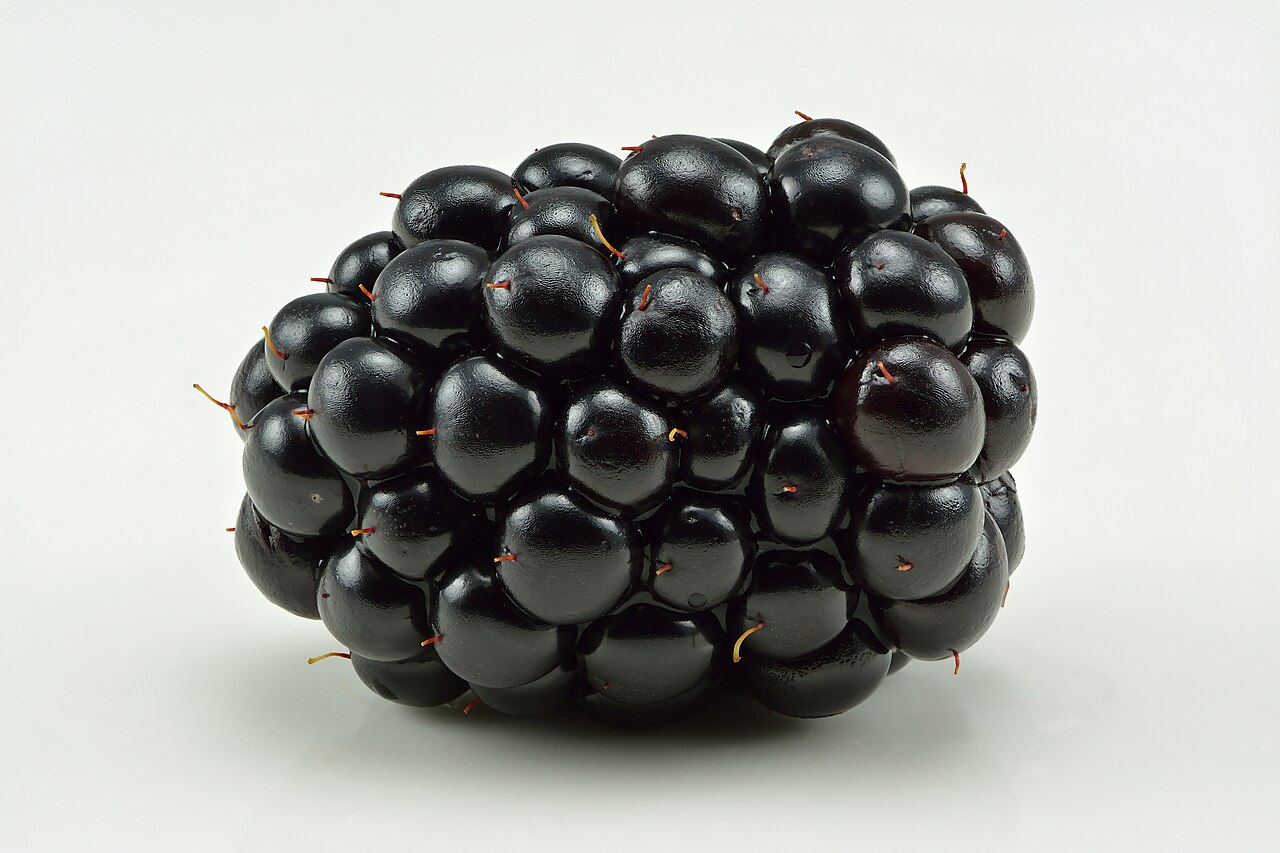
Typical commercial yields range from 5,000 to 10,000 pounds per acre, making blackberries a viable crop for many growers. Botanically, the fruit isn't a true berry; it's an aggregate fruit made of tiny drupelets. The key difference from raspberries is that when you pick a blackberry, the torus (the stem-like receptacle) stays attached to the fruit, whereas a raspberry leaves its torus behind on the vine.
Plants
The plant itself is a perennial that grows biennial stems, or canes, from its roots. In the first year, a primocane shoots up to about 3–6 meters long, trailing along the ground with large, palmate leaves (5–7 leaflets) and no flowers. In the second year, that cane becomes a floricane, which doesn't grow taller but sends out lateral buds that bloom.
Both first- and second-year canes bear short, sharp thorns, though thornless varieties were developed as early as the 1920s–1950s, with cultivars like 'Thornless Evergreen' and 'Boysenberry' leading the way. If left alone, the plants form dense, tangled thickets, but trellises can keep them in check in gardens or farms. Blackberries tolerate poor soil and spread easily in wasteland, ditches, and along roadsides.
Flowers appear in late spring and early summer at the branch tips, each about 2–3 cm across with five white-to-pink petals. Each drupelet forms from an ovule fertilized by a male gamete; undeveloped ovules usually mean not enough pollinators visited. Raspberry bushy dwarf virus can cause incomplete drupelet development and crumbly fruit, though it sometimes shows no symptoms.

Genetics
Genetically, the trait for primocane fruiting maps to the F Locus on LG7, while thornlessness maps to LG4. Understanding this helps with genetic screening of crossbreeds and engineering for desirable traits.
Ecology
Ecologically, blackberry leaves feed certain caterpillars and are also a favorite of deer and other grazing mammals. The concealer moth Alabonia geoffrella has caterpillars that live inside dead blackberry shoots.
Scientific classification
- CladeTracheophytes
- CladeAngiosperms
- CladeEudicots
- CladeRosids
- OrderRosales
- FamilyRosaceae
- GenusRubus
Sources: Wikipedia taxobox: Blackberry (CC BY-SA 4.0)
Quick Facts
- Field
- Botany, Horticulture
- Known for
- Edible aggregate fruit
- commercial cultivation
- invasive species in some regions
- Native range
- Europe, northwestern Africa, temperate western and central Asia, North America
- Leading producer
- Mexico (worldwide)
- Oregon
- US (commercial blackberry producer)
- Species count
- Over 375 species
Facts from the source article.
Lore & Background
Blackberries are perennial plants with biennial stems called canes. In the first year, a primocane grows 3–6 meters trailing on the ground, bearing large palmate leaves but no flowers. In the second year, the cane becomes a floricane, with lateral buds opening to produce flowering laterals.
First- and second-year shoots bear short, curved, sharp thorns, though thornless cultivars have been developed since the 1920s–1950s, with examples like 'Thornless Evergreen' and 'Boysenberry' predating the 21st century. Unmanaged plants form dense tangles, but can be controlled with trellises. The flowers bloom in late spring and early summer, each 2–3 cm in diameter with five white-pink petals.
Botanical Identity and Taxonomic Tangle
The blackberry occupies a fascinating and often muddled position in botanical classification. Belonging to the genus Rubus within the rose family, it encompasses over 375 species spread across Europe, northwestern Africa, temperate Asia, and both Americas. Yet the very ease with which these species cross-pollinate and produce hybrids—both within the subgenus Rubus and between it and Idaeobatus—has made clean species boundaries nearly impossible to maintain. Historically, taxonomists have resorted to grouping related forms into species aggregates rather than forcing artificial distinctions.
Even the fruit itself defies its common name: botanically, a blackberry is not a berry at all but an aggregate of tiny drupelets clustered around a central receptacle. This structural detail also separates it from its raspberry cousins. When you pick a raspberry, the hollow core remains because the receptacle stays on the vine; a blackberry, by contrast, carries that receptacle with it, leaving no hollow center. The result is a fruit whose identity is as layered and hybrid as the plant that produces it.

Two-Year Cane Architecture and Flowering
Blackberry plants follow a striking two-year reproductive rhythm that shapes every aspect of their cultivation. As perennials, they send up new stems—called primocanes—from their root system each spring. In that first year, the primocane grows vigorously, trailing along the ground to a length of three to six metres while bearing large, palmate compound leaves of five to seven leaflets, yet it produces no flowers whatsoever. The following year, that same cane transforms into a floricane: growth stops, and lateral buds burst open into flowering branches.
Both first- and second-year shoots carry short, sharply curved thorns, though breeders in the early 21st century finally developed reliable thornless cultivars. Left unmanaged, the canes tangle into dense, impenetrable thickets that gardeners must corral with trellises. Flowers appear in late spring and early summer at branch tips, each roughly two to three centimetres across with five pale white-pink petals. Behind the scenes, genetics researchers have mapped the F Locus on linkage group 7 as controlling primocane fruiting, while thorn presence or absence is governed by a locus on linkage group 4—knowledge that now accelerates the selection of desirable traits in new crosses.
Ecological Ambivalence: Beloved and Invasive
The blackberry occupies a paradoxical place in the natural world, simultaneously cherished and combated. Across much of Europe, wild blackberry thickets are an integral part of the landscape, and picking their fruit remains a beloved seasonal pastime. Ecologically, the plants support a web of life: their leaves feed caterpillars and are relished by deer, while the concealer moth Alabonia geoffrella has been found developing inside dead blackberry shoots. Once ripe, the berries travel through the digestive tracts of red foxes, American black bears, Eurasian badgers, and small birds, which disperse the seeds to new locations.
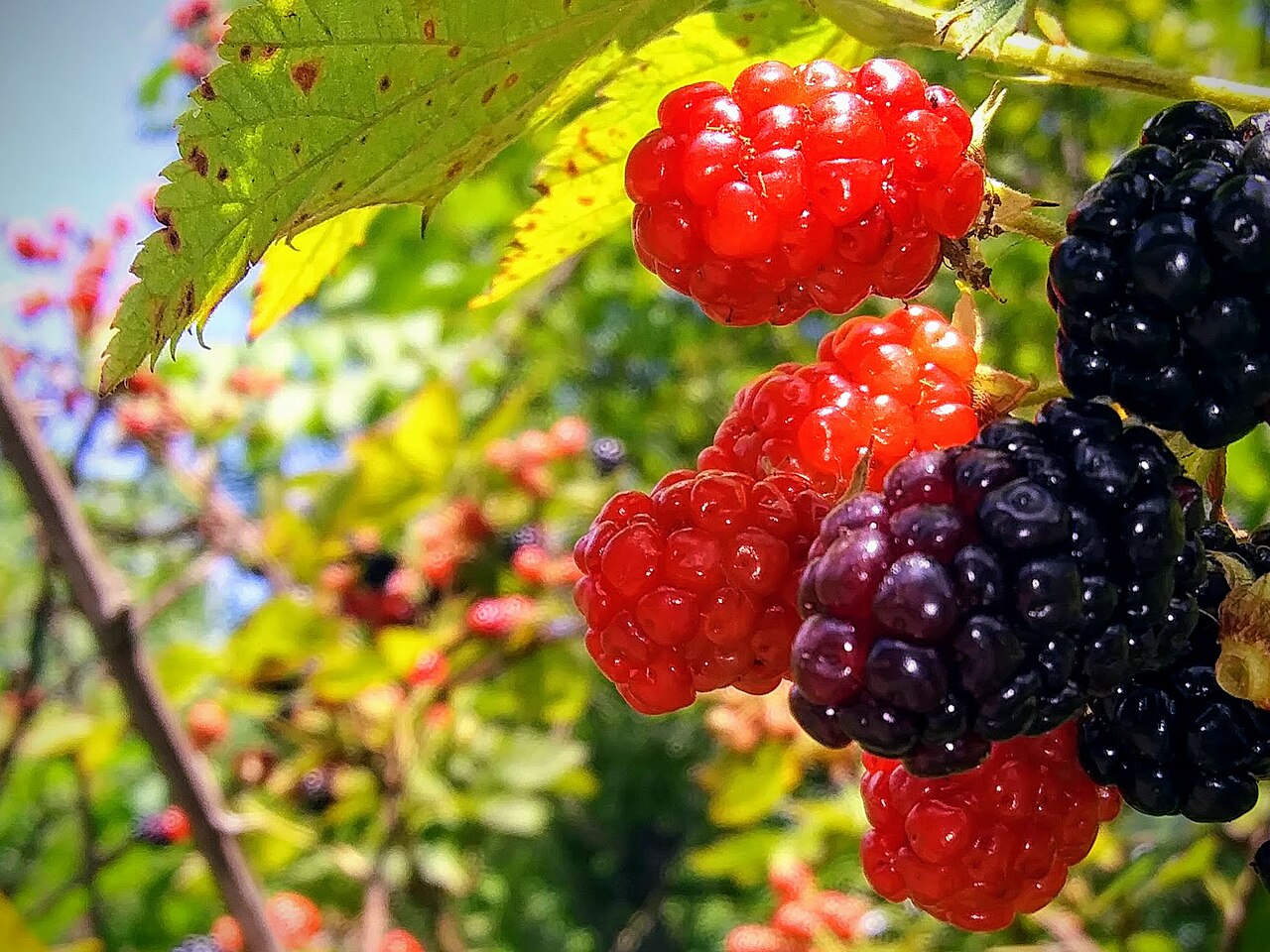
Yet that same vigorous growth habit—sending down roots from any cane that touches soil and pushing up suckers from established roots—makes unmanaged blackberries a persistent weed. In the Pacific Northwest of Canada and the United States, Rubus armeniacus, the Himalayan blackberry, has become a noxious invasive species choking urban parks and woodlands. Similar problems arise in Australia, Chile, and New Zealand, where both the Himalayan and evergreen blackberry (Rubus laciniatus) have naturalized and spread aggressively. An old folk expression captures the fruit's deceptive ripening: blackberries are red when they're green.
From Loganberry to Machine Harvest: A Breeding Story
The commercial blackberry industry owes much of its shape to a century and a half of deliberate crossbreeding, much of it in the United States. In 1880, Judge James Harvey Logan in Santa Cruz, California, created the loganberry, a blackberry-raspberry hybrid that opened the door to multi-species cultivars. The first thornless variety appeared in 1921, but its berries sacrificed much of their flavor, stalling progress for decades. The breakthrough came in the 1990s and early 2000s, when the US Department of Agriculture released cultivars such as Triple Crown, Black Diamond, Black Pearl, and the marionberry Nightfall—varieties bred for machine-harvesting efficiency, larger and firmer fruit, higher yields, and improved taste.
Today, Mexico leads global production, shipping nearly its entire crop to fill off-season fresh markets in North America and Europe, a market long dominated by the EMBRAPA-bred cultivar Tupy until 2018. In the United States, Oregon stands as the top commercial producer, yielding roughly 19.3 million kilograms across 2,500 hectares in 2017. Because the many Rubus species hybridize so readily, most modern cultivars carry the genetic legacy of more than one parent species, making each berry a small monument to accumulated breeding decisions.
Reader's Guide
The blackberry holds significance as a commercially important fruit crop, with Mexico leading global production and Oregon as the top US producer. Its vigorous growth and ability to tolerate poor soils make it both valuable for cultivation and problematic as an invasive species, particularly Rubus armeniacus in the Pacific Northwest. Modern hybridization, primarily in the United States, has produced numerous cultivars with improved traits such as thornlessness, higher yields, and larger fruit.
The development of primocane-fruiting and erect varieties has expanded growing options. The blackberry's ecological role includes providing food for caterpillars, deer, and mammals like red foxes and black bears, which disperse its seeds. Its legacy includes the loganberry, a hybrid with raspberry developed in 1880, and ongoing breeding programs at institutions like Oregon State University and the University of Arkansas.
Frequently Asked Questions
What is a blackberry?
A blackberry is an edible aggregate fruit produced by more than 375 species within the Rubus genus, a member of the rose family. Its native range spans Europe, northwestern Africa, temperate western and central Asia, and both North and South America.
Where are blackberries commercially grown and how much do they yield?
Mexico is the leading blackberry producer worldwide, while Oregon tops U.S. commercial output. A single well-managed acre can generate up to 20,000 pounds of fruit in a single season, which drives much of the crop's commercial appeal.
Are blackberries a problem in the wild?
In several regions outside their native range, blackberry species have become naturalized and are listed as invasive. Their vigorous cane growth and prolific hybridization let them spread aggressively through disturbed habitats.
More in Fruit Trees & Berries
Sources
Compiled from Wikipedia and the sources listed below. Text from Wikipedia is available under CC BY-SA 4.0; this entry is adapted from it.
- Wikipedia: Blackberry (CC BY-SA 4.0).
- Word definitions: the Codexery glossary, each quoted from its Wikipedia article.
Spotted an error? Know more?
Reader corrections go straight into our review queue. Suggest an edit · How this site is sourced