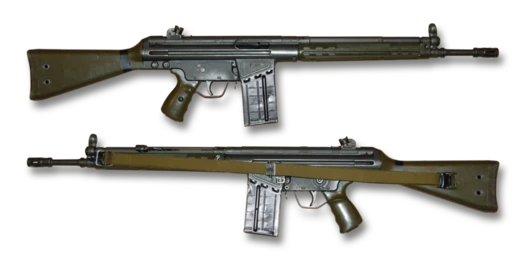
SIG MP41
Swiss submachine gun candidate passed over in 1941 trials.
Last updated
The SIG MP-41 Neuhausen Submachine Gun is a Swiss firearm designed by Schweizerische Industrie Gesellschaft in 1941. It was one of the candidates considered for the Swiss Army during World War II but was not selected. Only about 200 samples were ever produced, making it a rare weapon.
History
In May 1940, the Kriegs Technisch Amt conducted an ordnance survey of the Swiss Army, which revealed fewer than 500 submachine guns were available. To address this, the army commissioned SIG and W+F Bern to develop new prototypes. SIG created the MP-41 as an evolution of its earlier MKMO platform, retaining the swiveling magazine housing that folded into the fore-end. A prototype without this feature was also made.
In 1941, SIG submitted 50 units for trials, competing against the Furrer MP41/44 from W+F. Colonel Adolf Furrer's influence derailed the selection process, leading the army to adopt the Furrer design. SIG attempted to market the MP-41 abroad but was blocked by Swiss neutrality laws. Only 200 units were built before the project was abandoned.
Did You Know?
- The MP-41 was made of forged steel, which made it heavy to carry and handle.
- SIG had previously produced the MK33 and MK37 submachine guns in the 1930s.
Frequently Asked Questions
Who made SIG MP41?
SIG MP41 was made by Schweizerische Industrie Gesellschaft (SIG, modern SIG Sauer).
Where was SIG MP41 developed?
SIG MP41 was developed in Switzerland.
More in FN, Heckler & Koch, SIG and Mauser Firearms
Sources
Compiled from Wikipedia and the sources listed below. Text from Wikipedia is available under CC BY-SA 4.0; this entry is adapted from it.
- Wikipedia: SIG MP41 (CC BY-SA 4.0).
- Word definitions: the Codexery glossary, each quoted from its Wikipedia article.
Spotted an error? Know more?
Reader corrections go straight into our review queue. Suggest an edit · How this site is sourced