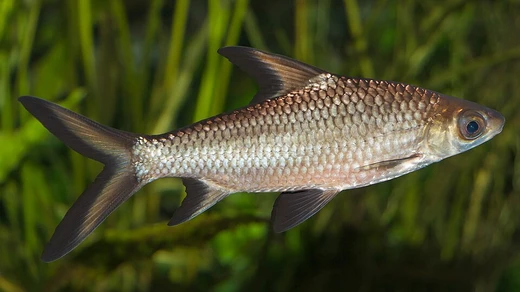
Cypriniformes
Order of ray-finned fish including carps, minnows, and loaches.

Cypriniformes is an order of ray-finned fish belonging to the superorder Ostariophysi, which also includes cyprinids and other ostariophysin fishes. This order contains between 11 and 12 families (though some authorities list up to 23), over 400 genera, and more than 4,250 named species, with new species and genera regularly described. Its members include barbs, loaches, botias, carps, danionins, and minnows. Cyprinids are most diverse in South and Southeast Asia and are completely absent from Australia and South America. The longest-lived documented cypriniform is a bigmouth buffalo that reached 112 years old. Their closest living relatives are Characiformes (characins and tetras), Gymnotiformes (electric eels and American knifefishes), and Siluriformes (catfishes).
Like other Ostariophysi, cypriniforms have a Weberian apparatus. They differ from most relatives by having only a dorsal fin on their backs, lacking the small, fleshy adipose fin found behind the dorsal fin in many other Ostariophysi. They also have a unique kinethmoid bone in the snout and lack teeth in the mouth, instead possessing pharyngeal teeth in the throat. These teeth grind against a chewing pad on the base of the skull, not an upper pharyngeal jaw as in cichlids.
The most notable family is Cyprinidae (carps and minnows), which accounts for two-thirds of the order's diversity. It is one of the largest fish families, widely distributed across Eurasia, North America, and Africa. Most species live strictly in freshwater, but some, like roach and bream, inhabit brackish water. At least one species, the Pacific redfin (*Pseudaspius brandtii*), lives in saltwater. Brackish and marine cyprinids are invariably anadromous, swimming upstream to spawn. The family Psilorhynchidae, sometimes separated, appears to be specially adapted cyprinids. Balitoridae and Gyrinocheilidae are mountain-stream fishes that feed on algae and small invertebrates, found only in tropical and subtropical Asia; Balitoridae is speciose, while Gyrinocheilidae contains only a few species. Suckers (Catostomidae) are large fishes found in temperate North America and eastern Asia, similar to carps in appearance and ecology. Cobitidae is common across Eurasia and parts of North Africa; these midsized fishes resemble catfish in appearance and behavior, feeding from the substrate and using barbels to find food at night or in murky water. Fishes in Cobitidae, Balitoridae, Botiidae, and Gyrinocheilidae are called loaches, though Gyrinocheilidae is not part of the "true" loach lineage and is related to suckers.
Historically, Cypriniformes included all Ostariophysi except catfish, making the group paraphyletic. Recently, Gonorhynchiformes, Characiformes, and Gymnotiformes have been separated into their own monophyletic orders. The families are traditionally divided into two suborders. Superfamily Cyprinioidea contains carps and minnows (Cyprinidae) and mountain carps (Psilorhynchidae). In 2012, Maurice Kottelat revised superfamily Cobitoidei to include hillstream loaches (Balitoridae), Barbuccidae, Botiidae, suckers (Catostomidae), true loaches (Cobitidae), Ellopostomatidae, Gastromyzontidae, sucking loaches (Gyrinocheilidae), stone loaches (Nemacheilidae), Serpenticobitidae, and long-finned loaches (Vaillantellidae). Catostomoidea is usually treated as a junior synonym of Cobitoidei, but could be split off with Catostomidae and Gyrinocheilidae; these might be closer to carps and minnows than to true loaches. While Cyprinioidea appears more "primitive" than loach-like forms, it remained successful in the original ecological niche of basal Ostariophysi. From this conservative lineage, at least two major radiations branched into torrential river habitats, acquiring similar adaptations.
Mountain carps are highly apomorphic cyprinids, possibly close to true carps (Cyprininae) or danionins. Some phylogenetic details are known—for instance, Cultrinae and Leuciscinae are close relatives and separate from Cyprininae—but no strong consensus exists on how the main lineages relate. A systematic list from oldest to most recent includes: family †Jianghanichthyidae (Paleocene to Eocene of China); suborder Gyrinocheiloidei with family Gyrinocheilidae (algae eaters); suborder Catostomoidei with family Catostomidae (suckers); and suborder Cobitoidei with families Botiidae (pointface loaches), Vaillantellidae (longfin loaches), Cobitidae (spined loaches), Barbuccidae (scooter loaches), and Gastromyzontidae (hillstream loaches).
- order
- Cypriniformes
- superorder
- Ostariophysi
- number_of_families
- 11–12 (up to 23 per some authorities)
- number_of_genera
- over 400
- closest_living_relatives
- Characiformes, Gymnotiformes, Siluriformes
Lore & Background
Cypriniformes possess a Weberian apparatus, like other Ostariophysi, but differ from most relatives in having only a dorsal fin (no adipose fin). They have a unique kinethmoid bone in the snout and lack teeth in the mouth, instead possessing pharyngeal teeth that grind against a chewing pad on the base of the skull. The most notable family is Cyprinidae (carps and minnows), which makes up two-thirds of the order's diversity and is widely distributed across Eurasia, North America, and Africa. Most species are strictly freshwater, but some inhabit brackish water, and at least one species, the Pacific redfin, is found in saltwater; brackish and marine cyprinids are invariably anadromous.
Reader's Guide
Cypriniformes is an order of ray-finned fish placed within the superorder Ostariophysi, which also includes characins, electric eels, and catfishes. They are distinguished from most other ostariophysans by possessing only a single dorsal fin, lacking the small adipose fin common in related groups. Cypriniformes also have a unique small bone in the snout called the kinethmoid and lack teeth in the mouth, instead possessing pharyngeal teeth in the throat that grind against a chewing pad on the skull base. The order contains over 4,250 named species across more than 400 genera, with new species regularly described. Cypriniformes are most diverse in South and Southeast Asia and are entirely absent from Australia and South America. The longest-lived documented individual, a bigmouth buffalo, reached 112 years. Most species are strictly freshwater, though some, like roach and bream, tolerate brackish water, and at least one species, the Pacific redfin, is found in saltwater; such marine forms are anadromous, migrating upstream to spawn. The family Cyprinidae (carps and minnows) makes up two-thirds of the order’s diversity and is one of the largest fish families, widely distributed across Eurasia, North America, and Africa. Other families include the suckers (Catostomidae), found in temperate North America and eastern Asia, and several loach families—such as Cobitidae, Balitoridae, Botiidae, and Gyrinocheilidae—which are common across Eurasia and parts of North Africa, often feeding from the substrate using barbels. The order’s systematics are debated; historically it included all Ostariophysi except catfish, but Characiformes, Gymnotiformes, and Gonorhynchiformes have since been separated. The superfamily Cyprinioidea contains carps and minnows, while Cobitoidei includes loaches and suckers, with some authorities recognizing up to 23 families. The mountain carps are highly specialized cyprinids, possibly related to true carps or danionins, but no consensus exists on the relationships among major lineages.
Did You Know?
- Cypriniformes lack teeth in the mouth but have pharyngeal teeth in the throat that grind against a chewing pad on the base of the skull.
- At least one cypriniform species, the Pacific redfin, is found in saltwater; all brackish and marine cyprinids are anadromous.
- Until 2025, no cypriniform fossil remains were known predating the Cenozoic; that year, remains from the early Maastrichtian (71–69 million years ago) were identified in Alaska.
More in Fish 1-24
Spotted an error? Know more?
This is a living reference — every entry is fact-audited, and reader corrections feed straight into our audit queue. Suggest an edit · See this site's audit record