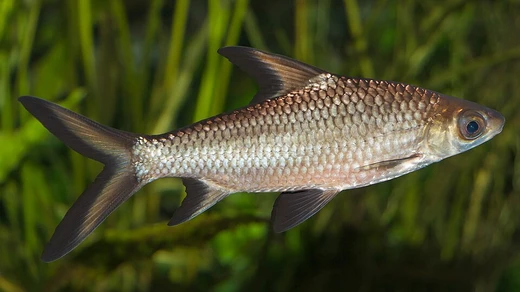
Carp
Freshwater fish of the family Cyprinidae, valued and invasive worldwide.

Carp is a common name for many species of freshwater fish in the family Cyprinidae, a large group of ray-finned fish that are mostly native to Eurasia. In much of the Old World, carp are highly valued as food, ornamental fish, and sport, and are even commercially farmed. However, in many parts of Africa, Australia, and most of the United States, they are seen as trash fish and invasive pests.
The family Cyprinidae belongs to the order Cypriniformes, which is grouped with Characiformes, Siluriformes, and Gymnotiformes into the superorder Ostariophysi. These groups share certain traits, such as living mainly in fresh water and having Weberian ossicles—a structure formed from the first five vertebrae, their ribs, and neural crests. The third pair of ribs connects to the inner ear and the swim bladder. Though not fully understood, this structure likely helps transmit vibrations from the swim bladder to the ear, improving hearing, which explains why Ostariophysi fish have excellent hearing.
Most cypriniformes have scales and teeth on their lower pharyngeal bones, which can be adapted to their diet. The only cyprinid genus that tolerates salt water is *Tribolodon*; a few other species enter brackish water but return to fresh water to spawn. All other cypriniformes live in continental waters and have wide distributions. Some people consider all cyprinids to be carp, and the family is often called the carp family.
In everyday use, "carp" usually refers to larger species like common carp (*Cyprinus carpio*), crucian carp (*Carassius carassius*), grass carp (*Ctenopharyngodon idella*), silver carp (*Hypophthalmichthys molitrix*), and bighead carp (*Hypophthalmichthys nobilis*). Common carp are native to Eastern Europe and Western Asia, so they are sometimes called Eurasian carp.
Carp have long been an important food fish. Several species, including goldfish (*Carassius auratus*) breeds and the domesticated koi (*Cyprinus rubrofuscus* var. "koi"), are popular ornamental fish. As a result, carp have been introduced to many places, with mixed outcomes. Several species are considered invasive in the United States, and large sums are spent worldwide on controlling them.
At least some carp species can survive for months with almost no oxygen—for instance, under ice or in stagnant water—by metabolizing glycogen into lactic acid, which is then converted into ethanol and carbon dioxide. The ethanol diffuses out through the gills.
In 1653, Izaak Walton wrote in *The Compleat Angler* that the carp is "the queen of rivers; a stately, a good, and a very subtle fish." Carp are valued differently by anglers. In Europe, they are highly prized as coarse fish that are difficult to hook, even when not eaten. The UK has a thriving carp angling market, with the British record at 68 lb 1 oz. This market is the fastest-growing in the UK and has spawned specialized magazines and websites. In the United States, carp are classified as rough fish and a damaging exotic species, but they also have sporting qualities. Despite a poor reputation as undesirable for fishing or eating—largely because they are invasive and outcompete native game fish—many state natural resources departments now view them as an angling fish. Groups like Wild Carp Companies, the American Carp Society, and the Carp Anglers Group promote the sport and work with fisheries to host events. Common carp are among the most abundant fish in Midwestern rivers, creeks, lakes, and ponds. They fight hard on the line, making them appealing to recreational anglers. Since their introduction to U.S. waters in the 1880s, they have been seen as game fish, despite being destructive and invasive.
Various carp species have been domesticated and raised as food fish in Europe and Asia for thousands of years. These species appear to have been domesticated independently, as they come from different parts of Eurasia. Aquaculture in China dates back at least 2,400 years; a fifth-century BC tract by Fan Li details pond-raising methods. Common carp originated in Central Europe. Several species known collectively as Asian carp were domesticated in East Asia. Carp from South Asia, such as catla (*Gibelion catla*), rohu (*Labeo rohita*), and mrigal (*Cirrhinus cirrhosus*), are called Indian carp. Their hardiness and adaptability have allowed domesticated species to spread worldwide. Although carp were once an important food fish, their cultural importance in Western Europe has declined as other fish species have become more available.
- field
- Freshwater fish (family Cyprinidae)
- native range
- Eurasia
- known for
- Important food fish, ornamental varieties (goldfish, koi), invasive species in some regions
- notable species
- Common carp, crucian carp, grass carp, silver carp, bighead carp
Lore & Background
Carp have long been an important food fish to humans. Several species such as the various goldfish breeds and the domesticated common carp variety known as koi have been popular ornamental fishes. As a result, carp have been introduced to various locations, though with mixed results. Several species of carp are considered invasive species in the United States, and worldwide large sums of money are spent on carp control. At least some species of carp are able to survive for months with practically no oxygen by metabolizing glycogen to form lactic acid which is then converted into ethanol and carbon dioxide, which diffuses into the surrounding water through the gills. The UK has a thriving carp angling market. In the United States, carp are classified as a rough fish and a damaging naturalized exotic species, but with sporting qualities; many states' departments of natural resources are beginning to view the carp as an angling fish instead of a maligned pest. Various species of carp have been domesticated and reared as food fish across Europe and Asia for thousands of years. Aquaculture has been pursued in China for at least 2,400 years. The common carp is originally from Central Europe. Several carp species (collectively known as Asian carp) were domesticated in East Asia. Carp that are originally from South Asia are known as Indian carp. Their hardiness and adaptability have allowed domesticated species to be propagated all around the world.
Reader's Guide
Carp hold a dual significance: they are a cornerstone of aquaculture and ornamental fishkeeping in Eurasia, yet are widely regarded as invasive pests in Africa, Australia, and most of the United States. Their biological adaptability—including the ability to survive months without oxygen—has facilitated their spread and resilience. In Europe, carp are a prized sport fish, with a thriving angling culture and specialized publications. In the United States, despite a poor reputation, carp are increasingly promoted as game fish by organizations such as the American Carp Society. Carp have been domesticated for thousands of years, with selective breeding programs improving growth, shape, and disease resistance. The Jian carp, developed in China in the late 1990s, now accounts for over 50% of China's carp aquaculture production. Ornamental varieties like goldfish and koi have been selectively bred for color and form for centuries. The family Cyprinidae is often known as the carp family, and most cypriniformes have scales and teeth on the inferior pharyngeal bones. Tribolodon is the only cyprinid genus that tolerates salt water. Carp remain a major food source in Asia, where their farming volume surpasses that of intensively sea-farmed species like salmon and tuna.
Did You Know?
- The term carp is a generic common name for numerous species of freshwater fish from the family Cyprinidae.
- At least some species of carp can survive for months with practically no oxygen by converting glycogen to ethanol and carbon dioxide.
- The common carp is native to both Eastern Europe and Western Asia, sometimes called a 'Eurasian' carp.
- Goldfish were first bred for color in China over a thousand years ago.
Frequently Asked Questions
Who is Carp?
Carp is not a single species but a common name covering many freshwater fish in the family Cyprinidae, a large group of ray-finned fish originally native to Eurasia. The name lumps together well-known members like common carp, crucian carp, grass carp, silver carp, and bighead carp.
What is Carp's role in the world?
In much of the Old World, carp species are highly prized as food fish and as ornamental varieties such as goldfish and koi. In Africa, Australia, and most of the United States, they are instead regarded as invasive pests and so-called trash fish that disrupt local ecosystems.
Where does Carp originate from?
Carp species are native to freshwater habitats across Eurasia, where they have lived for millennia. Their global spread today is largely the result of human introduction for aquaculture, stocking, and the ornamental trade.
Why is Carp so important to fans and anglers?
Carp are a major target for recreational fishing in many regions and serve as a staple food source in parts of Asia and Europe. Their ornamental descendants—goldfish and koi—have also made the family a household name in the pet and garden-pond world.
What happens to Carp outside its native range?
Once established in new waterways, carp often outcompete native species for food and habitat, leading to significant ecological damage. This is why they are classified as invasive in the Americas, Australia, and several African countries, where control programs are costly and ongoing.
More in Fish 1-24
Spotted an error? Know more?
This is a living reference — every entry is fact-audited, and reader corrections feed straight into our audit queue. Suggest an edit · See this site's audit record