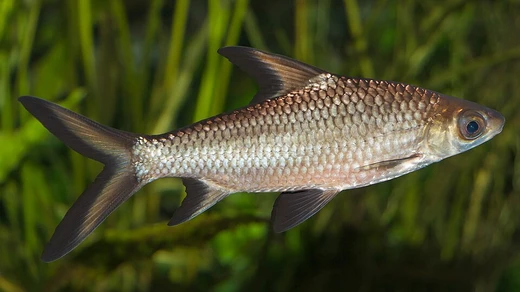
Bichir
Archaic ray-finned fishes with lungs and dorsal finlets.

The Polypteridae family, which includes bichirs and the reedfish, is the sole family within the order Polypteriformes. These are ancient ray-finned fish. All species live in freshwater across tropical Africa and the Nile River system, favoring swampy, shallow floodplains and estuaries.
These fish have elongated bodies and a row of 7 to 18 small dorsal finlets instead of a single dorsal fin. Each finlet has double-edged tips, and these are the only fins with spines; the rest have soft rays. Their bodies are covered in thick, rhombic, bone-like scales. Their jaw structure is more similar to that of tetrapods than to teleost fish. Bichirs also have other primitive traits, such as fleshy pectoral fins that resemble those of lobe-finned fish. On top of their heads, they have a pair of slit-like openings called spiracles for breathing air. They possess two gular plates and paired ventral lungs. Both lungs are smooth, unchambered sacs. The right lung is larger and runs the length of the body cavity, while the smaller left lung reaches the stomach. Air enters through a slit-like glottis on the underside of the esophagus, leading to the right lung, with a separate opening connecting the right lung to the left. They have four pairs of gill arches. Depending on the species, maximum body length ranges from about 25 cm to over 100 cm.
Polypterids are nocturnal predators, feeding on small vertebrates, crustaceans, and insects. In aquariums, they commonly eat bloodworms. They have an extraordinary sense of smell. For reproduction, a female lays 100 to 300 eggs over several days, which are then fertilized by the male.
These fish are facultative air-breathers, meaning they breathe air from the surface when their water is low in oxygen. Their lungs are highly vascularized for gas exchange. Deoxygenated blood reaches the lungs via paired pulmonary arteries branching from the fourth gill arch, and oxygenated blood returns through pulmonary veins. Unlike most lungfish and tetrapods, their lungs are smooth sacs rather than having alveoli. They are unique in using recoil aspiration to breathe. When undisturbed or in very shallow water where they cannot tilt their body to breathe through their mouth, they prefer to take in air through their spiracles.
Bichirs and reedfish are popular in public and large home aquariums. They are sometimes marketed as "dragon bichir" or "dragon fin" due to their dragon-like look. Although predatory, they are otherwise peaceful and usually rest on the bottom, though they swim more when lots of large plants are present. They make good tankmates with fish that are too large to be prey but not so large as to be predators. Some aquarists note that pleco catfish may eat the slime coat off polypterids. In captivity, they can live 10 to 30 years or more. Heavily planted tanks suit them well, mimicking their natural habitat.
The family Polypteridae contains two living genera, *Polypterus* and *Erpetoichthys*, along with the extinct genus *Bawitius*. The living species include the reedfish (*Erpetoichthys calabaricus*) and various bichirs such as the West African, Guinean, Nile, Congo, saddled, Mokèlé-mbèmbé, ornate, mottled, barred, shortfin, gray, and Teugelsi bichirs, among others. Fossil species are known from the Late Cretaceous of Egypt and the late Miocene.
- field
- Ichthyology
- known_for
- Archaic ray-finned fishes with paired lungs and dorsal finlets
- native_region
- Tropical Africa and Nile River system
- oldest_fossil_age
- Around 100 million years old (early Late Cretaceous)
- maximum_length
- 25 cm to over 100 cm depending on species
Lore & Background
Polypterids are elongated fish with a unique series of dorsal finlets varying from seven to 18, instead of a single dorsal fin. Each finlet has bifid tips, and they are the only fins with spines; the rest are composed of soft rays. Their body is covered in thick, bonelike, rhombic (ganoid) scales, and their jaw structure more closely resembles that of tetrapods than of teleost fishes. They have fleshy pectoral fins superficially similar to those of lobe-finned fishes, a pair of slit-like spiracles on top of their heads for air breathing, two gular plates, and paired ventral lungs. These lungs are unchambered sacs; the right lung extends the full length of the body cavity, while the smaller left lung reaches the stomach. Air is taken in through the spiracles or mouth, and they breathe via recoil aspiration, a unique method among fishes. They are facultative air-breathers, relying on surface air when water is poorly oxygenated. Polypterids are nocturnal predators, feeding on small vertebrates, crustaceans, and insects, and possess extraordinary olfactory ability. Reproduction involves females laying 100 to 300 eggs over several days, fertilized externally. They inhabit freshwater environments across tropical Africa and the Nile system, favoring swampy floodplains, shallow estuaries, and heavily vegetated areas. As a group, they are considered the sister lineage to all other living ray-finned fishes, having diverged at least 330 million years ago. The oldest known polypterid fossils date to around 100 million years ago, from the early Late Cretaceous of South America and Africa. Maximum body length ranges from 25 cm to over 100 cm depending on species. In captivity, they can live 10 to 30 years or more and are popular in large aquaria, where they are peaceful with appropriately sized tankmates.
Reader's Guide
Their anatomy preserves primitive features such as ganoid scales, fleshy pectoral fins, and paired lungs, offering insights into the evolution of air breathing and the transition from fish to tetrapods. They are facultative air-breathers, using recoil aspiration via spiracles or mouth, and their lungs are smooth sacs unlike the alveolated tissue of lungfish and tetrapods. In captivity, they are popular aquarium subjects with life expectancies of 10–30+ years, known for their dragon-like appearance and peaceful nature when kept with appropriately sized tankmates. Their classification includes two living genera, Polypterus and Erpetoichthys, with 14 extant species, and fossil relatives such as Bawitius from the Late Cretaceous.
Did You Know?
- Polypterids have a pair of slit-like spiracles on top of their heads used to breathe air.
- Their lungs are unchambered sacs; the right lung reaches the whole length of the body cavity.
- They breathe using recoil aspiration, a unique method among fishes.
- The oldest polypterid fossils are around 100 million years old, from the early Late Cretaceous of South America and Africa.
Frequently Asked Questions
What is a bichir?
A bichir is a member of the family Polypteridae, the only family in the order Polypteriformes. It is an ancient ray-finned fish distinguished by a row of small dorsal finlets and a pair of functional lungs.
What makes bichirs unique among ray-finned fishes?
Bichirs breathe air through true lungs, a trait virtually absent in other actinopterygian lineages. They also carry numerous independent dorsal finlets along the back instead of a single fused dorsal fin.
Where do bichirs live in the wild?
Every bichir species is restricted to freshwater habitats in tropical Africa and the Nile River system. They typically occupy shallow, slow-moving floodplains, swamps, and brackish estuaries.
How old is the bichir lineage?
The earliest known bichir fossils date to roughly 100 million years ago, in the early Late Cretaceous. That makes them one of the oldest continuously surviving ray-finned fish lineages.
How big do bichirs get?
Size varies widely across the family, from species that top out near 25 cm to others exceeding 100 cm in total length. The range reflects the considerable diversity among the roughly twenty recognized species.
More in Fish 1-24
Spotted an error? Know more?
This is a living reference — every entry is fact-audited, and reader corrections feed straight into our audit queue. Suggest an edit · See this site's audit record