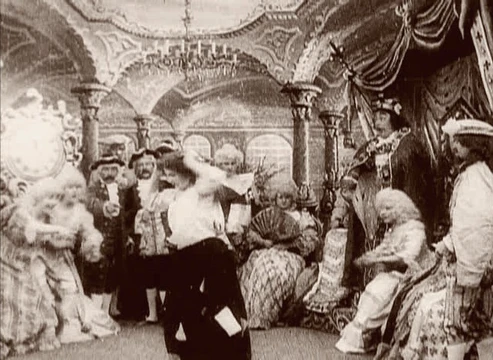
Cinderella or the Glass Slipper
Méliès's 1913 remake of his own 1899 Cinderella.
Georges Méliès directed this 1913 French silent film, a remake of his own 1899 Cinderella, which had been his first major hit. Based on Charles Perrault's fairy tale, it stars Louise Lagrange as one of the stepsisters and features Méliès himself as the prince's messenger.
Quick Facts
- Director
- Georges Méliès
- Producer
- Charles Pathé
- Based on
- "Cinderella", Charles Perrault
- Editing
- Ferdinand Zecca
- Studio
- Star Film Company
- Distributor
- Pathé Frères
- Released
- 3 January 1913, France
- Country
- France
Facts from the source article.
Production
Georges Méliès first brought Cinderella to the screen in 1899, a film that became his first major hit. His 1913 version is a remake of that earlier work, with both drawing from Charles Perrault’s original fairy tale. Filming took place during the summer and autumn of 1912. Méliès himself appears as the prince’s messenger, the one who searches for the owner of the glass slipper. His daughter, Georgette Méliès, was likely one of the two camera operators—since 1902, Méliès had shot each of his films with two cameras at once to serve international distribution. Louise Lagrange, who later acted in numerous French and Hollywood productions, plays one of Cinderella’s sisters. She later described Méliès as kind, courteous, and meticulously careful when filming special effects. Her sister Marthe Vinot is believed to appear in the film as well, though her role is unknown. The role of Prince Charming is also played by a woman. For the scene where the court tries the slipper on every woman, Méliès reused a town-square set originally built for his 1906 film Robert Macaire and Bertrand. The special effects rely on stage machinery, dissolves, and substitution splices. Like all Méliès films from 1911 and 1912, this one was made under Charles Pathé’s supervision for Pathé Frères. After receiving the film, Pathé had Ferdinand Zecca edit it. Zecca reportedly cut it to half the length Méliès intended and likely added cross-cutting and medium shots—techniques that were unusual for Méliès. In 1944, Méliès’s widow Jehanne d’Alcy told the Cinémathèque française that Zecca had “massacred” the film, removing its best scenes, including one where pumpkins race across a garden. She claimed the editing was sabotage meant to destroy Méliès’s career. This accusation was never proven, though the film’s abrupt linear edits suggest Zecca reedited the entire work.
Release and reception
Advertisements from December 1912 announced that the film would be released on 3 January 1913, billing it as a fairy play in two parts and thirty tableaux based on Charles Perrault's masterpiece. Unlike Méliès's 1899 version, this 1913 film failed to attract audiences and exhibitors, largely because his theatrical style had become outdated. In a 1979 study, film scholar John Frazer noted that while Zecca's interference is obvious, the surviving footage remains "an agreeable example of Méliès's art with a few particularly fine effects." Folklorist Jack Zipes, writing in a 2010 book on fairy-tale cinema, faulted the film for overemphasizing melodrama and special effects, resulting in "boring scenes that had little comic relief." However, he also highlighted several strengths: the harsh treatment of Cinderella by her stepsisters, the fairy transformations, and the intricate handling of the glass slipper. One of the two original edited negatives still exists, held by the Cinémathèque Française. When that institution launched a 2013–2021 project to digitally restore thirty-three Méliès films, Cinderella received top priority. Working with the Fondation Jérôme Seydoux-Pathé, the Cinémathèque also hired composer Lawrence Lehérissey to create a new piano score for the restoration.
More in Films Based on Charles Perrault's Cinderella
Spotted an error? Know more?
Reader corrections go straight into our review queue. Suggest an edit · How this site is sourced