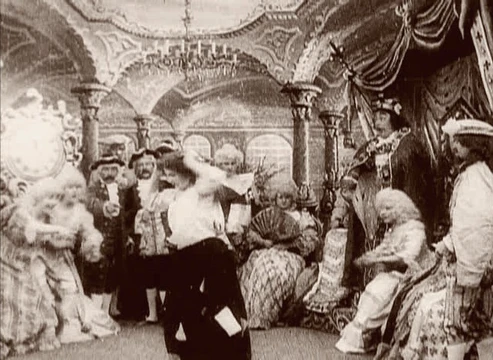
Cinderella (1899 film)
First film adaptation of Charles Perrault's Cinderella.
Georges Méliès directed this 1899 French trick film, an adaptation of Charles Perrault’s fairy tale. Released under his Star Film Company as catalogue numbers 219–224, it was billed as a grande féerie extraordinaire en 20 tableaux. This is the earliest known movie version of the classic story.
Quick Facts
- Director
- Georges Méliès
- Based on
- Cinderella, Charles Perrault
- Starring
- Mlle Barral
- Bleuette Bernon
- Jeanne d'Alcy
- Georges Méliès
- Released
- 1899, 10, France, 25 December 1899, United States
- Runtime
- 6 minutes
- Country
- France
- Language
- Silent
Facts from the source article.
Cast
Identifying the actors in Georges Méliès’s films is often difficult. The list below relies on research by film scholars Georges Sadoul, Jacques Malthête, and Laurent Mannoni. Mlle Barral plays Cinderella; she had earlier performed in Méliès’s farce The Bridegroom’s Dilemma. Bleuette Bernon is the Fairy Godmother. Méliès discovered her in the 1890s when she sang at the cabaret L’Enfer, and her work on Cinderella overlaps with her shows at the Eldorado cabaret. She also appears as Phoebe, the woman on the crescent moon, in A Trip to the Moon. Carmelli plays the Prince; he acted at Méliès’s Théâtre Robert-Houdin. Jehanne d’Alcy plays the Queen, the Prince’s mother. She had theatrical success by 1896 but left the stage for film, becoming one of the first to do so, and later married Méliès. Dupeyron appears as a party guest. Méliès himself plays the genie of the midnight clock and a halberdier; he acted in at least 300 of his 520 films.
Production
For his 1899 film Cinderella, Georges Méliès looked to Gustave Doré’s engravings for a Perrault edition to shape the movie’s look. Doré’s style influenced Méliès throughout his career, especially here and in his adaptations of four other tales Doré had illustrated: Red Riding Hood, Blue Beard, The Wandering Jew, and Baron Munchausen’s Dream. The most likely direct spark was a stage version that opened in 1896 at the Théâtre de la Galerie-Vivienne and later played at Méliès’s own Théâtre Robert-Houdin during Christmas 1897, performed by the Troupe Raymond. He may also have drawn from the Théâtre du Châtelet’s elaborate 1895 production. This was Méliès’s first film to use multiple scenes, with six different sets and five scene changes. His catalogue, probably for promotional effect, broke the action into twenty smaller tableaux. The large number of extras required Méliès to appoint a Chief Extra to manage them. Special effects relied on multiple exposures, dissolves, and substitution splices.
Reception
Cinderella was the first film to bring Georges Melies widespread acclaim. It found audiences in French fairgrounds and music halls across Europe and America, encouraging him to produce more elaborate, multi-scene fantasy films. His next such project, Joan of Arc from 1900, became his first to exceed 200 meters of film and was another hit. Film historian Lewis Jacobs noted that the spectacle of Cinderella later shaped the work of director Cecil B. DeMille. Melies revisited the fairy tale in 1912 with Cinderella or the Glass Slipper, produced under Pathé Freres. This remake failed, partly due to creative clashes between Melies, Ferdinand Zecca, and Charles Pathé, and partly because Melies's theatrical approach had grown outdated by then.
More in Films Based on Charles Perrault's Cinderella
Spotted an error? Know more?
Reader corrections go straight into our review queue. Suggest an edit · How this site is sourced