Miso
A traditional Japanese seasoning made from fermented soybeans, salt, and kōji, used in soups, sauces, and pickling.
Last updated

publicdomainq.net · via Wikipedia: Miso · CC0
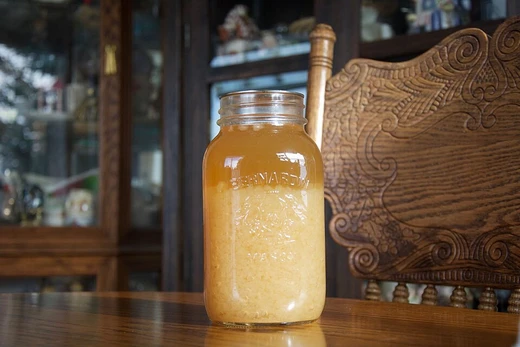
Fermenting soybeans with salt and the fungus Aspergillus oryzae (kōji), sometimes alongside rice or barley, produces a thick paste known as miso, a traditional Japanese seasoning.[1] Miso serves as a base for miso soup—a staple Japanese dish—when combined with dashi stock, and is also employed in sauces, spreads, and for pickling vegetables, fish, or meats.[1] Rich in minerals and containing a high level of protein, miso was a key nutritional component in feudal Japan.[1]
Key facts and history
A miso predecessor originated in China during the third century BC.[2] The oldest written record of the word "miso" appears in the Japanese history text "Nihon Sandai Jitsuroku" completed in 901.[3] Miso was used as salary for high-level bureaucrats and treated as a precious seasoning according to the Engi-Shiki Code.[3] Buying and selling miso began before the era of those first shops.[3]
The exact beginnings of miso in Japan remain uncertain.[4] During the Jōmon period (14,000–300 BC), a Neolithic era, both grain-based and fish-based misos were produced in Japan.[4] The term evolved from mishō (or mishou) in the Nara period (710–794) to misho and subsequently to miso.[5] Localized miso varieties, suited to different regional climates and cultures, spread across Japan during the Edo period (1603–1868), when the product was also referred to as hishio and kuki.[6][7]
What the cited sources add
The Abokichi.com account states that a prototype of Japanese miso dates back to the Yayoi period.[3] According to the same source, the first miso factory in Japan was built by Date Masamune in his castle.[3] The Indoindians.com article notes that miso was believed to be a luxury food limited to wealthy aristocrats.[7] The Indoindians.com article reports that miso provides two grams of protein per tablespoon and is a source of B vitamins, vitamins E and K, and folic acid.[7]
According to that article, Buddhist monks discovered that grinding soybeans into a paste introduced novel culinary techniques.[7]
References
- Wikipedia, "Miso" (CC BY-SA 4.0), which cites: "Global Miso Market 2018-2022", Research and Markets (we also read that source) en.wikipedia.org
- Wikipedia, "Miso" (CC BY-SA 4.0), which cites: Shurtleff, "History of Miso, Soybean Jiang (China), Jang (Korea) and Tauco (Indonesia) (200 BC-2009)", Soyinfo Center, 2009, p. 627; Albala, "Beans: a history", Berg Publishers, 2007, p. 216 (original not read by us) en.wikipedia.org
- "The origin of miso", Abokichi.com, 2017-03-02. facts only, no text reused. abokichi.com
- Wikipedia, "Miso" (CC BY-SA 4.0), which cites: "お味噌の歴史 (The History of Miso)", Yamajirushi Jyozo (original not read by us) en.wikipedia.org
- Wikipedia, "Miso" (CC BY-SA 4.0), which cites: "Open innovation of Marukome and Panasonic to create "New Miso Life"", Panasonic.com, 2018-03-07; "The origin of miso", Abokichi.com, 2017-03-02 (we also read that source) en.wikipedia.org
- Wikipedia, "Miso" (CC BY-SA 4.0), which cites: khintan, "All About Miso & Miso Soup Recipe", Indoindians.com, 2020-12-02; Writers, "Everything You Need to Know About Miso Paste YABAI - The Modern, Vibrant Face of Japan", YABAI, 16 May 2017 (we also read that source) en.wikipedia.org
- khintan, "All About Miso & Miso Soup Recipe", Indoindians.com, 2020-12-02. facts only, no text reused. indoindians.com
Each numbered sentence above was checked against the source it cites before publication. Sentences citing Wikipedia adapt text from the English Wikipedia article Miso (contributors), used under CC BY-SA 4.0; this entry is available under the same licence. Other sources were used for facts only; no text or images are copied from them.
Also in the Codexery
More in Fermented Foods
Sources
Compiled from Wikipedia and the sources listed below. Text from Wikipedia is available under CC BY-SA 4.0; this entry is adapted from it.
- Wikipedia: Miso (CC BY-SA 4.0).
Spotted an error? Know more?
Reader corrections go straight into our review queue. Suggest an edit · How this site is sourced