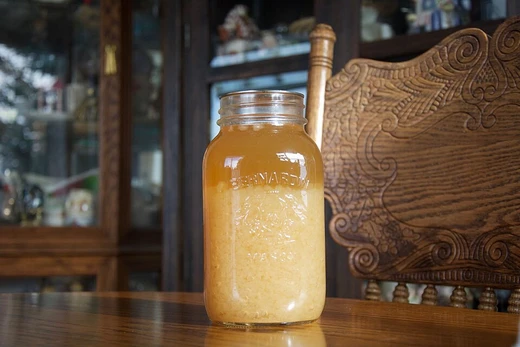
Tempeh
Traditional Indonesian fermented soybean cake
Last updated

Veganbaking.net from USA · via Wikipedia: Tempeh · CC BY-SA 2.0
Tempeh is a traditional Indonesian food made from fermented soybeans, bound into a cake form by a fungus such as Rhizopus oligosporus.[1] Unlike tofu, tempeh is a whole-soybean product with a firm texture and earthy flavor.[2] On the island of Java, this food is a fundamental protein source for the local population.[2]
Key facts and history
Food historian Murdijati Gardjito argued that tempeh was made by native Javanese people and predates Chinese-style tofu products.[3] In 2025, Zaelani formalized this as the "Okara-Tempe Hypothesis"[4][5] Tempeh is unique among major traditional soyfoods as the only one that did not originate in China or Japan.[6] The world's earliest known reference to tempeh appeared in the Serat Centini, probably written around 1815.[6]
Indonesia is the country of origin for tempeh, and historical records point to its initial creation in Bayat, Klaten, Central Java, with common consumption occurring around the year 1700.[7] The word tempe is believed to come from the Old Javanese term tumpi, which describes a whitish food created from fried batter.[8] An 1896 article written in German contains the earliest documented instance of the spelling "tempeh".[9][6] Black soybeans, a plant that is indigenous to the area, were the original soybean type employed in tempeh production.[10]
According to food historian Mary Astuti, the native soybean variety was cultivated in the region prior to the arrival of Chinese people.[11]
What the cited sources add
The same source states that before cooking, soy tempeh contains 19.5% protein, compared with 17.9% for hamburger and 21% for chicken.[6] Research by Sjamsuridzal et al. in 2021 found that tempeh made with traditional inoculation methods is more likely to include molds like Rhizopus arrhizus, resulting in a white woolly appearance and more pleasant aroma.[12][13] Research from 2017 by Muzdalifah and colleagues showed that prolonging the fermentation period leads to a higher pH level and an undesirable darkening of the tempeh's color.[14][15]
References
- Wikipedia, "Tempeh" (CC BY-SA 4.0), which cites: Shurtleff, "History of Tempeh", www.soyinfocenter.com, p. 1; "Tempeh", Dictionary.com (original not read by us) en.wikipedia.org
- Wikipedia, "Tempeh" (CC BY-SA 4.0), which cites: Bennett, "The Complete Idiot's Guide to Vegan Cooking", Penguin, 2008, p. 17; Dragonwagon, "Passionate Vegetarian", Workman Publishing, 2002, p. 639 (original not read by us) en.wikipedia.org
- Wikipedia, "Tempeh" (CC BY-SA 4.0), which cites: Media, "Sejarah Tempe, Makanan Asli Indonesia yang Mendunia", KOMPAS.com, 12 September 2020 (original not read by us) en.wikipedia.org
- Wikipedia, "Tempeh" (CC BY-SA 4.0), which cites: Hendri F. Isnaeni, "Sejarah Tempe", Historia, 9 July 2014; Zaelani, "The Okara-Tempe Hypothesis: A Waste-Driven Model for the Origins and Early Evolution of Indonesian Tempe Fermentation", 2025-12-24 (we also read that source) en.wikipedia.org
- Natura Zaelani, "The Okara-Tempe Hypothesis: A Waste-Driven Model for the Origins and Early Evolution of Indonesian Tempe Fermentation", Zenodo (CERN European Organization for Nuclear Research) (2025), doi:10.5281/zenodo.18042625. OpenAlex metadata CC0; paper not read. doi.org
- "History of Tempeh - page 1", www.soyinfocenter.com. facts only, no text reused. soyinfocenter.com
- Wikipedia, "Tempeh" (CC BY-SA 4.0), which cites: "Pemerhati Ajukan Tempe Sebagai Warisan Budaya Dunia - National Geographic", nationalgeographic.grid.id (original not read by us) en.wikipedia.org
- Wikipedia, "Tempeh" (CC BY-SA 4.0), which cites: "Resep Peyek/tumpi teri medan oleh Siti bundae arfa shaka", Cookpad, 26 June 2018; Hendri F. Isnaeni, "Sejarah Tempe", Historia, 9 July 2014 (original not read by us) en.wikipedia.org
- Wikipedia, "Tempeh" (CC BY-SA 4.0), which cites: "History of Tempeh - page 1", www.soyinfocenter.com (we also read that source) en.wikipedia.org
- Wikipedia, "Tempeh" (CC BY-SA 4.0), which cites: "Sejarah Kedelai, Manfaat Kedelai, Dan Serat Dalam Kedelai Distributor bahan pakan ternak hijauan, bungkil kedelai, meat bone meal, DDGS, kedelai import", 14 November 2011; "Sejarah Tahu, Tahu Sejarah", Historia - Majalah Sejarah Populer Pertama di Indonesia, 2014-01-10 (we also read that source) en.wikipedia.org
- Wikipedia, "Tempeh" (CC BY-SA 4.0), which cites: Hendri F. Isnaeni, "Sejarah Tempe", Historia, 9 July 2014 (original not read by us) en.wikipedia.org
- Wikipedia, "Tempeh" (CC BY-SA 4.0), which cites: Sjamsuridzal, "The effect of the use of commercial tempeh starter on the diversity of Rhizopus tempeh in Indonesia", Scientific Reports, 2021-12-14, p. 23932 (we also read that source) en.wikipedia.org
- Wellyzar Sjamsuridzal, "The effect of the use of commercial tempeh starter on the diversity of Rhizopus tempeh in Indonesia", Scientific Reports (2021), doi:10.1038/s41598-021-03308-6. OpenAlex metadata CC0; paper not read. doi.org
- Wikipedia, "Tempeh" (CC BY-SA 4.0), which cites: Muzdalifah, "Colour and pH changes of tempe during extended fermentation", 2017, p. 020036 (we also read that source) en.wikipedia.org
- Dian Muzdalifah, "Colour and pH changes of tempe during extended fermentation", AIP conference proceedings (2017), doi:10.1063/1.4973163. OpenAlex metadata CC0; paper not read. doi.org
Each numbered sentence above was checked against the source it cites before publication. Sentences citing Wikipedia adapt text from the English Wikipedia article Tempeh (contributors), used under CC BY-SA 4.0; this entry is available under the same licence. Other sources were used for facts only; no text or images are copied from them.
More in Fermented Foods
Sources
Compiled from Wikipedia and the sources listed below. Text from Wikipedia is available under CC BY-SA 4.0; this entry is adapted from it.
- Wikipedia: Tempeh (CC BY-SA 4.0).
Spotted an error? Know more?
Reader corrections go straight into our review queue. Suggest an edit · How this site is sourced