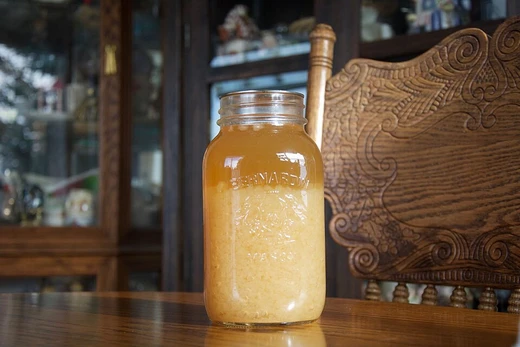
Kombucha
A fermented, effervescent sweetened black tea drink with a SCOBY culture.
Last updated

Mgarten at English Wikipedia · via Wikipedia: Kombucha · CC BY-SA 3.0
Kombucha is a fermented, effervescent sweetened black tea drink produced by a symbiotic culture of bacteria and yeast (SCOBY).[1][2] To differentiate the drink from the microbial culture it is made from, people sometimes refer to it as kombucha tea.[3] It is common to add flavorings such as fruit, spices, or juice to kombucha.[3]
Key facts and history
The yeast component generally includes Saccharomyces cerevisiae, along with other species.[2] The drink's traditional regional origins are believed to be in China.[4] Currently, kombucha is made by homebrewers all over the world and is also produced commercially in bottles.[5] The types of microbes present in a SCOBY are not uniform.[2]
A nearly constant bacterial presence in the culture is Gluconacetobacter xylinus, which converts the alcohols made by yeasts into acetic acid.[2] While many health advantages are attributed to drinking kombucha, there is hardly any scientific proof for these assertions.[6] Serious negative effects from the drink are uncommon and may be due to contamination when it is made at home.[6]
What the cited sources add
A 2019 review by Julie M. Kapp and Walton Sumner enumerated numerous potential health risks including hyponatremia, lactic acidosis, and toxic hepatitis.[7][8] The same 2019 review stated that "kombucha is not considered harmful if about 4 oz per day is consumed by healthy individuals".[7][8] The same source reports that animal studies have shown kombucha has antioxidant and antidiabetic effects, but human studies are lacking.[9] A Guardian article from 2018 notes that kombucha's twangy taste can be enhanced by adding fruits and spices.[10]
A 2003 systematic review by E. Ernst indicated that while adverse events from kombucha are infrequent, they might not all be reported.[11][12] In 2009, the American Cancer Society stated that "serious side effects and occasional deaths have been associated with drinking Kombucha tea".[13][12]
References
- Wikipedia, "Kombucha" (CC BY-SA 4.0), which cites: Jayabalan, "A Review on Kombucha Tea—Microbiology, Composition, Fermentation, Beneficial Effects, Toxicity, and Tea Fungus", Comprehensive Reviews in Food Science and Food Safety, 21 June 2014, p. 538–550 (original not read by us) en.wikipedia.org
- Wikipedia, "Kombucha" (CC BY-SA 4.0), which cites: Jonas, "Production and application of microbial cellulose", Polymer Degradation and Stability, 1998, p. 101–106; Jayabalan, "A Review on Kombucha Tea—Microbiology, Composition, Fermentation, Beneficial Effects, Toxicity, and Tea Fungus", Comprehensive Reviews in Food Science and Food Safety, 21 June 2014, p. 538–550; Bauer, "What is kombucha tea? Does it have any health benefits?", Mayo Clinic, 8 July 2017; Wollan, "Kombucha Tea Attracts a Following and Doubters", The New York Times, 24 March 2010 (we also read that source) en.wikipedia.org
- Wikipedia, "Kombucha" (CC BY-SA 4.0), which cites: "A mug of kombucha for your health?", Mayo Clinic (original not read by us) en.wikipedia.org
- Wikipedia, "Kombucha" (CC BY-SA 4.0), which cites: "1980年代的红茶菌热始末", 自然辩证法通讯, 2024, p. 77–87; "How kombucha went from seaweed tea in Japan to a hit in North America", CBC; "kombucha Description, History, & Nutrition", Encyclopedia Britannica; LaGory, "The Big Book of Kombucha", Storey Publishing, LLC, 2016, p. 251 (we also read that source) en.wikipedia.org
- Wikipedia, "Kombucha" (CC BY-SA 4.0), which cites: Troitino, "Kombucha 101: Demystifying The Past, Present And Future Of The Fermented Tea Drink", Forbes; Mullerova, "Mykologia: Měsičník pro pěstovánía šíření znalosti hub po stránce vědecké i praktické", Czechoslovak Mycological Club in Prague, 1924, p. 41; Jayabalan, "A Review on Kombucha Tea—Microbiology, Composition, Fermentation, Beneficial Effects, Toxicity, and Tea Fungus", Comprehensive Reviews in Food Science and Food Safety, 21 June 2014, p. 538–550; "Kombucha Market Size, Share & Trends Analysis Report By Flavor (Original, Flavored), en.wikipedia.org
- Wikipedia, "Kombucha" (CC BY-SA 4.0), which cites: Ernst, "Kombucha: A Systematic Review of the Clinical Evidence", Complementary Medicine Research, 2003, p. 85–87; Kapp, "Kombucha: a systematic review of the empirical evidence of human health benefit", Annals of Epidemiology, February 2019, p. 66–70; "Kombucha", mskcc.org, 22 May 2014; "American Cancer Society Complete Guide to Complementary and Alternative Cancer Therapies", American Cancer Society, 2009, p. 629–633; Ernst, "Kombucha: A Systematic Review of the Clinical Evidence", Complementary Medicine Research, 2003, p. 85–87; Bauer, "What en.wikipedia.org
- Julie M. Kapp, "Kombucha: a systematic review of the empirical evidence of human health benefit", Annals of Epidemiology (2018), doi:10.1016/j.annepidem.2018.11.001. OpenAlex metadata CC0; paper not read. doi.org
- Wikipedia, "Kombucha" (CC BY-SA 4.0), which cites: "Kombucha: a systematic review of the empirical evidence of human health benefit", Annals of Epidemiology, February 2019, p. 66–70; "Kombucha: a systematic review of the empirical evidence of human health benefit", Annals of Epidemiology, February 2019, p. 66–70 (we also read that source) en.wikipedia.org
- "Kombucha", mskcc.org, 22 May 2014. facts only, no text reused. mskcc.org
- Fleming, "Kombucha: can the fermented drink compete with beer at the bar?", The Guardian, 11 October 2018. facts only, no text reused. theguardian.com
- E. Ernst, "Kombucha: A Systematic Review of the Clinical Evidence", Complementary Medicine Research (2003), doi:10.1159/000071667. OpenAlex metadata CC0; paper not read. doi.org
- Wikipedia, "Kombucha" (CC BY-SA 4.0), which cites: Ernst, "Kombucha: A Systematic Review of the Clinical Evidence", Complementary Medicine Research, 2003, p. 85–87; "American Cancer Society Complete Guide to Complementary and Alternative Cancer Therapies", American Cancer Society, 2009, p. 629–633; Bauer, "What is kombucha tea? Does it have any health benefits?", Mayo Clinic; Villarreal-Soto, "Understanding Kombucha Tea Fermentation: A Review", Journal of Food Science, 2018, p. 580–588; "Kombucha", maricopa.gov, 2017; "Botulism", who.int, September 25, 2023 (we also read that source) en.wikipedia.org
- "American Cancer Society Complete Guide to Complementary and Alternative Cancer Therapies", American Cancer Society, 2009, p. 629–633. facts only, no text reused. archive.org
Each numbered sentence above was checked against the source it cites before publication. Sentences citing Wikipedia adapt text from the English Wikipedia article Kombucha (contributors), used under CC BY-SA 4.0; this entry is available under the same licence. Other sources were used for facts only; no text or images are copied from them.
More in Fermented Foods
Sources
Compiled from Wikipedia and the sources listed below. Text from Wikipedia is available under CC BY-SA 4.0; this entry is adapted from it.
- Wikipedia: Kombucha (CC BY-SA 4.0).
- Word definitions: the , each quoted from its Wikipedia article.
Spotted an error? Know more?
Reader corrections go straight into our review queue. Suggest an edit · How this site is sourced