Kefir
Fermented milk drink made from symbiotic kefir grains.
Last updated

Quijote at Russian Wikipedia · via Wikipedia: Kefir · CC BY-SA 3.0
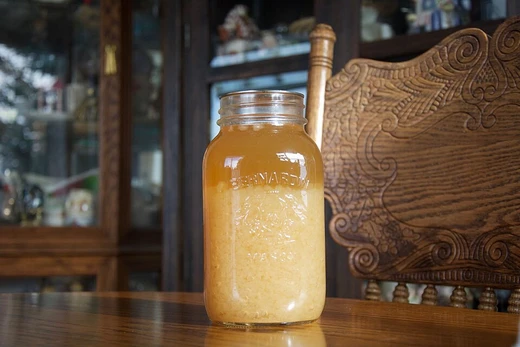
Kefir is a fermented milk drink made by inoculating cow, goat, or sheep milk with kefir grains, which are a mesophilic symbiotic culture.[1][2] The drink produced by fermentation has a tart, fizzy, and mildly alcoholic character, and its texture is comparable to that of a pourable yogurt.[3]
Quick Facts
- Main ingredients
- Milk and kefir grains
Facts from the source article.
Key facts and history
The fermentation process decreases lactose levels by 20–30% relative to the initial milk.[4] A 2016 study of kefir sold in Germany showed an ethanol level of only 0.02 g per litre.[5] Evidence of kefir was discovered in 3,600-year-old graves at the Bronze Age Xiaohe Cemetery.[6] Within the North Caucasus, the beverage holds a significant place in the traditional culinary practices of the Circassian people.[7]
The initial formation of kefir grains results from the auto-aggregation of Lactobacillus kefiranofaciens and either Maudiozyma turicensis or M. humilis, which together create a biofilm matrix of the heteropolysaccharide kefiran.[8] The fermentation process primarily converts lactose into lactic acid, which causes the milk to become acidic.[9]
What the cited sources add
The International Milk Genomics Consortium account states that kefir originated thousands of years ago in the Caucasus Mountains at the border of Europe and Asia.[10] Saloff-Coste's account notes that legend says kefir grains were a gift to Orthodox people from Mohammed, who forbade giving away the secret of preparation.[11] The same source reports that kefir is rich in Vitamin B12, B1, and Vitamin K, and is an excellent source of biotin.[11] Saloff-Coste also states that in the former Soviet Union, kefir accounts for 70% of the total amount of fermented milk consumed.[11]
The International Milk Genomics Consortium account describes kefir grains as resembling tiny, slimy cauliflower florets or clumps of sticky rice, made up of lactic acid bacteria, acetic acid bacteria, and yeast cells embedded in milk proteins and kefirans.[10] Ninane's study found that significant variation in quantitative microbial composition of a kefir grain starter occurred in partially controlled cultivation conditions.[12]
References
- Wikipedia, "Kefir" (CC BY-SA 4.0), which cites: "kefir". Oxford Dictionaries.; kefir . dictionary.reference.com (original not read by us) en.wikipedia.org
- Wikipedia, "Kefir" (CC BY-SA 4.0), which cites: "A review on traditional Turkish fermented non-alcoholic beverages: microbiota, fermentation process and quality characteristics", International Journal of Food Microbiology, October 2013, p. 44–56 (we also read that source) en.wikipedia.org
- Wikipedia, "Kefir" (CC BY-SA 4.0), which cites: "Cheese and Fermented Milk Foods", FV Kowsikowski, August 2026 (we also read that source) en.wikipedia.org
- Wikipedia, "Kefir" (CC BY-SA 4.0), which cites: Rosa, "Milk kefir : nutritional, microbiological and health benefits", Nutrition Research Reviews, June 2017, p. 82–96; Irigoyen, "Microbiological, physicochemical, and sensory characteristics of kefir during storage", Food Chemistry, May 2005, p. 613–620; Hertzler, "Kefir improves lactose digestion and tolerance in adults with lactose maldigestion", Journal of the American Dietetic Association, May 2003, p. 582–587 (original not read by us) en.wikipedia.org
- Wikipedia, "Kefir" (CC BY-SA 4.0), which cites: "Estimates of Ethanol Exposure in Children from Food not Labeled as Alcohol-Containing", Journal of Analytical Toxicology, September 2016, p. 537–542; "Handbook of fermented functional foods", CRC Press, 2008; "Handbook of fermented functional foods", CRC Press, 2008 (original not read by us) en.wikipedia.org
- Wikipedia, "Kefir" (CC BY-SA 4.0), which cites: Liu, "Bronze Age cheese reveals human-Lactobacillus interactions over evolutionary history", Cell, 2024, p. 5891–5900.e8 (original not read by us) en.wikipedia.org
- Wikipedia, "Kefir" (CC BY-SA 4.0), which cites: Oboturova, "Nutritional and Health Aspects of Traditional and Ethnic Foods of Eastern Europe", 2022, p. 69–91; Katchieva, "Kefir revisited: Insights from the North Caucasus", World Journal of Experimental Medicine, 20 December 2025; Yıldırım, "Kuzey Kafkasya Bölgesi Toplumlarının Mutfak Kültürleri Üzerine Bir İnceleme", Artvin Çoruh Üniversitesi Uluslararası Sosyal Bilimler Dergisi, 21 July 2024; Yaman, "Çerkes Mutfağının Sürdürülebilirliği Üzerine Bir Araştırma: Sakarya İli Örneği (A Research on Sustainability of Circassian Kitchen: Sakarya City en.wikipedia.org
- Wikipedia, "Kefir" (CC BY-SA 4.0), which cites: Liu, "Saccharomycetaceae: delineation of fungal genera based on phylogenomic analyses, genomic relatedness indices and genomics-based synapomorphies", Persoonia - Molecular Phylogeny and Evolution of Fungi, 30 June 2024,; Kumura, "Screening of Dairy Yeast Strains for Probiotic Applications", Journal of Dairy Science, December 2004, p. 4050–4056; "Investigation of microorganisms involved in biosynthesis of the kefir grain", Food Microbiology, December 2012, p. 274–285; "Description of Saccharomyces turicensis sp. nov., a new species from kefyr", S en.wikipedia.org
- Wikipedia, "Kefir" (CC BY-SA 4.0), which cites: "Microbiological, technological and therapeutic properties of kefir: a natural probiotic beverage", Brazilian Journal of Microbiology, October 2013, p. 341–349 (we also read that source) en.wikipedia.org
- "Kefir Consumption—a Growing Culture", International Milk Genomics Consortium, September 2015. facts only, no text reused. milkgenomics.org
- Saloff-Coste, "Section Fabrication of kefir", 2002. facts only, no text reused. coproweb.free.fr
- Ninane, "Variability of the microbial abundance of a kefir grain starter cultivated in partially controlled conditions", Biotechnologie, Agronomie, Société et Environnement/Biotechnology, Agronomy, Society and Environmen. facts only, no text reused. popups.uliege.be
Each numbered sentence above was checked against the source it cites before publication. Sentences citing Wikipedia adapt text from the English Wikipedia article Kefir (contributors), used under CC BY-SA 4.0; this entry is available under the same licence. Other sources were used for facts only; no text or images are copied from them.
More in Fermented Foods
Sources
Compiled from Wikipedia and the sources listed below. Text from Wikipedia is available under CC BY-SA 4.0; this entry is adapted from it.
- Wikipedia: Kefir (CC BY-SA 4.0).
- Word definitions: the , each quoted from its Wikipedia article.
Spotted an error? Know more?
Reader corrections go straight into our review queue. Suggest an edit · How this site is sourced