Acetic acid
The second simplest carboxylic acid, key to vinegar and industrial chemistry.
Last updated

Michael D. Turnbull · CC0
Acetic acid, systematically named ethanoic acid, is an acidic, colourless liquid and organic compound with the chemical formula CH₃COOH. It is the active component of vinegar and the second simplest carboxylic acid (after formic acid). The trivial name "acetic acid" derives from the Latin word for vinegar, meaning "to sour," and it remains the preferred IUPAC name.
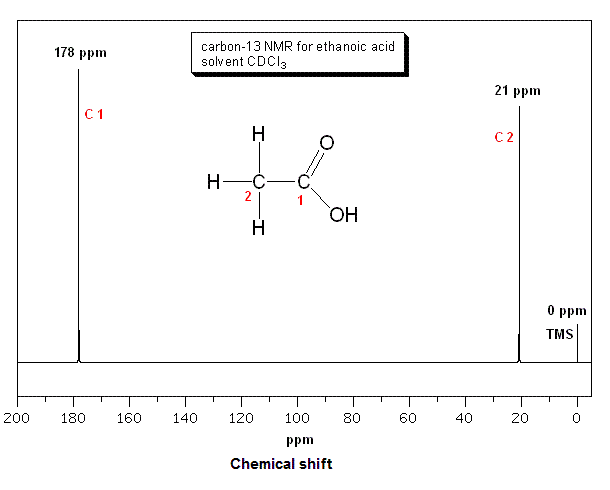
Its systematic name, "ethanoic acid," follows substitutive nomenclature. When anhydrous, it is called glacial acetic acid, a name that comes from its ability to form solid, ice-like crystals slightly below room temperature at 16.6 °C. Because water is always present in the atmosphere, truly water-free acetic acid is unattainable; even 0.1% water lowers its melting point by 0.2 °C. Common abbreviations include AcOH or HOAc, where Ac represents the acetyl group, and HAc is sometimes used in acid–base contexts. The conjugate base, acetate, forms salts and esters.
History
Acetic acid is likely the first acid produced in large quantities in history, as vinegar has been used for at least 10,000 years, naturally resulting from exposure of beer and wine to air. By the third century BCE, the Greek philosopher Theophrastus described its use on metals to produce pigments like white lead and verdigris. Hippocrates employed it as an antiseptic and remedy for various ailments.
Ancient Romans boiled soured wine in lead pots to produce sapa, a syrup rich in sweet lead acetate, contributing to lead poisoning. In the 16th century, Andreas Libavius produced acetone from dry distillation of lead acetate. For centuries, chemists believed glacial acetic acid and vinegar acid were different substances until French chemist Pierre Adet proved them identical.
In 1845, Hermann Kolbe synthesized acetic acid from inorganic compounds via chlorination of carbon disulfide, pyrolysis, and electrolytic reduction. By 1910, most glacial acetic acid came from wood distillation, treated with milk of lime and sulfuric acid; Germany then produced 10,000 tons annually, 30% for indigo dye. The first commercial methanol carbonylation process, using a cobalt catalyst, was developed by BASF in 1963, followed by a rhodium-based catalyst in 1968 that operated at lower pressure with minimal by-products.

Lore & Background
Acetic acid is likely the first acid to be produced in large quantities in history, with vinegar production dating from the third millennium BCE. The presence of water in vinegar has such a profound effect on acetic acid's properties that for centuries chemists believed that glacial acetic acid and the acid found in vinegar were two different substances.
French chemist Pierre Adet proved them identical. In 1845 German chemist Hermann Kolbe synthesized acetic acid from inorganic compounds for the first time. Interstellar acetic acid was first detected in the Sagittarius B2 North molecular cloud using solely radio interferometers.

Ancient Origins & Historical Uses
Acetic acid's story stretches back further than any other acid in recorded history. Vinegar, its dilute form, has been produced for at least ten thousand years as a natural consequence of exposing beer or wine to air, since acetic acid-producing bacteria exist everywhere on Earth. This makes it likely the first acid ever manufactured in meaningful quantities. By the third century BCE, the Greek philosopher Theophrastus documented how vinegar reacted with metals to create pigments for art, including white lead and verdigris.
Hippocrates turned to vinegar as a medical antiseptic and a remedy for fever, constipation, ulcers, and pleurisy. The ancient Romans took a different path, boiling soured wine into a sweet syrup called sapa. When this was prepared in lead vessels, it became rich in lead acetate—a substance nicknamed sugar of lead or sugar of Saturn—which quietly poisoned the Roman aristocracy. Centuries later, the sixteenth-century German alchemist Andreas Libavius described making acetone from the dry distillation of lead acetate, marking an early step toward modern organic chemistry.
From Wood Tar to Rhodium Catalysts
The industrial story of acetic acid production is a remarkable arc of chemical engineering. By 1910, most glacial acetic acid came from pyroligneous liquor, a byproduct of destructive wood distillation. The acid was isolated using milk of lime to form calcium acetate, then recovered by acidification with sulfuric acid.

Germany alone produced ten thousand tons of glacial acetic acid, roughly thirty percent of which fed the indigo dye industry. The methanol carbonylation route had been recognized as attractive since the 1920s—Henri Dreyfus at British Celanese even built a pilot plant in 1925—but the corrosive mixture at pressures above two hundred atmospheres defeated commercialization. BASF broke through in 1963 with a cobalt-catalyzed process. Then in 1968, a rhodium-based catalyst was discovered that operated efficiently at lower pressure with minimal by-products.
Monsanto built the first plant using it in 1970, and this became the dominant global method. In the late 1990s, BP Chemicals introduced the Cativa process using an iridium catalyst for even greater efficiency and a greener profile. Today, global demand stands at approximately 17.88 million metric tonnes per year.
Naming, Symbols & the Glacial Paradox
The naming of acetic acid carries layers of linguistic and chemical history. The trivial name acetic acid is actually the preferred IUPAC designation, rooted in the Latin acetum, meaning to sour, a nod to the bitter taste of fermented fruits. The systematic alternative, ethanoic acid, follows substitutive nomenclature rules.
A particularly evocative term is glacial acetic acid, describing the anhydrous form that forms ice-like crystals just below room temperature at 16.6 degrees Celsius. The German equivalent, Eisessig, translates literally as ice vinegar. For centuries, chemists mistakenly believed glacial acetic acid and the acid found in vinegar were entirely different substances, a confusion only resolved when French chemist Pierre Adet proved their identity.

In notation, acetic acid is commonly abbreviated as AcOH or HOAc, where Ac represents the acetyl group. Its conjugate base, acetate, appears in salts and esters. The carboxymethyl group, formed by removing one hydrogen from the methyl group, carries the formula −CH2−C(=O)−OH.

From Kitchen Shelves to Cellular Metabolism
Acetic acid occupies a uniquely broad niche, spanning household shelves, industrial factories, and the innermost machinery of living cells. In kitchens, it serves as the active component of vinegar and is regulated under the food additive code E260 as both an acidity regulator and a condiment. In garages, diluted acetic acid powers descaling agents. On an industrial scale, it is a critical reagent for producing cellulose acetate used in photographic film, polyvinyl acetate for wood adhesives, and synthetic fibres and fabrics.
Yet perhaps its most profound role is biochemical. The acetyl group, derived directly from acetic acid, is fundamental to all known life. When bound to coenzyme A, it sits at the center of carbohydrate and fat metabolism, making this simple two-carbon molecule an indispensable participant in energy production across every organism. As the second simplest carboxylic acid after formic acid, its reach extends from the ancient fermentation of grapes to the molecular pathways that sustain human cells.
Reader's Guide
Acetic acid is the second simplest carboxylic acid and the active component of vinegar, which has been produced since the third millennium BCE, making it likely the first acid manufactured in large quantities. Vinegar results naturally from exposing beer or wine to air due to globally present bacteria. Historically, the Greek philosopher Theophrastus described vinegar’s use on metals to create pigments like white lead and verdigris. Hippocrates employed vinegar as an antiseptic and remedy for various ailments.
Ancient Romans boiled soured wine in lead pots to produce sapa, rich in sweet lead acetate, contributing to lead poisoning among the aristocracy. In the 16th century, Andreas Libavius described producing acetone from lead acetate. For centuries, chemists believed glacial acetic acid and vinegar acid were different substances until Pierre Adet proved them identical. By 1910, most glacial acetic acid came from wood distillation, treated with lime and sulfuric acid; Germany then produced 10,000 tons annually, 30% for indigo dye.
The modern methanol carbonylation process, using a rhodium catalyst discovered in 1968, now dominates production. Acetic acid is essential in biochemistry: its acetyl group, bound to coenzyme A, is central to carbohydrate and fat metabolism. Industrially, it is used for cellulose acetate, polyvinyl acetate, synthetic fibres, and as food additive E260. Global demand in 2023 was about 17.88 million metric tonnes per year.
More in Chemistry Fundamentals
Sources
Compiled from Wikipedia and the sources listed below. Text from Wikipedia is available under CC BY-SA 4.0; this entry is adapted from it.
- Wikipedia: Acetic acid (CC BY-SA 4.0).
- Word definitions: the Codexery glossary, each quoted from its Wikipedia article.
Spotted an error? Know more?
Reader corrections go straight into our review queue. Suggest an edit · How this site is sourced