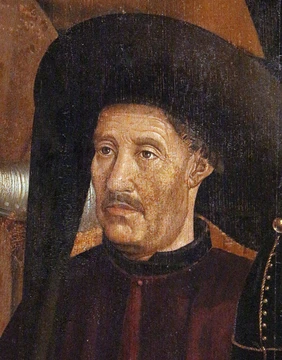
Alonso de Ojeda
Spanish explorer who led early expeditions along the Venezuelan coast.
Last updated
Alonso de Ojeda (c. 1466 – c. 1515) was a Spanish explorer, governor, and conquistador active in the early years of American colonization. He is best known for giving Venezuela its name during his first two expeditions, and for being the first European to set foot in Guyana, Curaçao, the La Guajira region of Colombia, and Lake Maracaibo. He later founded the settlement of Santa Cruz (La Guairita). His travels also took him to Trinidad, Tobago, and Aruba, sometimes alongside Amerigo Vespucci and Juan de la Cosa.
Early life
Ojeda was born around 1466 in Torrejoncillo del Rey, New Castile. His father, Rodrigo de Huete, was a minor noble who fought for Queen Isabella during the War of the Castilian Succession in 1474. Grateful for his support, Isabella took young Alonso under her protection.
As a youth, Ojeda served the Duke of Medinaceli, Luis de la Cerda, and distinguished himself in the conquest of Granada through his military skill, swordsmanship, and bravery. He was small in stature, clever, and handsome, and according to Bartolomé de las Casas, he combined all possible bodily perfections despite his size. It was said he was always the first to draw blood in a fight.
Arrival in Hispaniola
After Columbus’s first voyage, a second, larger fleet was organized by Juan Rodríguez de Fonseca. Medinaceli had been a patron to both Columbus and Ojeda, so Ojeda—still relatively young—was chosen to captain one of the ships. Fonseca was impressed with him and later became his most important patron.
The fleet sailed for Hispaniola in September 1493 and reached the Caribbean in November. At Guadalupe, a landing party went missing, and Columbus sent Ojeda ashore with armed men to search. The missing group returned on their own, but Ojeda’s search uncovered evidence that the Caribs on the island practiced cannibalism.
They reached Hispaniola at the end of November and found the fort of Navidad destroyed, with all the Spaniards left behind dead. Local natives blamed a cacique named Caonabo. The Spanish began exploring and built a settlement called Isabela. In January 1494, Columbus sent Ojeda with a small armed party to search for gold in the mountainous Cibao region.
Ojeda returned two weeks later with substantial gold nuggets and reported that the area held much gold. In March, Columbus led nearly 500 men to explore Cibao, but the hunt for gold was unsuccessful; however, natives brought gold to trade. Columbus built a fort, Santo Tomás, and left a nobleman from Aragon named de Margarit in command.
In April 1494, Columbus sent Ojeda with about 350 soldiers to relieve de Margarit. Columbus wanted de Margarit to take most of the soldiers to search for gold, seize food from natives, and capture Caonabo. At a river crossing controlled by a friendly tribe, Ojeda arrested the local cacique and other officials, accusing them of stealing clothes during an earlier expedition.
He cut the ears off one captive and sent the rest back to Isabela in chains. This brutal punishment turned the local people against the Spanish. When Ojeda reached the fort, de Margarit refused to follow Columbus’s orders and stayed put, later returning to Spain in disapproval of the chaotic situation and mistreatment of the Indians.
After de Margarit’s refusal, Columbus ordered Ojeda to capture Caonabo, the cacique blamed for destroying Navidad. According to Las Casas, Ojeda tricked Caonabo by presenting him with polished brass manacles and shackles, convincing him to wear them as a royal symbol. The ruse worked, and Ojeda brought the chief back to Columbus. Following Ojeda’s earlier mistreatment at the river, a fort had to be built to protect the crossing.
Late in 1494, the first Indian rebellion occurred there; the fort was destroyed and ten Spaniards killed. Columbus retaliated with a force of 500 led by Ojeda. The rebels were badly beaten, and about 1,500 were taken as slaves—600 shipped to Spain, the rest distributed on the island.
Ojeda also fought in the battle of Vega Real (or Jáquimo), where his command led the Spanish to victory. Las Casas claimed the native army numbered ten thousand warriors against only about four hundred Spanish soldiers, though these figures may be exaggerated. Ojeda returned to Spain in 1496.
First voyage to Venezuela
Back in Spain, the Catholic Monarchs commissioned Ojeda to sail for America again, without Columbus’s permission. He departed on 18 May 1499 with three caravels, accompanied by pilot and cartographer Juan de la Cosa and Italian navigator Amerigo Vespucci. Columbus had touched a small part of the Venezuelan coast in 1498, but it was only after this voyage that sustained exploration began.
Lore & Background
Alonso de Ojeda was born in Torrejoncillo del Rey, New Castile around 1466. His father, Rodrigo de Huete, was a minor noble who fought for Isabel in 1474 during the War of the Castilian Succession. Isabel was grateful for his support and put his son, Alonso, under her protection. In his youth, Alonso served the Duke of Medinaceli, Luis de la Cerda.
In service to the duke, he distinguished himself in the conquest of Granada with his military abilities, his skill as a swordsman and his bravery. Alonso was slight of stature, clever, and handsome. It was reputed that he was always the first to draw blood in any fight. According to Bartolomé de las Casas, he combined "in his person all the bodily perfections that man could have, despite his small size."
Ojeda sailed with Columbus's second fleet in 1493, captaining a ship to Hispaniola. There he led searches for missing men, discovered gold in Cibao, and used a ruse to capture the cacique Caonabo. His brutal punishment of local Indians—cutting off a captive's ears—sparked rebellion. He commanded Spanish forces at the battle of Vega Real and returned to Spain in 1496.
In 1499, commissioned by the Catholic Monarchs, Ojeda sailed with Juan de la Cosa and Amerigo Vespucci to explore the Venezuelan coast. He entered the Gulf of Venezuela, where palafito villages reminded Vespucci of Venice, leading to the name 'Venezuela.' He reached Lake Maracaibo on 24 August 1499 and named Cabo de la Vela. The expedition returned to Hispaniola with pearls, gold, and slaves, but poor returns led to conflict with Columbus's followers.
Reader's Guide
Alonso de Ojeda's significance lies in his role as a pioneering explorer of the South American mainland, particularly the coast of Venezuela. His 1499 voyage, the first detailed reconnaissance of that region, established sustained contact with indigenous peoples and produced the earliest known map of Venezuela, drawn by Juan de la Cosa. Ojeda's naming of Venezuela—whether inspired by Venetian-style stilt houses or a local term—remains a lasting geographical legacy. He also holds the distinction of being the first European to visit Guyana, Curaçao, Colombia (La Guajira), and Lake Maracaibo.
However, his legacy is tempered by his harsh treatment of native populations, including mutilation and enslavement, which provoked rebellion and contributed to the chaotic early colonial period. His expeditions, part of the 'minor journeys' after Columbus, expanded Spanish knowledge and claims in the New World, though they yielded limited immediate profit. Ojeda's career exemplifies the blend of exploration, brutality, and ambition that characterized the first wave of Spanish conquistadors.
Also in the Codexery
More in Explorers & Navigators
Sources
Compiled from Wikipedia and the sources listed below. Text from Wikipedia is available under CC BY-SA 4.0; this entry is adapted from it.
- Wikipedia: Alonso de Ojeda (CC BY-SA 4.0).
Spotted an error? Know more?
Reader corrections go straight into our review queue. Suggest an edit · How this site is sourced