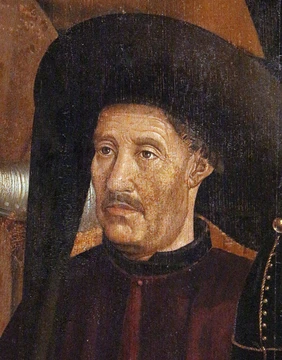
Benjamin of Tudela
Twelfth-century Jewish traveler who documented Jewish communities across three continents.
Last updated
Benjamin of Tudela (1130–1175), also known as Benjamin ben Jonah, was a medieval Jewish traveler from Tudela in the Kingdom of Navarre. He journeyed through Europe, Asia, and Africa in the twelfth century, and his vivid descriptions of western Asia preceded those of Marco Polo by a hundred years. His book, The Travels of Benjamin, is a major work in medieval geography and Jewish history, valued for its reliable accounts of Jewish communities, geography, and everyday life.
Lore & Background
Little is known of Benjamin of Tudela's personal life, apart from his being a native of Tudela in the Kingdom of Navarre, living during the second half of the 12th century, and his father's name being Jonah. He is often referred to as Rabbi by non-Jewish sources, though there is no reliable evidence he was ever one. He set out from the northeast Iberian Peninsula around 1165, possibly as a pilgrimage to the Holy Land, and may have had commercial motives, showing interest in the coral trade. He stopped frequently, meeting people, describing occupations, and giving demographic counts of Jews in each town and country.
Reader's Guide
Benjamin of Tudela's significance lies in his detailed and generally reliable account of Jewish communities and diverse cultures across Europe, Asia, and Africa during the Middle Ages. His work, The Travels of Benjamin, originally written in Hebrew, was later translated into Latin and most major European languages, receiving much attention from Renaissance scholars in the sixteenth century. Modern historians credit him with giving accurate descriptions of everyday life, and his journeys reveal the interconnectedness and diversity of Jewish communities at that time.
He visited 300 cities, including important sites in Jewish history such as Susa, Sura, and Pumbedita, and his description of the ruins outside Mosul is one of the earliest accurate accounts of ancient Nineveh. He also introduced Western Europeans to distant peoples and places, such as the Al-Hashishin, and recorded details about China and Tibet. His legacy is commemorated by a street in Jerusalem's Rehavia neighborhood, a street in Tel Aviv, a street in the former Jewish Quarter of Tudela, and a high-school in his hometown named after him.
Also in the Codexery
More in Explorers & Navigators
Sources
Compiled from Wikipedia and the sources listed below. Text from Wikipedia is available under CC BY-SA 4.0; this entry is adapted from it.
- Wikipedia: Benjamin of Tudela (CC BY-SA 4.0).
Spotted an error? Know more?
Reader corrections go straight into our review queue. Suggest an edit · How this site is sourced