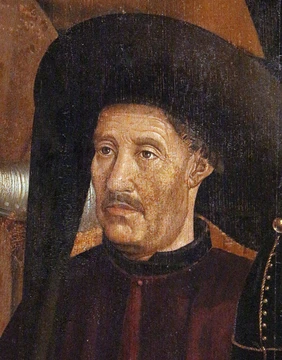
Bartolomeu Dias
Portuguese explorer who first rounded Africa's southern tip.
Last updated
Bartolomeu Dias, a Portuguese explorer and mariner, died on 29 May 1500. He is best known for being the first European to sail around the southern tip of Africa, which he accomplished in February 1488. During this voyage, he also proved that the most efficient southward route for ships was to steer diagonally southwest into the open ocean, far west of the African coastline. Vasco da Gama later used these discoveries to open a sea route from Europe to Asia.
Early life
Dias came from a maritime family. An ancestor, Dinis Dias, had explored the African coast in the 1440s and discovered the Cap-Vert peninsula in present-day Senegal in 1445.
Sorting out Dias’s biography is tricky because several Portuguese sailors with the same name were active at the same time. In 1481, he joined an expedition led by Diogo de Azambuja to build a fortress and trading post called São Jorge da Mina in the Gulf of Guinea. There is indirect evidence that he may have also taken part in Diogo Cão’s first expedition (1482–1484) down the African coast to the Congo River.
Voyage around Africa
By 1486, Dias appears to have been a cavalier in the king’s household and superintendent of the royal warehouses. On 10 October 1486, King John II of Portugal granted him an annuity of 6,000 reis for “services to come.” Sometime after that—likely around July or August 1487, not July 1486 as traditionally thought—he left Lisbon with three ships to continue the African exploration that Diogo Cão had advanced.
Dias was also tasked with finding Prester John, a legendary Christian ruler believed to live somewhere beyond Europe, possibly in Africa. He commanded two caravels of about 50 tons each, the São Cristóvão and São Pantaleão, plus a square-rigged supply ship captained by his brother Diogo. He recruited top pilots, including Pero de Alenquer and João de Santiago, both of whom had sailed with Cão.
No original documents from this historic voyage survive, because nearly all maritime records were destroyed in the 1755 Lisbon earthquake and tsunami. Most of what we know comes from the sixteenth-century historian João de Barros, who wrote about the voyage sixty years later.
The small fleet left Lisbon around July 1487. Like Cão, Dias carried carved stone pillars called padrões to mark his progress at important landfalls. He also brought six Africans who had been kidnapped by Cão and taught Portuguese.
Lore & Background
Dias's family had a maritime background. One of his ancestors, Dinis Dias, explored the African coast in the 1440s and discovered the Cap-Vert peninsula in today's Senegal in 1445.
Tracing his biography is complicated by the existence of several contemporary Portuguese seafarers with the same name. In 1481, Dias accompanied an expedition, led by Diogo de Azambuja, to construct a fortress and trading post called São Jorge da Mina in the Gulf of Guinea. Indirect evidence also points to his possible participation in Diogo Cão's first expedition (1482–1484), down the African coast to the Congo River.
In 1486 he seems to have been a cavalier of the king's household and superintendent of the royal warehouses. On 10 October 1486, he received an annuity of 6,000 reis from King John II of Portugal for 'services to come'.
Reader's Guide
Bartolomeu Dias's 1487–1488 expedition marked a pivotal moment in European exploration. By rounding the southern tip of Africa, he demonstrated that the Atlantic and Indian Oceans were connected, opening the possibility of a sea route from Europe to Asia. His discovery that the most effective southward route lay in the open ocean, well west of the African coast, became standard practice for subsequent Portuguese voyages, including Vasco da Gama's successful journey to India. Despite these achievements, Dias received little recognition at the time; no record of an adequate reward has been found.
He later assisted in the design and construction of da Gama's ships and participated in the early part of da Gama's voyage. Dias perished in May 1500 when his ship was lost in a storm near the Cape of Good Hope during Pedro Álvares Cabral's second Indian expedition. His legacy is commemorated by the Bartolomeu Dias Museum Complex in Mossel Bay and by navigational beacons at the Cape of Good Hope.
Frequently Asked Questions
Who is Bartolomeu Dias?
Bartolomeu Dias was a Portuguese mariner and explorer who, in February 1488, became the first European to round the southern tip of Africa. He came from a family with long-standing ties to coastal navigation along the African shore.
How did Bartolomeu Dias's discoveries connect to Vasco da Gama?
Dias's route knowledge gave Portuguese navigators the essential groundwork for reaching the Indian Ocean by sea. Vasco da Gama later built directly on those findings to complete the first direct European sea voyage to Asia.
When did Bartolomeu Dias die?
He died on 29 May 1500, roughly twelve years after his landmark round of Africa's southern tip. His exact birth date is not recorded in surviving sources.
What was Bartolomeu Dias's family background?
Dias grew up in a Portuguese maritime household with a tradition of coastal exploration. An ancestor, Dinis Dias e Fernandes, had already charted stretches of the African coastline as early as the 1440s.
Also in the Codexery
More in Explorers & Navigators
Sources
Compiled from Wikipedia and the sources listed below. Text from Wikipedia is available under CC BY-SA 4.0; this entry is adapted from it.
- Wikipedia: Bartolomeu Dias (CC BY-SA 4.0).
Spotted an error? Know more?
Reader corrections go straight into our review queue. Suggest an edit · How this site is sourced