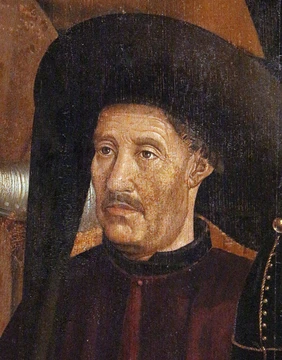
Bartholomew Gosnold
English barrister, explorer, and privateer who helped found Jamestown.
Last updated
Bartholomew Gosnold (1571–1607) was an English barrister, explorer, and privateer. He was a key figure in the establishment of the Virginia Company in London and the Jamestown colony in America. He also commanded the first recorded European voyage to reach Cape Cod. Preservation Virginia has called him the "prime mover of the colonization of Virginia."
Early life and family
Gosnold was born in 1571 in Grundisburgh, Suffolk, England. The family home was at Otley Hall in Otley, Suffolk. His parents were Anthony Gosnold and Dorothy Bacon. His cousin was Henry Gosnold, a judge and friend of Francis Bacon.
Bartholomew had a younger brother, Anthony, born between 1573 and 1578, who later joined him in Virginia. A cousin also named Anthony Gosnold was living in Virginia as late as 1615. A 1578 will from his great-grandmother Ann Gosnold lists five sisters: Elizabeth, Margaret, Dorothy, Anne, and Mary.
He studied at Jesus College, Cambridge, and then law at the Middle Temple. At Cambridge, he likely met John Brereton, who would accompany him on his 1602 voyage to New England—the first Englishmen to land on that coast. He was also friends with Richard Hakluyt and sailed with Walter Raleigh.
In 1595, he married Mary Goldinge at Latton, Essex. Mary was the daughter of Robert Goldinge and Martha Judd. Martha was the daughter of Sir Andrew Judd, a wealthy London merchant and Lord Mayor of London in 1550–51.
More importantly, Sir Andrew Judd was also grandfather to Thomas Smith, a founder of the Virginia Company. One biographer noted that the marriage seemed arranged with foresight, uniting a man from the landed gentry with a woman from London’s wealthy merchant class. The couple had seven children, six baptized at Bury St Edmunds between 1597 and 1607: Martha (baptized 1597, died 1598), Mary (1599–1660, married Richard Pepys, great-uncle of diarist Samuel Pepys), Robert (baptized 1600–1681), Susan (baptized 1602), Bartholomew (baptized 1603), Francisca (buried 1604), Paul (baptized 1605, a Royalist clergyman ejected in 1643), and Martha (baptized 1607, married John Blemell in 1633).
Early maritime career
No records survive of Gosnold’s early maritime training. However, since he was trusted with a ship for a 1602 colonizing attempt in southern New England, he must have had considerable experience. His biographer suggests, based on circumstantial evidence, that he served under the Earl of Essex on voyages to the Azores in 1597–98. Many who took part in those voyages later became involved in Virginia colonization.
Organizing a colonial enterprise
Gosnold became an early and active supporter of English settlement in the New World. In the Elizabethan and Stuart eras, exploration and colonization were private ventures. The crown did not pay for them but granted monopolies to individuals or corporations to exploit claimed territories. This made the ventures profit-driven, similar to privateering.
A would-be colonizer like Gosnold had to raise money from private investors. As such ventures grew, large corporations emerged, much like those that controlled trade routes. Several obstacles stood in the way. Ireland was a cheaper alternative for colonization, especially in shipping.
Most investors in New World ventures were also involved in Irish projects. Thomas Smith’s son, for instance, took part in the first major effort to colonize Ulster (though he was killed early on). There was also great financial risk. Sir Walter Raleigh lost £40,000 on the Roanoke colony and pledged more to try to find the lost settlers.
A new colonial plan had gained acceptance by the mid-1590s. It came from a report by Edward Hayes to Lord Burghley, outlining the reasons and methods for settlement.
The argument was that colonization should start in northern Virginia (New England). The climate there was more like England’s, and the land could produce similar crops. The coast also had abundant fish prized in Europe, which could support a small foothold and eventually generate profit as more settlers arrived.
Expedition to Cape Cod and environs
English plans to colonize New England took concrete form in the early to mid-1590s with Hayes’s treatise. The first expedition from England to southern New England followed Hayes’s principles. Captain Gosnold secured backing to attempt founding an English colony in the New World.
Lore & Background
Gosnold was born in Grundisburgh, Suffolk, in 1571, the son of Anthony Gosnold and Dorothy Bacon. He graduated from Jesus College, Cambridge, studied law at the Middle Temple, and married Mary Goldinge in 1595. Through his wife, he gained connections to wealthy London merchants, including Thomas Smith, a founder of the Virginia Company. Gosnold had seven children, six baptized at Bury St Edmunds between 1597 and 1607.
In 1602, Gosnold captained the Concord from Falmouth, Cornwall, with 32 men, including John Brereton and Gabriel Archer. He pioneered a direct sailing route from the Azores to New England, making landfall at Cape Elizabeth, Maine, on 14 May 1602. He named Cape Cod for its abundant fish and explored Martha's Vineyard, whose name's origin remains uncertain. The expedition attempted a settlement on Cuttyhunk Island but abandoned it after strained relations with Native people led to an attack on two Englishmen.
Gosnold was instrumental in organizing the Virginia Company, raising capital from private sources despite the financial risks of colonization. He died in 1607, shortly after the founding of Jamestown.
Reader's Guide
Gosnold's significance lies in his role as a driving force behind English colonization in North America. His 1602 expedition to Cape Cod and the Elizabeth Islands demonstrated a viable northern route and provided practical experience for later ventures. He helped secure investment for the Virginia Company, which established Jamestown in 1607, the first permanent English settlement in America. Preservation Virginia calls him the 'prime mover of the colonization of Virginia,' highlighting his organizational and exploratory contributions.
His marriage connected him to merchant networks essential for funding colonial projects. Though his early death in 1607 cut short his direct involvement, his efforts laid groundwork for English expansion. Uncertainty about his early maritime experience but suggests he served under the Earl of Essex in 1597–98. His legacy is tied to both the naming of Cape Cod and the founding of Jamestown.
Frequently Asked Questions
What was Bartholomew Gosnold's role in founding Jamestown?
Gosnold helped establish the Virginia Company of London, the chartered body that sponsored the 1607 Jamestown settlement. Preservation Virginia credits him as the 'prime mover' of Virginia's colonization.
What is Bartholomew Gosnold's claim to fame regarding Cape Cod?
He led the first documented European expedition to reach and record Cape Cod, making him the earliest known European to put that New England coastline on the map.
When did Bartholomew Gosnold die?
He died in 1607, the same year the Jamestown colony was established, in his hometown of Grundisburgh, Suffolk, England.
Also in the Codexery
More in Explorers & Navigators
Sources
Compiled from Wikipedia and the sources listed below. Text from Wikipedia is available under CC BY-SA 4.0; this entry is adapted from it.
- Wikipedia: Bartholomew Gosnold (CC BY-SA 4.0).
Spotted an error? Know more?
Reader corrections go straight into our review queue. Suggest an edit · How this site is sourced