Terraforming of Mars
Hypothetical planetary engineering to make Mars habitable.

The idea of terraforming Mars involves a series of large-scale engineering projects aimed at turning the planet into a place where humans and other life could live without protective gear. This would require altering the planet’s climate, air, and surface, along with building entirely new ecosystems. Mars is often chosen over other candidates because it has water and a geological past that suggests it once had a thick atmosphere similar to Earth’s.
Several factors make Mars attractive for colonization. Future population growth, resource shortages, and the possibility of a planetary catastrophe—like nuclear war, runaway global warming, or a deadly pandemic—could push humanity to settle other worlds. Mars, being the most Earth-like planet in the Solar System, is a logical target. It likely had a thicker atmosphere and liquid water early in its history, but lost them over hundreds of millions of years due to atmospheric escape. If terraformed, Mars could serve as a backup for humanity.
However, the Martian environment poses serious challenges. Light levels are only about 60% of Earth’s, gravity is 38%, and the atmosphere is unbreathable, with pressure around 1% of Earth’s—well below the Armstrong limit where bodily fluids boil. Average surface temperature is -63°C, compared to Earth’s 14°C. Other issues include toxic soil, global dust storms, no natural food sources, and no global magnetic field to shield against solar radiation. The lack of a magnetic field has allowed the solar wind to strip away Mars’s atmosphere over time; current loss of CO₂ is about 1 millibar per billion years. For comparison, Venus has a dense atmosphere but almost no water vapor, partly because it also lacks a large magnetic field. Earth’s ozone layer prevents ultraviolet light from breaking water into hydrogen and oxygen.
Low gravity and pressure are major hurdles. It’s unknown if 38% gravity is enough to avoid health problems from weightlessness. The existing CO₂ atmosphere is only 1% of Earth’s pressure, but warming the planet could release enough CO₂ ice from the soil and south polar cap to create a 30–60 kPa atmosphere. Liquid water would then appear, boosting warming and density. Yet Mars’s lower gravity requires 2.6 times Earth’s column of air to reach the optimal 100 kPa surface pressure.
- Field
- Planetary engineering
- Known for
- Hypothetical transformation of Mars into a habitable planet
- Challenges
- Low gravity, toxic soil, low light levels, lack of magnetic field
- Key advantages
- Presence of water, geological history of dense atmosphere
- Current status
- Considered infeasible using present-day technology
Lore & Background
The terraforming of Mars would aim to modify the planet's climate, atmosphere, and surface to allow humans and other lifeforms to live without protection. Hazards include low gravity, toxic soil, low light levels relative to Earth's, and the lack of a magnetic field. Although new techniques have emerged that could raise Mars's average global temperature by tens of degrees within a few decades, the terraforming of Mars is considered to be infeasible using present-day technology. Disagreement exists about whether future technology should render the planet habitable.
Reader's Guide
The significance of terraforming Mars lies in its potential to address concerns about resource consumption and depletion on Earth and to decrease the odds of humanity's extinction. Objections include ethical concerns about terraforming and the considerable energy and resource costs involved. Mars is the most Earth-like of the other planets in the Solar System, with indications it once had a thicker atmosphere and abundant water. Challenges include low surface gravity (38% of Earth's), unbreathable atmosphere, low atmospheric pressure (about 1% of Earth's), ionizing radiation, average temperature −63 °C, and no global magnetic field. Research continues, and terraformed Mars could become humanity's last hope in the event of catastrophes such as nuclear war, uncontrolled global warming, or a virulent epidemic. Side effects of some methods include potential displacement or destruction of any indigenous life if such life exists.
Did You Know?
- Mars has no intrinsic global magnetic field, but the solar wind directly interacts with its atmosphere, forming a magnetosphere from magnetic field tubes.
- The current loss rate of CO2 from Mars's atmosphere to space is equivalent to approximately 1 millibar per billion years.
- If Mars's atmospheric pressure could rise above 19 kPa, a pressure suit would not be required; visitors would only need a mask supplying 100% oxygen under positive pressure.
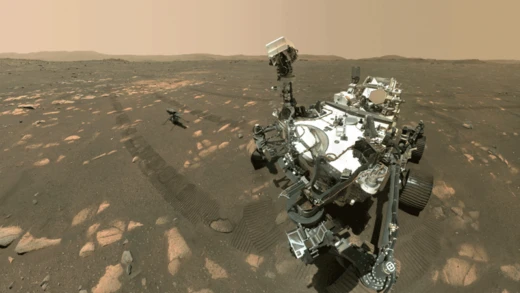
- In 2021, the NASA Mars rover Perseverance was able to make oxygen on Mars, though the process is complex and takes considerable time to produce a small amount.
More in Exploration of Mars 1-24
Spotted an error? Know more?
Reader corrections go straight into our review queue. Suggest an edit · How this site is sourced