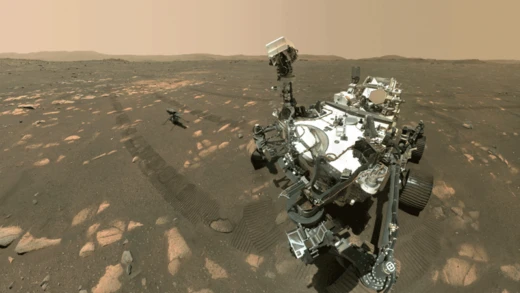
Mars landing
Ten robotic spacecraft have successfully soft-landed on Mars.

A Mars landing is the landing of a spacecraft on the surface of Mars. As of 2023, ten robotic, uncrewed spacecraft have achieved successful soft landings on Mars, with the Soviet Union, United States, and China having conducted such landings. The first successful landing was by the Soviet Mars 3 in 1971, though it failed after 14.5 seconds. Subsequent successful landings include NASA's Viking 1 and Viking 2 in 1976, Mars Pathfinder in 1997, and China's Tianwen 1 in 2021.
- First successful rover
- Sojourner, delivered by Mars Pathfinder in 1997
Lore & Background
The first attempted Mars landing was the Soviet Mars 1962B, which failed to launch. In 1971, Mars 2 and Mars 3 each carried a lander; Mars 2 crashed, but Mars 3 became the first to soft-land, though it transmitted data for only 14.5 seconds before failing, possibly due to a dust storm. Subsequent Soviet attempts, including Mars 6 and Mars 7 in 1973, also failed. The American Viking program succeeded in 1976 with two landers that transmitted extensive data, including color images and temperature readings. After a gap, Mars Pathfinder landed in 1997, deploying the first successful rover, Sojourner. In 2021, China's Tianwen 1 successfully landed its first rover.
Reader's Guide
Mars landings represent a significant technological achievement due to the planet's thin atmosphere and challenging entry, descent, and landing (EDL) process. All successful landings have used an aeroshell and parachute sequence, with three descent options: retrorockets for stationary landers, airbags for lighter rovers (e.g., Mars Pathfinder), and a sky crane for heavier rovers like Curiosity and Perseverance. The Soviet Union's early success with Mars 3 was followed by decades of failures, including the British Beagle 2, which landed in 2003 but was confirmed lost in 2015. The Viking program's use of orbiting spacecraft as communication relays set a standard for data transmission. Future heavier payloads may require new technologies like the Low-Density Supersonic Decelerator. The legacy of Mars landings includes evidence of past liquid water and a thicker atmosphere, as suggested by Mars Pathfinder data.
Did You Know?
- Mars 3 was the first successful Mars landing in 1971, but it failed after 14.5 seconds on the surface.
- The British Beagle 2 landed in 2003, but its landing was only confirmed in 2015 due to loss of contact.
- Not all Mars landings have used a standard aeroshell and parachute; for example, Mars 3 used a different entry system, and some landings like Mars Pathfinder used airbags for final descent.
- The Viking program's landers used orbiting spacecraft as communications satellites to relay data to Earth.
The Brutal Arithmetic of Reaching Mars
The journey to Mars has been one of the most unforgiving challenges in space exploration. Roughly sixty percent of all spacecraft sent toward the red planet failed before completing their missions, with some perishing before observations could even begin. The Soviet program's early attempts in the 1960s illustrate this harsh reality: Mars 2MV-3 No.1 in November 1962 never escaped low Earth orbit and burned up in the atmosphere. Even after the technology matured, failures continued in a long, painful list—Mars Observer in 1992, Mars 96 in 1996, Mars Climate Orbiter and Mars Polar Lander in 1999, Nozomi in 2003, Beagle 2 in 2003, Fobos-Grunt in 2011, and Schiaparelli in 2016. The engineering of interplanetary journeys is extraordinarily complicated, and the early attempts bore the brunt of this difficulty. Yet from this graveyard of failed probes, a growing body of knowledge about Martian geology and habitability potential has emerged, making each successful mission all the more precious.
Pioneering Firsts on the Red Planet
The story of Mars exploration is punctuated by landmark firsts that each opened a new chapter. In July 1965, NASA's Mariner 4 achieved the first successful flyby, sending back the first close-up images of another planet. Two and a half years later, in November 1971, Mariner 9 became the first spacecraft to orbit a planet other than Earth. That same year, the Soviet Union made history with surface contact: Mars 2 crashed during descent on November 27, but Mars 3 achieved the first soft landing on December 2, though its signal was lost shortly after. The Viking program in 1976 brought two orbiters and landers that successfully touched down, with Viking 1 operating for six years and Viking 2 for three, relaying the first color panoramas of the Martian surface. In July 1997, Mars Pathfinder delivered the small Sojourner rover to Ares Vallis, returning a wealth of images and marking a new era of mobile surface exploration.
Rovers That Outlived Their Warranties
Some Mars missions have defied every expectation of their design lifespans. NASA's twin Mars Exploration Rovers, Spirit and Opportunity, landed in January 2004 and operated for years far beyond their original specifications, becoming symbols of what robust engineering and favorable conditions can achieve on another world. Today, two rovers remain functional on the Martian surface: Curiosity and Perseverance, both operated by NASA. Perseverance was joined by the Ingenuity helicopter, which scouted promising sites for the rover's scientific study before its mission concluded in 2024. Not every rover has enjoyed such longevity. China's Zhurong rover, part of the Tianwen-1 mission, entered hibernation in May 2022 as sandstorms and Martian winter approached. It was expected to wake in December 2022, but as of April 2023 it had not moved and is presumed permanently inactive—a reminder that the Martian environment remains an adversary no engineer can fully tame.
Eyes in Orbit and the Science They Reveal
Six orbiters currently survey Mars from above, collectively amassing vast quantities of data about the planet. These include Mars Odyssey, Mars Express, the Mars Reconnaissance Orbiter, the Trace Gas Orbiter, the Hope Mars Mission, and Tianwen-1. Their contributions have been transformative. Mars Odyssey's Gamma Ray Spectrometer detected significant hydrogen in the upper metre of regolith, pointing to large deposits of water ice beneath the surface. The European Space Agency's Mars Express, which reached Mars in 2003, made two remarkable announcements: in early 2004, its Planetary Fourier Spectrometer team reported methane in the atmosphere—a potential biosignature—and in June 2006, the agency confirmed the discovery of aurora on Mars. The surface itself is organized into thirty quadrangles, each named for a prominent physiographic feature, providing a systematic framework for the ongoing geological study that these orbiters support.
Frequently Asked Questions
What is a Mars landing?
A Mars landing is the event in which a spacecraft makes a soft touchdown on the surface of the red planet. Every successful landing to date has involved an uncrewed robotic vehicle rather than a crewed mission.
Who was first to land on Mars?
The Soviet Mars 3 probe achieved the first successful touchdown in 1971, but it lost contact after just 14.5 seconds of operation. No earlier attempt had managed to survive the descent and stay on the surface.
Which nations have successfully landed a spacecraft on Mars?
Only three countries have pulled off a soft landing on Mars: the Soviet Union, the United States, and China. All ten successful landings recorded as of 2023 came from these three nations.
What was the first rover to drive on Mars?
Sojourner holds that distinction, having been carried to the surface by NASA's Mars Pathfinder lander in 1997. It was the first wheeled vehicle ever to operate on Martian soil.
How many spacecraft have successfully landed on Mars?
As of 2023, ten uncrewed robotic spacecraft have completed successful soft landings on the Martian surface. Notable examples include NASA's Viking 1 and Viking 2 in 1976 and China's Tianwen 1 in 2021.
More in Exploration of Mars 1-24
Spotted an error? Know more?
Reader corrections go straight into our review queue. Suggest an edit · How this site is sourced