Cape York (Mars)
Mars location explored by Opportunity rover for clay smectites.

Cape York is a location on Mars, situated on the western rim of Endeavour crater. It was explored by the Opportunity rover (MER-B) in the early 2010s after the rover arrived at Endeavour crater in August 2011. The site was of scientific interest because the CRISM instrument on the Mars Reconnaissance Orbiter identified clay smectites in the area, prompting the rover's investigation.
- Type
- Martian geological feature
- Location
- Western rim of Endeavour crater, Mars
- Discovery instrument
- CRISM on Mars Reconnaissance Orbiter
- Key rover
- Opportunity (MER-B)
- Arrival date
- Sol 2709 (August 9, 2011)
- Notable sites
- Greeley Haven, Matijevic Hill, Spirit Point, Odyssey crater
Lore & Background
Cape York is a segment of the western rim of Endeavour crater on Mars. The Opportunity rover arrived at this feature on sol 2709 (August 9, 2011), at a landmark called Spirit Point, named after its rover twin. The rover had traversed 21 km (13 mi) from Victoria crater over three years to reach this point. Opportunity spent about two years exploring Cape York in the early 2010s before moving south. The CRISM instrument on the Mars Reconnaissance Orbiter had identified clay smectites in the area, which was a key reason for sending the rover there. During its stay, Opportunity spent its fifth Martian winter at a location called Greeley Haven at Cape York, where it also took a panorama. The rover was stationed at Greeley Haven for 19 weeks to survive the winter and resumed movement in May 2012 to further explore Cape York. Other locations and science targets at Cape York include Chester Lake, Esperance, Grasberg, Homestake rock, Matijevic Hill, Monte Cristo, Odyssey crater, Tisdale 2, Whitewater Lake outcrops, and Whim Creek. Odyssey crater is on the southern end of Cape York.
Reader's Guide
Cape York holds significance as a site where the Opportunity rover investigated clay smectites, minerals that form in the presence of water, providing evidence of past aqueous environments on Mars. The rover's two-year exploration of this rim segment, including its winter survival at Greeley Haven, demonstrated the longevity and scientific productivity of the mission. The identification of clay smectites by the CRISM instrument guided the rover's traverse, highlighting the synergy between orbital and surface exploration. Cape York also served as a gateway to further southward exploration, with areas like Botany Bay, Sutherland Point, Nobby's Head, and Solander Point lying beyond. The site's diverse science targets, such as Matijevic Hill and Homestake rock, contributed to understanding the geological history of Endeavour crater's rim. The rover's arrival at Spirit Point marked the culmination of a three-year, 21 km journey from Victoria crater, underscoring the endurance of the MER-B mission.
Did You Know?
- The Opportunity rover arrived at Cape York at Spirit Point on sol 2709 (August 9, 2011).
- Opportunity spent its fifth Martian winter at Greeley Haven at Cape York, stationed there for 19 weeks.
The Gauntlet of Interplanetary Travel
Sending a spacecraft to Mars is among the most demanding engineering challenges humanity has attempted, and the record reflects just how punishing the journey can be. Roughly sixty percent of all probes launched toward the red planet have failed before completing their intended missions, with some perishing before they could even begin gathering observations. The early attempts in the late twentieth century were particularly brutal, as engineers were still learning the physics of interplanetary transfer and the harsh realities of the Martian environment. Yet this grim statistic coexists with stories of extraordinary resilience. The twin Mars Exploration Rovers, Spirit and Opportunity, far exceeded their designed operational lifetimes, continuing to traverse and analyze the Martian surface for years beyond what their specifications called for. This duality—devastating loss alongside unexpected triumph—defines the emotional landscape of Mars exploration and underscores why each successful mission feels like a hard-won victory against the odds.
The Living Fleet on and Above Mars
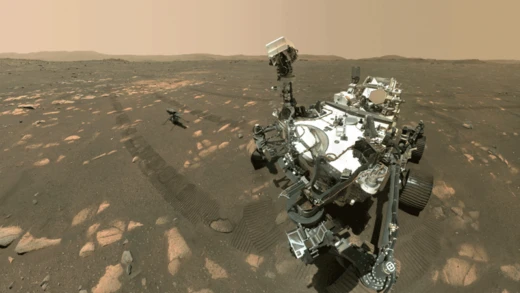
As of the mid-2020s, Mars hosts an active and diverse fleet of robotic instruments. Two rovers remain functional on the surface: NASA's Curiosity and Perseverance. Perseverance was notably accompanied by the Ingenuity helicopter, which performed aerial scouting of terrain for the rover to examine before its mission concluded in 2024. China's Zhurong rover, part of the Tianwen-1 program by CNSA, operated until May 2022 when approaching sandstorms and the onset of Martian winter forced it into hibernation. A planned awakening in December 2022 never materialized, and by April 2023 the vehicle had shown no movement, leading observers to presume it was permanently inactive. Above the planet, six orbiters continue to survey Mars from space—Mars Odyssey, Mars Express, Mars Reconnaissance Orbiter, the Trace Gas Orbiter, the Hope Mars Mission, and Tianwen-1—collectively delivering enormous volumes of scientific data. In April 2024, NASA selected multiple companies to begin feasibility studies for commercial services that would support future robotic science operations on the planet.
The Clock of Opportunity
Unlike a road trip where you can depart at any hour, a mission to Mars is governed by the orbital mechanics of two planets. The minimum-energy launch windows open at intervals of roughly two years and two months—precisely 780 days, which corresponds to the synodic period between Earth and Mars. Missing a window means waiting another full cycle before the geometry of the two orbits aligns favorably for a low-energy transfer. Beyond this biennial rhythm, there is a longer modulation: the lowest available transfer energy oscillates on a cycle of approximately sixteen years. Historical examples illustrate this pattern clearly. Energy requirements hit a minimum during the 1969 and 1971 windows, climbed to a peak in the late 1970s, then dropped again to lows in 1986 and 1988. This layered temporal structure means that mission planners must think in terms of both the immediate two-year window and the broader multi-decade energy landscape, making the timing of a launch a strategic decision as much as a technical one.
Pioneers and Firsts
The story of robotic Mars exploration is punctuated by a succession of firsts that each redefined what was possible. The Soviet program opened the era in 1960 with a series of probes, including the first intended flyby and the first attempted hard landing, both of which failed. NASA's Mariner 4 then achieved the first successful flyby in July 1965, followed by Mariner 9 becoming the first probe to orbit another planet in November 1971. That same year, the Soviet Mars 2 and Mars 3 landers made the first attempts to touch down on the surface; Mars 2 crashed, but Mars 3 accomplished the first soft landing. The Viking program in 1976 delivered two successful landers that relayed the first color panoramas of the Martian landscape. In 1997, Mars Pathfinder carried the tiny Sojourner rover to Ares Vallis, and in January 2004 the twin MER rovers Spirit and Opportunity touched down, both going on to exceed every operational expectation. Each milestone built upon the last, transforming Mars from a distant smudge in the sky into a world mapped, sampled, and studied in ever-greater detail.
Frequently Asked Questions
What is Cape York (Mars)?
Cape York is a named geological feature on the western rim of Endeavour crater on Mars. It became a targeted exploration site because orbital observations revealed clay smectite minerals in the surrounding terrain.
How did scientists identify Cape York (Mars) as a worthwhile target?
The CRISM imaging spectrometer on the Mars Reconnaissance Orbiter detected signatures of smectite clays in that region. Those mineral signatures indicated past liquid-water interactions, making the site a priority for in-situ investigation.
Which rover explored Cape York (Mars) and when did it arrive?
Opportunity (MER-B) reached the area around Sol 2709, corresponding to August 9, 2011, shortly after it drove into Endeavour crater. The rover spent the following months sampling and imaging the smectite-bearing rocks and soils there.
Why is Cape York (Mars) important for understanding Mars' history?
Smectite clays form in the presence of water and specific pH conditions, so their occurrence points to an ancient aqueous environment. Studying them in situ gave scientists direct evidence about the wet, mild conditions that once existed on the Martian surface.
What other notable landmarks are near Cape York (Mars)?
The broader Endeavour crater exploration zone includes several other named features such as Greeley Haven, Matijevic Hill, Spirit Point, and Odyssey crater. Together these sites formed the extended route Opportunity traversed during its extended mission in the early 2010s.
More in Exploration of Mars 1-24
Spotted an error? Know more?
Reader corrections go straight into our review queue. Suggest an edit · How this site is sourced