Flag of Mars
Concepts for flags representing the planet Mars.

A flag of Mars is a concept of a possible flag design, meant to symbolize the planet Mars or to represent a fictional Martian government, in works of fiction. Proposed designs include those by Thomas O. Paine and Pascal Lee, as well as various flags appearing in science fiction.
- First proposed design
- Thomas O. Paine, 1984
- Second proposed design
- Pascal Lee, 1999
- Notable recipient of paine's flag
- Ray Bradbury, 2005
- Flown into space
- Pascal Lee's design on STS-103
- Featured in fiction
- Multiple works from 1953 to 2015
Lore & Background
Thomas O. Paine, the third Administrator of NASA, designed a Mars flag in 1984. His design includes a sliver of Earth near the hoist side and a star near the other side, with a representation of the Mars planet symbol in the center. The flag was illustrated by artist Carter Emmart and published on the cover of The Planetary Report. Paine created the flag as an award for advancing human exploration of Mars. On November 12, 2005, Ray Bradbury received a Mars flag as part of the Thomas O. Paine Award for the Advancement of Human Exploration of Mars, presented during The Planetary Society's 25th Anniversary Awards Dinner.
Pascal Lee, a research engineer at NASA Ames through a contractor or affiliated institute, designed a tricolor flag for Mars in 1999. It was flown into space on STS-103 by astronaut John M. Grunsfeld. The colors red, green, and blue represent the transformation of Mars from a lifeless planet to one teeming with life, inspired by Kim Stanley Robinson's Mars trilogy. It is also flown at the Flashline Mars Arctic Research Station on behalf of the Mars Society.
In science fiction, various flags appear. In the 1953 Chuck Jones cartoon Duck Dodgers in the 24½th Century, Marvin the Martian carries a white triangular flag with a red circle. In Robert A. Heinlein's 1961 novel Stranger in a Strange Land, a flag of Mars is improvised with a white field and the sigil of Mars in red. Greg Bear's 1994 novel Moving Mars describes a flag with red Mars and two moons in a blue field above a diagonal, white below. The 1996 film Mars Attacks! features a green flag with a black circle, red pyramid, and an eye. In James S. A. Corey's 2011 book Leviathan Wakes, the flag depicts a lonely star and thirty stripes. The 2015 television series The Expanse shows a flag of the Martian Congressional Republic divided horizontally into orange and black stripes, with a hollow red circle, a blue crescent, and dots for Phobos and Deimos, created by graphic designer Jonathan Hunter.
Reader's Guide
The concept of a flag of Mars serves both as a symbol for the planet itself and as a representation of fictional Martian governments in literature and media. Thomas O. Paine's 1984 design, created as an award for advancing human exploration, links the flag to real-world space advocacy and was presented to Ray Bradbury in 2005. Pascal Lee's 1999 tricolor flag, flown into space on STS-103, ties the concept to actual spaceflight and the Mars Society's research stations. The numerous science fiction depictions, from Marvin the Martian's flag in 1953 to the detailed design in The Expanse television series, show how the flag of Mars has become a recurring motif in popular culture, reflecting evolving ideas about Mars colonization and governance. These designs collectively illustrate the intersection of vexillology, space exploration, and speculative fiction, offering a visual shorthand for humanity's aspirations and narratives about the Red Planet.
Did You Know?
- Thomas O. Paine, the third NASA Administrator, designed a Mars flag in 1984.
- The flag of the Martian Congressional Republic in The Expanse television series was created by graphic designer Jonathan Hunter.
Pioneering the Red Planet and the Price of Failure
Humanity's first attempts to reach Mars began in 1960 with a string of Soviet probes, including the earliest planned flybys and impact landings. The very first of these, Mars 2MV-3 No.1, launched in November 1962, never even escaped low Earth orbit and burned up in our atmosphere. It would take another three years before NASA's Mariner 4 achieved the first successful close flyby in July 1965, and a further six years before Mariner 9 became the first craft to enter orbit around another planet in November 1971. That same year brought the first surface contacts: the Soviet Mars 2 crashed during descent, while Mars 3 achieved the first soft landing on December 2. The following decade saw NASA's Viking orbiters and landers succeed in 1976, with Viking 1 operating for six years. Despite these milestones, nearly six in ten Mars-bound spacecraft have been lost before their missions could be fulfilled, a sobering statistic that underscores just how difficult interplanetary travel remains. Yet among the losses, stories like the twin rovers Spirit and Opportunity, which far outlasted their designed lifespans, remind us that perseverance can yield extraordinary results.
The Active Fleet: Rovers, Orbiters, and New Frontiers
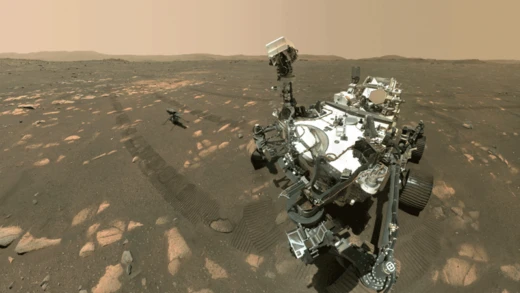
Today, two NASA rovers—Curiosity and Perseverance—continue to traverse the Martian surface, gathering data that deepens our understanding of the planet's geology and potential for habitability. Perseverance was joined by the Ingenuity helicopter, which performed aerial scouting of candidate study sites before its mission concluded in 2024. China's Zhurong rover, part of the Tianwen-1 mission, operated until May 2022, when approaching sandstorms and the onset of Martian winter forced it into hibernation. Though a December 2022 wake-up was anticipated, the rover had not moved by April 2023 and is now presumed permanently inactive. Above the surface, six orbiters maintain a continuous watch: Mars Odyssey, Mars Express, Mars Reconnaissance Orbiter, the Trace Gas Orbiter, the Hope Mars Mission, and Tianwen-1, collectively contributing vast quantities of scientific information. Looking ahead, in April 2024 NASA selected several commercial companies to begin studies on providing services that would further enable robotic science operations on Mars, signaling a shift toward broader participation in planetary exploration.
Reading the Red Planet: From Telescopes to Orbital Science
Long before any spacecraft left Earth, telescopic observations of Mars sparked the imagination. Early astronomers interpreted seasonal color shifts as vegetation and mistook linear surface features for evidence of intelligent construction. Subsequent observations revealed the moons Phobos and Deimos, polar ice caps, and the colossal Olympus Mons, the tallest mountain in the entire Solar System. These discoveries fueled decades of interest in the red planet. We now know Mars is a rocky world that formed alongside Earth, yet it possesses only half our planet's diameter, a thin atmosphere, and a cold, desert-like surface. The planet's surface is organized into thirty quadrangles, each named after a prominent physiographic feature. Orbital science has added crucial layers to this picture: Mars Odyssey's Gamma Ray Spectrometer identified significant hydrogen in the upper regolith, likely indicating substantial water-ice deposits, while Mars Express detected methane in the atmosphere—a possible biosignature—and in 2006 confirmed the existence of aurora on Mars.
The Clockwork of Launch Windows and Engineering Challenges
Launch windows offering the lowest energy requirements for a Mars expedition recur roughly every two years and two months—a span of 780 days that matches the synodic period between Earth and Mars. Beyond this biennial rhythm, the lowest available transfer energy fluctuates on a roughly sixteen-year cycle. Historical minima occurred in the 1969 and 1971 windows, rose to a peak in the late 1970s, and dipped again in 1986 and 1988. These constraints mean that mission planners must align their ambitions with a fixed astronomical calendar rather than choosing departure dates freely. Engineering an interplanetary journey is inherently complex, and the exploration program has borne the cost: in some cases the vehicles were gone before a single observation was recorded. This high failure rate, particularly prominent in the early attempts, reflects the extreme challenges of navigating, entering orbit, and landing on a distant world. The combination of rigid launch timing and unforgiving engineering demands makes every successful Mars mission a remarkable achievement against the odds.
Frequently Asked Questions
Who is credited with the first proposed flag design for Mars?
Thomas O. Paine put forward the earliest known concept for a Martian flag back in 1984, establishing a visual identity for the red planet that later designers would build upon.
What exactly is the Flag of Mars?
It refers to a collection of proposed flag concepts designed to symbolize the planet Mars or to stand in for a fictional Martian government. These designs have appeared in both real-world proposals and science fiction narratives.
Has a Mars flag design ever actually been in space?
Yes — Pascal Lee's 1999 flag concept was carried aboard the Space Shuttle mission STS-103, making it one of the few proposed Martian flags to leave Earth's atmosphere.
Who is a notable figure connected to the Mars flag?
Science fiction legend Ray Bradbury was presented with Thomas O. Paine's flag design in 2005, a tribute to Bradbury's decades of writing about life on Mars.
How long has the Mars flag appeared in fiction?
Flag concepts for Mars have shown up in science fiction works spanning from 1953 all the way through 2015, giving the idea a long and varied presence across the genre.
More in Exploration of Mars 1-24
Spotted an error? Know more?
Reader corrections go straight into our review queue. Suggest an edit · How this site is sourced