Indian Mars exploration missions
ISRO's ongoing series of Mars exploration missions.

ISRO's exploration of Mars is an ongoing program, currently focused on orbiter missions. So far, one spacecraft has been placed in orbit around the planet; it lost contact with Earth in 2022. A second mission is under consideration for a future launch window, though no official name or date has been confirmed.
The first mission, the Mars Orbiter Mission (MOM), launched in 2013. Designed to operate for six months, it far exceeded expectations, remaining active for over seven years before contact was lost.
The proposed second mission will operate in a lower orbit than its predecessor, with its closest and farthest points from the surface much nearer to Mars. It will carry a larger scientific payload, including a hyperspectral camera, a very high-resolution panchromatic camera, and a radar. These instruments are intended to study Mars' early crust, recent basalts, and ongoing surface activity like boulder falls. A rover is a proposed component, but the payload has not been finalized.
ISRO has also conceptualized a Mars UAV called Marble (Martian Boundary Layer Explorer). This aerial vehicle, currently only a conceptual study, is designed to fly up to 100 meters in the thin Martian atmosphere to profile it. It will conduct high-resolution vertical measurements of critical atmospheric parameters and perform the first in-situ readings in the near-surface boundary layer. Its payloads include sensors for temperature, humidity, pressure, wind speed, electric field, and trace species and dust to measure the vertical distribution of dust aerosols. This information was shared by Jayadev Pradeep, a scientist at the Space Physics Laboratory of the Vikram Sarabhai Space Centre, during a webinar.
Quick Facts
- Country
- India
- Organization
- ISRO
- Programme
- y
- Purpose
- Exploration of Mars
- Duration
- 2013–present
- Firstflight
- Mars Orbiter Mission, · 2013 · 11 · 5
- Launchsite
- Satish Dhawan Space Centre
- Launcher
- PSLV-XL
Facts from the source article.
Lore & Background
The first mission, known as Mars Orbiter Mission (MOM), was launched in 2013 carrying the Mars Orbiter Mission orbiter. Originally expected to operate for six months, it lived well past its expected lifetime and lost contact with Earth in 2022, lasting over seven years. A second Indian mission to Mars is proposed, which will operate in a lower orbit with Periareon and Apoareon altitude closer to the Martian surface. It will carry greater scientific payload including a hyperspectral camera, a very high resolution panchromatic camera, and a radar to study Mars' early crust, recent basalts, and ongoing activities such as boulder falls. A rover is a proposed component, but the payload has not been finalized. ISRO has also conceptualized a Mars UAV called Marble (Martian Boundary Layer Explorer) with a suite of payloads for aerial exploration, capable of flying up to 100 meters in the thin Martian air to profile the atmosphere. It will conduct high-resolution vertical profiling of critical atmospheric parameters and perform first-of-its-kind in-situ measurements in the near-surface boundary layers of Mars. However, Marble remains only a conceptual study, not an officially confirmed payload.
Reader's Guide
The Indian Mars exploration missions represent a significant step in planetary science for ISRO. The Mars Orbiter Mission demonstrated India's capability to reach Mars orbit and operated far beyond its planned six-month lifespan, providing extended data before losing contact in 2022. The planned Mars Lander Mission for 2030 aims to advance understanding of Mars' early crust, recent basalts, and ongoing surface activities through a lower orbit and enhanced instruments. The inclusion of the Marble UAV, designed to fly up to 100 meters in the thin Martian atmosphere, would enable unprecedented vertical profiling of atmospheric parameters. These missions contribute to global knowledge of Mars' geology and atmosphere, and the information shared by scientist Jayadev Pradeep during a webinar highlights the scientific community's engagement. The missions are part of ISRO's broader space exploration efforts, alongside the Chandrayaan programme and the Indian Human Spaceflight Programme.
Did You Know?
- The Mars Orbiter Mission (MOM) was launched in 2013 and lasted over seven years, far beyond its planned six-month mission.
- The second Indian Mars mission is proposed, but its official name and launch date have not been confirmed.
- The Marble UAV is a conceptual study designed to fly up to 100 meters in the thin Martian air for atmospheric profiling.
The Brutal Odds of Reaching the Red Planet
The journey to Mars has historically been one of the most punishing challenges in all of spaceflight. Roughly sixty percent of every spacecraft destined for the red planet failed before completing its mission, and some perished before observations could even begin. The Soviet program's early 1960s attempts included probes that never managed to leave low Earth orbit, decaying and disintegrating in the atmosphere, as well as others that crashed during descent. The 1971 Mars 2 lander failed during its descent and was lost in a crash, while its successor Mars 6 in 1974 managed only corrupted atmospheric data before failing. The 1988 Phobos 1 lost contact en route, and Phobos 2 failed before it could deploy its two surface landers. A long and sobering list of later failures followed: Mars Observer in 1992, Mars 96 in 1996, Mars Climate Orbiter and Mars Polar Lander both in 1999, Nozomi and Beagle 2 in 2003, Fobos-Grunt in 2011, and Schiaparelli in 2016. Each loss underscored how unforgiving interplanetary navigation and entry systems remain, even as technology steadily improves.
A Timeline of Firsts That Redrew the Map
Mars exploration was built on a sequence of hard-won firsts that progressively expanded humanity's reach. In July 1965, NASA's Mariner 4 achieved the first successful flyby of the planet, returning close-up imagery that transformed our understanding. Two and a half years later, Mariner 9 became the first space probe to orbit another planet, entering Martian orbit in November 1971. That same year, the Soviet Mars 3 lander accomplished the first soft landing on Mars in December, following the crash of its twin, Mars 2, which had failed during descent. NASA's Viking program in 1976 delivered two orbiters and two landers that successfully touched down, with Viking 1 remaining operational for six years and Viking 2 for three, relaying the first color panoramas of the surface. The 1997 Mars Pathfinder mission carried the Sojourner rover to Ares Vallis, returning numerous images. Then in January 2004, the twin rovers Spirit and Opportunity landed, both operating for years far beyond their design specifications—a testament to how engineering reliability had finally caught up with the ambition of interplanetary travel.
Mars as a World: What the Instruments Reveal
Mars is a rocky planet that formed around the same epoch as Earth, yet it is only half Earth's diameter and wrapped in a thin atmosphere, giving it a cold, desert-like surface. Early telescopic observations had suggested seasonal vegetation and even intelligent design behind apparent linear features, but subsequent observations revealed two small moons—Phobos and Deimos—polar ice caps, and Olympus Mons, the tallest mountain in the Solar System. The planet's surface is catalogued into thirty quadrangles, each named for a prominent physiographic feature within that region. Scientific instruments have deepened our understanding considerably: Mars Odyssey's Gamma Ray Spectrometer detected significant hydrogen in the upper metre or so of regolith, interpreted as evidence of large water-ice deposits. ESA's Mars Express detected methane in the Martian atmosphere in early 2004—a potential biosignature—and announced the discovery of aurora on Mars in June 2006. These findings continue to fuel questions about the planet's geology and its potential habitability.
The Present Fleet and the Road Ahead
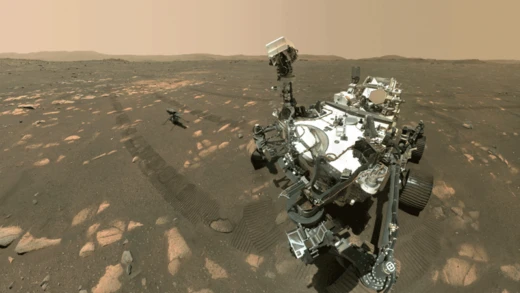
As of the latest reporting, two functional rovers—Curiosity and Perseverance, both NASA assets—operate on the Martian surface. Perseverance was joined by the Ingenuity helicopter, which scouted sites for the rover to study before the helicopter's mission ended in 2024. China's Zhurong rover, part of the Tianwen-1 mission by the China National Space Administration, entered hibernation in May 2022 due to approaching sandstorms and Martian winter; it was expected to wake in December 2022, but by April 2023 it had not moved and is presumed permanently inactive. Six orbiters continue to survey the planet: Mars Odyssey, Mars Express, Mars Reconnaissance Orbiter, the Trace Gas Orbiter, the Hope Mars Mission, and Tianwen-1, collectively contributing massive volumes of information. In April 2024, NASA chose a group of companies to kick off studies aimed at delivering commercial services that would further support robotic science operations on Mars, signaling a shift toward a broader, multi-stakeholder approach to sustaining exploration of the red planet.
Frequently Asked Questions
What is Indian Mars exploration missions?
It refers to ISRO's ongoing series of robotic Mars orbiter missions, beginning with the Mars Orbiter Mission in 2013. As of now, one spacecraft has completed its operational life and a second mission is being studied for a future launch window.
What happened to India's first Mars orbiter?
The Mars Orbiter Mission (MOM) launched in 2013 and was originally slated for a six-month science campaign. It kept operating well beyond that window, lasting more than seven years, before Earth lost communication with the spacecraft in 2022.
Is there a confirmed second Indian Mars mission?
A follow-up mission is under active consideration, but ISRO has not yet published an official name or a locked-in launch date. The plan calls for it to fly in a lower Mars orbit than MOM in order to gather higher-resolution data.
What instruments and vehicles are proposed for the next Indian Mars mission?
The working payload list includes a hyperspectral imager, a panchromatic camera, and a radar sounder. A small rover and a micro-UAV nicknamed "Marble" have also been floated, though neither has been finalized for the mission.
Why do fans consider Indian Mars exploration a milestone?
India reached Mars orbit on its very first attempt, making it the first Asian country to do so and the first nation to succeed on a debut interplanetary try. The program's longevity—MOM outlasting its design life by more than a factor of ten—also set a benchmark for cost-effective deep-space operations.
More in Exploration of Mars 1-24
Spotted an error? Know more?
Reader corrections go straight into our review queue. Suggest an edit · How this site is sourced