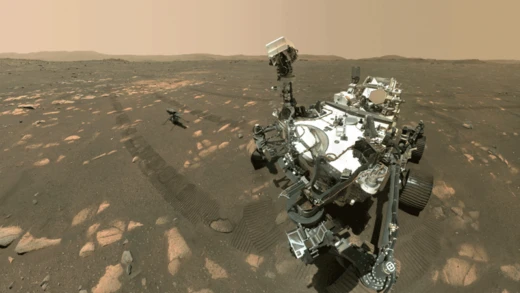
Martian regolith
Unconsolidated surface layer of Mars, toxic due to perchlorates.

Martian regolith is the loose, mixed layer of surface material that covers Mars. The finer part of this layer is often called Martian soil. Unlike Earth soil, which contains organic matter, Martian soil is defined by its physical properties: it includes any unconsolidated material fine enough to be moved by wind, while rocks are considered to be fragments larger than about 10 centimeters that stay put under normal wind conditions. This practical definition helps scientists using different types of remote sensing—from gamma rays to radio waves—agree on what they are measuring. Martian soil can include ripples, dunes, sediment fragments, concretions, dust, sand, and rocky pieces. Martian dust is even finer, made up of particles smaller than 30 micrometers.
A key hazard of Martian regolith is its toxicity, caused by high levels of perchlorate compounds. Chlorine was first detected in Martian soil by the Mars Pathfinder lander's APXS instrument, and later confirmed by Spirit, Opportunity, and Curiosity. The Mars Odyssey orbiter has also found perchlorates across the planet. Calcium perchlorate was first identified in 2008 by the Phoenix lander, at concentrations around 0.5%—a level toxic to humans and plants. A 2013 Earth-based study showed that a 0.5 gram per liter concentration reduced chlorophyll in plant leaves, weakened root oxidizing power, shrank plant size above and below ground, and caused perchlorates to build up in leaves. One plant, Eichhornia crassipes, resisted the perchlorates and could be used to remove them, though it would then contain high levels itself. Some bacteria can adapt to or even live on perchlorates. In 2022, NASA and the U.S. National Science Foundation funded research into using the bacterium Dehalococcoides mccartyi to break perchlorates into harmless chlorides and oxygen. However, the strong ultraviolet radiation on Mars breaks molecular bonds, creating even more dangerous chemicals that are more lethal to bacteria than perchlorates alone. Combined with cold temperatures, this means plants would need to be grown indoors.
The chlorine in Martian perchlorates likely comes from volcanoes or the weathering of basalt by water, while the oxygen probably comes from the atmosphere, with some contribution from minerals.
- Water content
- Water-equivalent hydrogen up to ~5% in high-latitude soils (Mars Odyssey data); equatorial regolith has much lower water content
Lore & Background
Fine Martian dust poses a health hazard, reacting with water to produce reactive molecules linked to lung disease. NASA's MEPAG has studied dust toxicity since 2001. The Mars 2020 rover Perseverance carries instruments (including MEDA, PIXL, SHERLOC) to study the environment and has been caching samples for potential return to Earth since 2021. The regolith in high-latitude regions contains water-equivalent hydrogen up to about 5% by weight, but equatorial regolith is much drier. Physical weathering currently dominates. The Phoenix lander found the regolith slightly alkaline with nutrients like magnesium, sodium, potassium, and chloride, comparing it to Earth garden soil.
Reader's Guide
Martian regolith is significant as the primary surface material on Mars, shaping both robotic and future human exploration. Its toxicity from perchlorates at 0.5% concentration poses a direct challenge for human habitation and agriculture, requiring mitigation strategies such as bacterial breakdown or indoor growth. The fine dust, reactive with water, adds respiratory hazards. Understanding regolith composition informs resource utilization—water extraction, nutrient availability, and construction—and helps interpret Mars' geological history, including past water activity and current aeolian processes. The functional definition of soil, distinct from terrestrial organic soil, enables consistent remote sensing across the electromagnetic spectrum. Ongoing missions like Mars 2020 aim to quantify these hazards and cache samples for Earth-based analysis, which could resolve uncertainties about toxicity and habitability. The regolith's slightly alkaline pH and presence of essential nutrients suggest that with perchlorate removal, it could support plant growth, as noted by Phoenix scientists. Its role as a record of environmental history, without requiring life to form, makes it a key target for astrobiology and planetary science.
Did You Know?
- Martian regolith contains perchlorates at about 0.5%, a level toxic to humans.
- The Phoenix lander found the regolith to be slightly alkaline with nutrients like magnesium, sodium, potassium, and chloride.
- Mars dust is less than 30 micrometres in diameter and can produce reactive molecules when mixed with water.
- The Mars 2020 rover will cache samples for potential return to Earth to study dust toxicity.
More in Exploration of Mars 1-24
Spotted an error? Know more?
Reader corrections go straight into our review queue. Suggest an edit · How this site is sourced