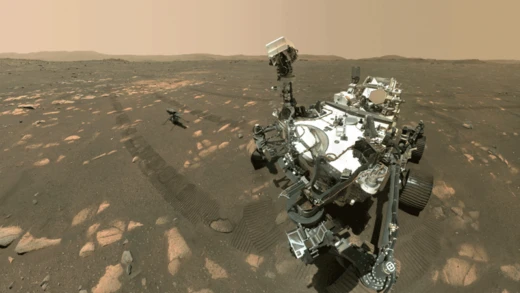
Mars Exploration Program
NASA's long-term program to explore Mars.

The Mars Exploration Program (MEP) is a NASA-led, long-term initiative to study Mars that began in 1993, though the program was formally established in 1994 after the Mars Observer failure. It employs orbiters, landers, and rovers to examine the planet’s potential for life, its climate, and its natural resources. The program is overseen by NASA’s Science Mission Directorate. After the Mars Exploration Program faced a roughly 40% reduction in its own budget for the 2013 fiscal year due to sequestration and the cancellation of the ExoMars partnership, the Mars Program Planning Group (MPPG) was created to restructure the MEP, bringing together experts from NASA’s Science Mission Directorate, Human Exploration and Operations Mission Directorate, and the Office of the Chief Technologist.
**Governance** The Mars Exploration Program Analysis Group (MEPAG) first met in October 1999, allowing the scientific community to help plan and prioritize MEP activities. Mars missions are often expensive; for instance, the Curiosity rover, which landed in August 2012, cost approximately $2.5 billion (including development, launch, and operations through its prime mission). NASA also aims to partner with the European Space Agency (ESA) on a mission to return a sample of Martian soil to Earth, a project that would likely cost at least $5 billion and take a decade to complete.
**Objectives** NASA identifies four broad MEP goals, all focused on understanding Mars’s potential for life.
* **Determine if life ever arose on Mars** – This starts with assessing whether the planet could have supported life. The program’s main strategy, “Follow the Water,” is based on the idea that where water exists, life is possible (as seen on Earth). If life ever emerged on Mars, it likely required a long-lasting water supply, so MEP searches for places where water is, was, or could be—such as ancient riverbeds, underground, or in polar ice caps. Life also needs energy. Because superoxides on the surface make sunlight an unlikely energy source, MEP looks for alternatives like geothermal or chemical energy, which sustain microscopic life beneath Earth’s surface. Scientists also search for biosignatures—traces of past or present life.
- Formed
- 1993 (formally established 1994)
- Field
- Planetary exploration
- Nationality
- United States (NASA)
- Known for
- Exploring Mars for signs of life, climate, and geology
- Budget challenge
- Roughly 40% cut to MEP budget in fiscal year 2013
Lore & Background
The Mars Exploration Program began in 1993, but was formally established in 1994 after the Mars Observer failure, to coordinate NASA's efforts to study Mars. It has deployed orbiters, landers, and rovers to assess the planet's habitability, climate, and resources. In response to a roughly 40% reduction to the MEP's own budget for fiscal year 2013 (due to sequestration and the cancellation of the ExoMars partnership), the Mars Program Planning Group was convened to restructure the program, bringing together leaders from NASA's Science Mission Directorate, Human Exploration and Operations Mission Directorate, and the Office of the Chief Technologist.
The program's scientific community input is facilitated by the Mars Exploration Program Analysis Group (MEPAG), which first convened in October 1999. Missions under MEP can be costly; for example, the Curiosity rover, which landed in August 2012, had a total cost of approximately $2.5 billion.
Reader's Guide
The Mars Exploration Program represents NASA's sustained commitment to understanding Mars as a potential habitat for life and as a destination for human exploration. Its significance lies in systematically addressing fundamental questions about the planet's past and present habitability, climate, and geology. By coordinating orbital, landed, and rover missions, MEP has advanced knowledge of Mars's water history, atmospheric dynamics, and surface processes. The program's 'Follow the Water' strategy has shaped mission priorities, leading to discoveries of ancient riverbeds and evidence of past water activity. The formation of the Mars Program Planning Group after budget cuts highlights the program's adaptability in the face of fiscal constraints. MEP's legacy includes not only scientific insights but also the development of technologies for entry, descent, and landing that are critical for future human missions. The program's collaborative efforts with the European Space Agency for a sample-return mission underscore its role in international space exploration. Despite high failure rates and engineering hurdles, MEP continues to drive progress in planetary science and exploration.
Did You Know?
- The Mars Exploration Program was formed in 1993 and is managed by NASA's Science Mission Directorate.
- The Curiosity rover, which landed on Mars in August 2012, had a budget exceeding $2.5 billion.
- Mars's atmosphere is about 100 times thinner than Earth's, complicating entry, descent, and landing.
- The Mars Exploration Program Analysis Group (MEPAG) first convened in October 1999 to gather scientific input.
More in Exploration of Mars 1-24
Spotted an error? Know more?
Reader corrections go straight into our review queue. Suggest an edit · How this site is sourced