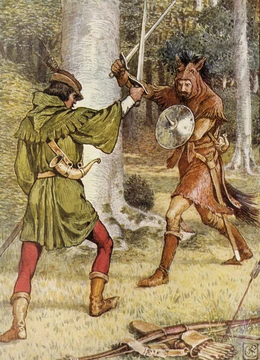
King Lindworm
A Danish fairy tale of a serpent prince disenchanted by a maiden.

King Lindworm, or Prince Lindworm (Danish: *Kong Lindorm*), is a Danish fairy tale collected and published in the 19th century by folklorist Svend Grundtvig. It belongs to the broader Animal as Bridegroom story cycle and is classified as ATU type 433B, a category in which a maiden breaks the enchantment of a serpentine husband.
In the tale, a queen who longs for a child follows an old woman’s advice to eat one of two roses—one red, one white—but not both. Forgetting, she eats both, and as a result gives birth to twin sons: the first is a lindworm, a creature half-man and half-snake, while the second is perfectly human. When the human prince grows up and seeks a bride, the lindworm insists that a wife be found for him first. None of the chosen maidens are willing, and he devours each one. Eventually, a shepherd’s daughter who has also spoken to the old woman agrees to marry him. She arrives wearing every dress she owns, and when the lindworm commands her to undress, she insists he shed one skin for each dress she removes. After the last skin falls away, his human form is revealed. Some versions omit the twin brother, and the gender of the soothsayer varies.
The tale was published in a collection of stories from the North, illustrated by Kay Nielsen, under the title *Prince Lindworm*.
In the first international folktale classification by Antti Aarne, this type was defined by a childless queen giving birth to a snake-shaped boy, who is disenchanted only after a maiden undresses with him and they enter a bath together. Scholar Bengt Holbek also referred to the type as King Wyvern. According to Svend Grundtvig’s own classification system, as translated by Astrid Lunding in 1910, the maiden may also disenchant the prince by whipping him in the bridal bed. Jan-Öjvind Swahn noted that the tale type is usually marked by the motifs of “release by bathing” and “seven shifts and seven skins.” Birgit Olsen added that in most versions, the heroine is advised by her mother’s spirit to wear many shifts on her wedding night.
Swedish scholar Waldemar Liungman observed that in the second part of the tale, the heroine faces a dilemma between a first and second husband, choosing the first. This dilemma appears in Nordic variants as well as in Eastern and Southeastern European ones.
Quick Facts
- Folk Tale Name
- King Lindworm
- Aarne-Thompson Grouping
- ATU 433B (Prince Lindworm)
- Aka
- Prince Lindworm
- Region
- Denmark
- Published In
- Gamle danske minder i folkemunde, by Svend Grundtvig (1854)
- Related
- The Bewitched Prince / The Dragon-Prince and the Stepmother / The Stepdaughter and the Black Serpent / The Girl With Two Husbands / Dragon-Child and Sun-Child
Facts from the source article.
Lore & Background
In the tale, a queen, childless, follows an old crone's advice to eat one of two roses but eats both, causing her first twin to be a lindworm—half-man, half-snake—while the second twin is perfect. When the younger brother seeks a bride, the lindworm insists on marrying first. He eats each unwilling bride until a shepherd's daughter, who also spoke to the crone, agrees to marry him. She wears every dress she owns, and as the lindworm sheds a skin for each dress she removes, his human form is revealed. Some versions omit the twin, and the soothsayer's gender varies.
Reader's Guide
King Lindworm is significant as a key variant of the international tale type ATU 433B, which deals with maidens disenchanting serpentine husbands. The tale is part of a broader cycle found across Scandinavia, the Near East, and India, with scholars like Stith Thompson and Anna Birgitta Waldmarson suggesting an origin in India that migrated to Scandinavia by the 17th century. The story's motifs—such as release by bathing, multiple shifts and skins, and the heroine's dilemma between two husbands—appear in Nordic and Mediterranean oikotypes. Variants from Denmark and Sweden often continue with the wife's adventures, including encounters with enchanted bird princes. The tale's distribution across the North Sea, Baltic, and Southern Europe highlights its enduring cross-cultural appeal.
Did You Know?
- The tale is classified as ATU 433B, 'The Prince as Serpent,' in the Aarne–Thompson–Uther Index.
- The lindworm is disenchanted when the maiden insists he shed a skin for each dress she removes.
- Some versions of the story omit the lindworm's twin brother.
- Scholar Bengt Holbek referred to the tale type as 'King Wyvern.'
More in European folklore 1-24
Spotted an error? Know more?
Reader corrections go straight into our review queue. Suggest an edit · How this site is sourced