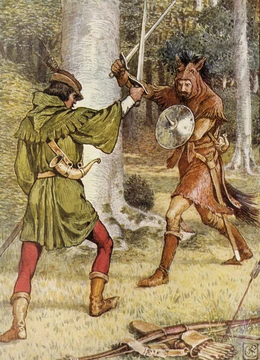
Brenin Llwyd
Silent, mist-cloaked figure that preys on mountain travellers.

Brenin Llwyd (the Grey King, also called the Monarch of the Mist) is a figure from Welsh legend. Sightings have been reported in mountainous areas across Wales. The figure is always silent, appears semi-corporeal, and is wrapped in mist or a grey cloak. It is said to target unwary travellers, especially children.
Though Brenin Llwyd is often seen as a solitary figure, accounts from different parts of Wales are very consistent. Folklorist Marie Trevelyan, writing in 1909, gave a typical description. In the north, he was seen as mighty and powerful, sitting among the mountains robed in grey clouds and mist. His favourite haunts included Snowdon, Cadair Idris, and Plinlimmon. In the south, he was described as "hungering" for victims, and children were warned not to climb too high for fear he would seize them. Trevelyan also recorded a story from a woman near the Smaelog mineral wells, who said locals warned everyone not to linger late because the Brenin Llwyd would come after them, even on bright summer evenings. A third account from Carmarthenshire adds details not found elsewhere: a "Court of the Mist" and hunting hounds called "the Dogs of the Sky." These elements suggest a link between the Brenin Llwyd and the Welsh Otherworld, Annwn, and its hounds, the Cŵn Annwn, placing him within a larger mythological framework.
Brenin Llwyd has been compared to other figures in Welsh, Celtic, and European mythology. In Wales, Gwyn ap Nudd, king of the Tylwyth Teg, also haunts mountain tops and is linked to the Cŵn Annwn.
Quick Facts
- Aka
- The Monarch of the Mist
- Grouping
- Legendary creature
- Sub Grouping
- Spirit or Gaint
- Country
- Wales
- Region
- Nationwide
Facts from the source article.
Lore & Background
Brenin Llwyd is often described as a solitary figure, but accounts from Carmarthenshire associate him with the 'Court of the Mist' and 'the Dogs of the Sky,' elements that link him to the Welsh Otherworld, Annwn, and its hounds, the Cŵn Annwn—contradicting any claim of complete isolation. Consistent accounts of the Brenin Llwyd are found across Wales, with only minimal variations. An archetypal description was given by folklorist Marie Trevelyan in 1909, noting that in the North he was described as very mighty and powerful, robed in grey clouds and mist, haunting Snowdon, Cadair Idris, Plinlimmon, and other lofty places. In the south, he was regarded as 'hungering' for victims, and children were warned not to venture too high up the mountains, lest the Brenin Llwyd should seize them.
Trevelyan records another encounter in a different locality much further south, where an old woman said that many a time she shuddered when they ascended to the mineral wells on the Smaelog, and was glad to come down, because people and children warned everybody not to stay late, even on bright summer evenings, for the Brenin Llwyd would come after them. Note that the legend of 'Belyn ap Madog' scaling Cadair Idris and encountering 'grey giants' is not recorded in standard sources such as Trevelyan's work or other established collections, and is therefore not considered part of the verified folklore.
Reader's Guide
Brenin Llwyd holds significance in Welsh mythology as a singular, solitary entity haunting mountainous regions, distinct from other mythological groups. The figure's consistent accounts across Wales, with minimal variations, indicate a widespread folkloric tradition. The association with Cadair Idris and other peaks links it to local legends, such as that of Belyn ap Madog, who encountered grey giants on the mountain. Comparisons have been drawn with other figures in Welsh, Celtic, and European mythology, including Gwyn ap Nudd, Idris Gawr, Herne the Hunter, and the Wild Hunt. A notable modern comparison is with the Am Fear Liath Mòr (Big Grey Man) of Scotland. In literature, aspects of the Brenin Llwyd mythos have been linked to the Middle English romance Gawain and the Green Knight, and the figure inspired the title of Susan Cooper's novel The Grey King, which won the 1976 Newbery Medal. The legend continues to appear in modern media, such as a 2016 investigation by comedians Mike Bubbins and John Rutledge on The Unexplainers radio show.
Did You Know?
- Brenin Llwyd is always silent and semi-corporeal, cloaked in mist or a grey cloak.
- The figure preys on unwary travellers, especially children.
- Folklorist Marie Trevelyan recorded accounts of the Brenin Llwyd in 1909.
- The legend of Belyn ap Madog involves him encountering grey giants on Cadair Idris.
A Presence Across the Welsh Highlands
Brenin Llwyd—known in English as the Grey King or, by a more poetic sobriquet, the Monarch of the Mist—stands as one of Wales's most geographically widespread supernatural figures. Unlike many mythological beings tied to a single locale, this silent, semi-corporeal entity is reported across the country's most rugged terrain, from the northern peaks of Snowdon, Cadair Idris, and Plinlimmon to the mineral wells of the Smaelog in the south and the hills of Carmarthenshire. Folklorist Marie Trevelyan, writing in 1909, noted that while regional tellings carried slight variations, the core image remained remarkably consistent: a solitary figure robed in grey clouds and mist, seated among the mountains, preying on careless travelers. In the north, the figure was described as mighty and powerful; in the south, as actively hungering for victims, with children specifically warned against lingering too high on the slopes. The Carmarthenshire variant added richer courtly imagery, linking the Grey King to a "Court of the Mist" and hunting hounds called the "Dogs of the Sky," suggesting a deeper entanglement with the Welsh Otherworld known as Annwn.
The Ascent of Belyn ap Madog
Among the most narratively rich tales attached to the Grey King is the legend of Belyn ap Madog, a young lord of Merionnydd driven by ambition to restore his family's former glory and earn worldwide renown as a hero. Aware of an old belief that spending a night atop Cadair Idris would either drive a person mad or grant them prophetic inspiration, Belyn climbed to the mountain's peak and sat in wait. After several hours, a wave of terror and suffocating dread seized him, and he fell gravely ill. Through a dim, pale light, he caught sight of towering figures that recalled the Grey King, accompanied by the clash of rushing water and competing winds. A loud voice then addressed him, seemingly reading his innermost thoughts, questioning his hunger for fame, and commanding him to abandon the pursuit of battle and stardom in favor of a life devoted to serving others. The following morning, as Belyn descended, he glanced back one final time to find the grey giants at the summit no longer menacing but gazing in his direction with outstretched arms, as though offering a blessing.
Echoes in the Celtic Mythological Landscape
Though Brenin Llwyd is a singular entity rather than a member of any mythological species, scholars and folklorists have drawn numerous parallels between the Grey King and other figures across Celtic and European tradition. Within Wales, the king of the Tylwyth Teg, Gwyn ap Nudd, shares the Grey King's affinity for mountain summits and his association with the Cŵn Annwn—the spectral hounds of the Otherworld. The Carmarthenshire variant's "Dogs of the Sky" further reinforce this link to Annwn. The Grey King's strong connection to Cadair Idris has also been compared to Idris Gawr, the giant traditionally regarded as sovereign of that very mountain. Beyond the Welsh borders, the figure's mist-shrouded, predatory nature invites comparison with Herne the Hunter and the broader pan-European Wild Hunt motif. Perhaps the most striking modern parallel is the Am Fear Liath Mòr, the "Big Grey Man" of Scottish Gaelic folklore, a similarly ghostly presence said to haunt the mists of Ben Macdui in the Cairngorms. These cross-cultural echoes suggest that the image of a silent, grey-cloaked sovereign lurking in high, misty places is a deeply resonant archetype.
From Mountain Mist to Modern Storytelling
The Grey King's influence has extended well beyond oral tradition into modern literature and media. The scholar Roger Sherman Loomis proposed that the enigmatic Bertilak de Hautdesert in the Middle English romance Gawain and the Green Knight may be a literary echo of Welsh legends including that of Brenin Llwyd, linking the figure to one of the most celebrated works of medieval English literature. In contemporary fantasy, Susan Cooper's fourth novel in The Dark Is Rising series carries the title The Grey King, directly borrowing the Welsh figure's name; the book earned the 1976 Newbery Medal, bringing the legend to a wide young readership. More recently, the 2016 radio comedy program The Unexplainers, hosted by Mike Bubbins and John Rutledge, took a lighthearted investigative turn toward the Grey King, treating the Welsh mountain specter as a subject for their characteristic blend of humor and pseudo-documentary inquiry. From medieval romance to award-winning children's fantasy to modern comedy radio, the silent monarch of the mist continues to inspire new retellings across vastly different genres and audiences.
Frequently Asked Questions
Who is Brenin Llwyd?
Brenin Llwyd, sometimes called the Grey King or the Monarch of the Mist, is a spectral figure from Welsh mountain folklore. He is depicted as a silent, semi-transparent entity draped in fog or a grey cloak who haunts highland paths.
What does Brenin Llwyd look like?
Witnesses consistently describe a hazy, almost translucent form wrapped in swirling mist or a heavy grey mantle. The figure never speaks and appears to shimmer or fade at the edges, giving it a distinctly ghostly quality.
Who is most at risk from Brenin Llwyd?
The legend specifically warns that careless travelers on remote mountain routes are in danger, with young children singled out as the figure's preferred victims. This detail holds remarkably steady across accounts from different regions of Wales.
Where in Wales has Brenin Llwyd been reported?
Sightings cluster in the upland and mountainous regions spread throughout Wales rather than being tied to one single peak or valley. In northern accounts, the figure is portrayed as a towering, majestic presence perched among the summits.
What is the earliest well-known written reference to Brenin Llwyd?
One of the better-known written descriptions comes from Welsh folklorist Marie Trevelyan, who recorded the figure's traits in her 1909 work on Welsh traditions. Her account helped cement the image of the silent, mist-shrouded monarch in the broader folklore record.
More in European folklore 1-24
Spotted an error? Know more?
Reader corrections go straight into our review queue. Suggest an edit · How this site is sourced