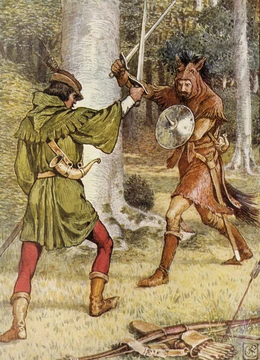
Adventures of Gilla Na Chreck An Gour
Irish fairy tale of a goatskin-clad hero who wins a princess.

The Irish fairy tale *Adventures of Gilla Na Chreck An Gour*—translated as "The Fellow in the Goatskin" or "The Lad with the Goat-Skin"—was first collected by folklorist Patrick Kennedy and appeared in his 1866 work *Legendary Fictions of the Irish Celts*. It later featured in Alfred Perceval Graves’s *Irish Fairy Book* (1909), and Joseph Jacobs published it as *The Lad with the Goat-Skin* in his *Celtic Fairy Tales*. The story belongs to the Aarne-Thompson-Uther Index type ATU 650, known as "Strong John."
The tale begins in Enniscorthy, where a destitute woman gives her son—a hearth-dwelling ash-lad—a goat-skin to wear around his waist. At nineteen years old and six feet tall, his mother sends him to the forest for firewood. There he encounters a nine-foot giant, spares his life, and receives a club. On a second trip, he meets a two-headed giant who gives him a magical fife that forces people to dance, and a three-headed giant who provides a green ointment that protects against burns, wounds, and scalding.
Later, Tom (the hero’s name) reaches a city and learns that the King of Dublin’s daughter has not laughed in seven years. He resolves to make her laugh three times. On his second attempt, he uses the fife to command a terrible wolf to dance. That same night, the king tells Tom he needs a powerful flail to defeat the Danes. Tom travels until he reaches the walls of hell, where he negotiates with devils to borrow the flail.
A rival at court named Redhead tries to wield the flail but fails, creating such a comical scene that the princess bursts out laughing. She accepts Tom as her husband. The Danes, terrified by rumors of the flail, abandon their plans to invade Dublin.
In terms of classification, ATU 650 stories feature a hero who exhibits superhuman strength as he matures, sometimes born from a union between a human and an otherworldly being. Some versions also include an episode from type ATU 1000, "Anger Bargain." This particular tale additionally contains elements of ATU 571, "All Stick Together." Folklorists Johannes Bolte and Jiri Polivka linked it to the Grimms’ *The Young Giant*, another ATU 650 story.
Regarding the hero’s name, folklorist Jeremiah Curtin noted that *Gilla na Grakin* (or *Gilla na g-croicean*) means "the fellow of the skins" and refers to a servant boy. The name appears in many Irish names.
Quick Facts
- Folk Tale Name
- Adventures of Gilla Na Chreck An Gour
- Aarne-Thompson Grouping
- ATU 650 (Strong John)
- Aka
- The Lad With the Goat-skin
- Region
- Ireland
- Published In
- Legendary Fictions of the Irish Celts by Patrick Kennedy (1866) / The Irish Fairy Book by Alfred Perceval Graves (1909)
- Related
- Strong Hans
Facts from the source article.
Lore & Background
The tale begins in Enniscorthy, where a poor woman gives her son a goat-skin to wear. At nineteen years old and six feet tall, he is sent to fetch firewood and encounters three giants: a nine-foot giant who gives him a club, a two-headed giant who gives a magical fife, and a three-headed giant who gives a green ointment granting immunity to burns and wounds. He later travels to a city where the King of Dublin's daughter has not laughed in seven years. Using the fife, he makes a wolf dance, and later a rival named Redhead fails to wield a flail borrowed from the devils of hell, causing the princess to laugh. The Danes abandon their invasion plans out of fear of the flail.
Reader's Guide
This tale is significant as a representative of ATU 650A, a type featuring a hero with superhuman strength, and also incorporates elements of ATU 571, where the hero makes a princess laugh. Folklorists Johannes Bolte and Jiri Polivka connected it to the Grimm tale The Young Giant. The hero's name, Gilla na Grakin, means 'the fellow of the skins' and appears in many Irish names, sometimes as an identity assumed by the hero Ceudach. Variants exist across Europe and America, including a Gaelic story Scéal Ghiolla na gCochall Craicionn and an American variant Gilly and his Goatskin Clothes collected by Marie Campbell. The tale's motifs—the magical objects, the laughing princess, and the hero's humble origins—are common in international folklore.
Did You Know?
- The tale is classified as ATU 650A, 'Strong John', and also includes an episode of ATU 571, 'Making the Princess Laugh'.
- Folklorist Jeremiah Curtin noted the name appears as a component of many Irish names.
- An American variant titled Gilly and his Goatskin Clothes was collected by Professor Marie Campbell.
Publication History & Folkloric Lineage
The tale first entered the written record through the work of Irish folklorist Patrick Kennedy, who collected it and included it in his 1866 volume Legendary Fictions of the Irish Celts. Nearly four decades later, Irish poet Alfred Perceval Graves gave the story a second life by publishing it in his 1909 Irish Fairy Book. A third English-language edition appeared when Joseph Jacobs adapted the narrative for his collection Celtic Fairy Tales, retitling it The Lad with the Goat-Skin. These multiple publications across different decades and editorial hands testify to the tale's enduring appeal within the broader Celtic storytelling tradition. The story's place in the Aarne-Thompson-Uther Index as ATU 650A, "Strong John," further anchors it within a well-studied family of tales in which a hero of extraordinary physical power comes of age and proves himself through a series of escalating challenges.
Plot & Narrative Structure
Set in Enniscorthy, the narrative follows a young man known as Gilla, the son of a destitute mother who can only afford to wrap him in a goatskin. By the time he reaches nineteen and stands six feet tall, his mother dispatches him into the forest to gather bresna. There he encounters three successive giants: a nine-foot colossus whose life he spares and who rewards him with a club, a two-headed figure who bestows a fife capable of compelling anyone to dance, and a three-headed being who grants him a green ointment rendering him immune to burns, wounds, and scalding. Carrying these gifts, Gilla arrives in a city where the King of Dublin's daughter has not laughed in seven years. Using the fife to force a wolf into a comical dance, and later watching his rival Redhead fail spectacularly to lift a flail that Gilla borrowed from the devils at the walls of hell, he coaxes three laughs from the princess. The Danes, hearing rumors of the flail's power, abandon their invasion plans entirely.
Folkloric Classification & Motifs
Folklorists have situated this tale within several overlapping typological frameworks. Beyond its primary ATU 650A classification, the narrative incorporates an episode of ATU 571, "Making the Princess Laugh," a motif in which a suitor must provoke mirth in a joyless royal bride. Johannes Bolte and Jiri Polivka, in their commentaries accompanying the Grimm fairy tales, drew a direct line between this Irish story and The Young Giant, another ATU 650 variant. The hero's name itself has attracted considerable scholarly attention. Jeremiah Curtin interpreted Gilla na Grakin as referring to a servant boy associated with skins, while Joseph Jacobs observed that the "Gilla" figure was a recurring character type across Celtic narratives. James MacDougall expanded the etymology, suggesting Gaelic renderings like Gille nan Cochla-craicinn, where "skinny husks" might denote either a transformative animal pelt or simple leather garments. Celtic studies scholarship further notes that the name surfaces as an assumed identity of Ceudach, the protagonist of what is described as the most popular of all Fenian folk-tales.
European Variants & Cross-Cultural Resonance
The Gilla motif extends well beyond the Irish version. In a Gaelic narrative published by British linguist Edmund Crosby Quiggin in 1906, two blacksmith apprentices, Céadach and Lonndubh, compete for the hand of the maiden Scaith Shioda. Céadach, dressed only in animal skins, is discovered cooking game by the hunting party of Fionn mac Cumhaill and is subsequently named Ghiolla na gCochall Craicionn by the king. A Sutherlandshire tale collected by Charlotte Louisa Hawkins Dempster tells of a king abducted by a fairy woman, whose son Fach-Mòhr is found by the Pictish king Ossian and introduces himself as Gillie-na-Cochlan Crackenach. There he discovers a resurrection elixir called Flaggan Fiacallach and ultimately heals his ailing half-brother. John Gregorson Campbell's version features Ceudach alongside friends White Dew and White Hand, who incur a silversmith's curse after accidentally striking her workshop with a ball, and who must each vie for the daughter of the King of the Iron City through a test of devotion.
Frequently Asked Questions
What is 'Adventures of Gilla Na Chreck An Gour'?
It is an Irish folk narrative about a young man who dons a goatskin and sets out on a quest that ultimately leads him to win a princess. The tale was first recorded by Patrick Kennedy and published in his 1866 collection of Irish legends.
What role does the goatskin-clad hero play in the story?
The protagonist fits the 'Strong John' archetype (ATU 650), meaning he is a physically formidable young man whose strength and courage drive the plot forward. His journey follows a classic pattern of trials that culminate in him claiming a royal bride.
Where does the story begin and what is the hero's background?
The narrative opens in Enniscorthy, where a poor woman raises her son in humble, hearth-side circumstances. This destitute starting point sets up the classic rags-to-royalty arc that defines the tale.
Where can I find published versions of this tale?
The earliest known print version appears in Patrick Kennedy's 1866 *Legendary Fictions of the Irish Celts*. It was later reprinted in Alfred Perceval Graves's 1909 *Irish Fairy Book* and in Joseph Jacobs's *Celtic Fairy Tales* under the title 'The Lad with the Goat-Skin.'
More in European folklore 1-24
Spotted an error? Know more?
Reader corrections go straight into our review queue. Suggest an edit · How this site is sourced