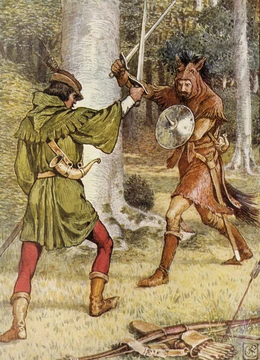
Holly King and Oak King
Seasonal kings embodying the endless battle of light and dark.

The Holly King and Oak King are personifications of the waning and waxing day length of the sun, respectively, in various neopagan traditions. They engage in an endless 'battle' that reflects the seasonal cycles of the year, including solar light and dark as well as crop renewal and growth. The Oak King rules the waxing year and the Holly King the waning year; the Holly King is defeated at the summer solstice, after which the waning day length rules, until the winter solstice, at which point the Oak King is reborn, regaining power and perpetuating the succession.
- Field
- Neopagan mythology, seasonal folklore
- Known for
- Personifying the waxing (Oak King) and waning (Holly King) day length of the sun in an endless seasonal battle
- Associated traditions
- Various neopagan traditions, Wicca
- Key interpreters
- Robert Graves, Sir James George Frazer, Stewart and Janet Farrar, Joanne Pearson
Lore & Background
The Holly King and Oak King are personifications of the waning and waxing day length of the sun, respectively, in various neopagan traditions. The two kings engage in an endless 'battle' reflecting the seasonal cycles of the year: not only solar light and dark, but also crop renewal and growth. The Oak King rules the waxing year and the Holly King the waning year; the Holly King is defeated at the summer solstice, after which the waning day length rules, until the winter solstice, at which point the Oak King is reborn, regaining power, and perpetuating the succession.
Robert Graves in The White Goddess identifies other legends and archetypes of paired hero-figures as the basis of the Holly/Oak King myth, including Lleu Llaw Gyffes and Gronw Pebr, Gwyn and Gwythyr, Lugh and Balor, Balan and Balin, and Gawain and the Green Knight. Similar comparisons had been previously suggested by Sir James George Frazer in The Golden Bough (in the full edition, in the chapter 'The Killing of the Tree Spirit' in the section 'The Battle of Summer and Winter'). Frazer drew parallels between folk-customs associated with May Day or the changing seasons in Scandinavian, Bavarian and Native American cultures, amongst others, in support of this theory. However the Divine King of Frazer was split into the kings of winter and summer in Graves' work.
Stewart and Janet Farrar characterize the Oak King ruling the waxing year and the Holly King ruling the waning year, and apply the interpretation to Wiccan seasonal rituals. According to Joanne Pearson, the Holly King is represented by holly and other evergreens, and personifies the dark half of the Wheel of the Year. The Holly King is also seen by some Neopagans as prehistoric forebear of the Father Christmas legend.
Reader's Guide
The significance of the Holly King and Oak King lies in their role as personifications of the solar cycle within neopagan traditions, particularly Wicca. Their endless battle mirrors the seasonal shift from light to dark and back, providing a mythological framework for understanding the year's rhythms. The concept draws on earlier scholarly work by Sir James George Frazer, who compared folk-customs from Scandinavian, Bavarian, and Native American cultures, and was later refined by Robert Graves, who split Frazer's Divine King into the two seasonal kings. Stewart and Janet Farrar applied the interpretation to Wiccan seasonal rituals, while Joanne Pearson linked the Holly King to evergreens and the dark half of the Wheel of the Year. The battle of light with dark is commonly played out in traditional folk dance and mummers plays across Britain, such as Calan Mai in Wales, Mazey Day in Cornwall, and Jack in the Green traditions in England. Some adherents of Modern Paganism consider the two counterparts as dual aspects of the Horned God waging for the favour of the Goddess. The legacy of the Holly King and Oak King endures as a symbolic representation of seasonal change and the eternal cycle of growth, decay, and renewal.
Did You Know?
- Robert Graves identified paired hero-figures such as Lleu Llaw Gyffes and Gronw Pebr as the basis of the Holly/Oak King myth, but did not include Jesus and John the Baptist.
- Sir James George Frazer drew parallels between folk-customs associated with May Day in Scandinavian, Bavarian, and Native American cultures.
- The Holly King is represented by holly and other evergreens, and is seen by some Neopagans as a prehistoric forebear of the Father Christmas legend.
More in European folklore 1-24
Spotted an error? Know more?
Reader corrections go straight into our review queue. Suggest an edit · How this site is sourced